

Essential guide to commercial leases in Queensland covering rent reviews, outgoings, make good clauses, and tenant protections under the Property Law Act 2023.

The Convergence of Commercial and Retail Leasing Law in Queensland
For Queensland business owners, signing a commercial lease represents one of the most significant financial commitments they will make. Whether leasing office space in Brisbane’s CBD, a warehouse on the Gold Coast, or a retail shopfront in a regional shopping centre, the legal and financial implications of that lease will shape the business for years to come. Yet many tenants enter these arrangements with limited understanding of their obligations, particularly regarding rent reviews, outgoings, make good requirements, and assignment rights.1
Since 1 August 2025, Queensland’s Property Law Act 2023 (Qld) (PLA 2023) has fundamentally reformed commercial leasing, introducing standardised terms, stricter landlord consent processes, and enhanced tenant protections that apply retrospectively to existing leases.2 Simultaneously, retail shop leases continue to be governed by the Retail Shop Leases Act 1994 (Qld) (RSLA), which provides additional protections for small retail businesses.3
The dangerous overlap between these two frameworks, combined with standard Real Estate Institute of Queensland (REIQ) lease terms, creates commercial traps that most business owners never see coming until it’s too late.
SUMMARY: Key Risks for Queensland Business Owners When you sign a commercial or retail lease in Queensland, you’re committing to far more than monthly rent. Standard lease terms typically require tenants to:
- Pay outgoings that can add 20-40% to total occupancy costs, including rates, insurance, maintenance, and land tax (for non retail leases)
- Make-good the premises at lease end, potentially costing tens of thousands of dollars to restore to base building condition
- Accept rent reviews using fixed increases (2 to 4%), CPI adjustments, or market reviews that can significantly increase costs over time
- Seek landlord consent for assignment, sublease, or alterations, which under the Property Law Act 2023 (Qld) must not be unreasonably withheld but follows strict procedures
The critical message: Before signing any commercial lease, obtain independent legal advice to understand your financial exposure, negotiate unfavourable terms, and protect your business from unexpected liabilities. What seems affordable at lease commencement can become financially crippling when outgoings escalate, make good obligations crystallise, or rent reviews trigger substantial increases.
Commercial vs Retail Leases: Understanding Which Law Applies
Before analysing specific lease obligations, business owners must first understand whether their lease is governed by general commercial leasing law or the stricter provisions of the RSLA. This distinction fundamentally affects tenant rights, landlord obligations, and dispute resolution processes.4
What Constitutes a Retail Shop Lease?
The RSLA applies to leases of retail shops, defined as premises either situated in a retail shopping centre or used wholly or predominantly for carrying on one or more retail businesses.5 A retail shopping centre includes premises where five or more retail businesses are located in one building or adjoining buildings separated only by common areas or roads, provided they are owned by one person.6
Crucially, the RSLA does not apply to:7
- Retail shops with a floor area exceeding 1,000m² leased by a public corporation or its subsidiaries8
- Premises in theme or amusement parks
- Premises at flea markets, arts and crafts markets
- Temporary retail stalls at agricultural shows, carnivals, festivals, or cultural events
- Premises where the retail business is conducted by the lessee as the lessor’s employee or agent
If your lease falls outside these definitions, it is governed solely by the PLA 2023 and general contract law, with significantly fewer statutory protections.9
Key Differences: Retail vs Commercial Leases
Retail shop leases under the RSLA benefit from mandatory protections including:
- Disclosure requirements: Lessors must provide a comprehensive disclosure statement (Form 1) at least seven days before the lease is entered, containing prescribed information about the premises, lease terms, outgoings estimates, and other material facts.10
- Outgoings restrictions: Land tax and capital expenditure cannot be recovered from retail tenants.11
- Audited statements requirements: Lessors must provide audited annual outgoings statements showing actual costs incurred.12
- Minimum lease terms: Retail leases must offer a minimum term (including options) of five years, unless the lessee requests a shorter term in writing.13
- Dispute resolution: Access to low-cost mediation and determination through the Queensland Small Business Commissioner (QSBC).14
Pure commercial leases (offices, warehouses, non retail spaces) do not benefit from these protections. Instead, they rely on the PLA 2023’s standardised terms and parties’ contractual negotiations.15
Understanding Outgoings: The Hidden Cost of Commercial Leasing
For most Queensland business owners, the quoted rent figure represents only part of their total occupancy costs. Outgoings, the operating expenses lessors pass on to tenants, can add 20-40% to monthly payments, yet remain poorly understood until the first invoice arrives.16
What Are Outgoings?
Outgoings are operating costs related to the premises that a commercial lessor reasonably incurs and passes on to tenants, either as part of or in addition to rent.17 There is no universal definition of outgoings in commercial leases, what constitutes recoverable outgoings depends entirely on the lease terms negotiated between parties.18
Common outgoings in Queensland commercial leases include:19
- Council rates: Levied by local government on the land and buildings
- Water and waste charges: Usage and service availability charges
- Building insurance: Lessor’s insurance premiums for the building (tenant must arrange contents insurance separately)
- Land tax: State tax on investment properties (cannot be recovered in retail shop leases but can in commercial leases)20
- Body corporate fees: If the premises are in a strata titled building21
- Fire protection and safety services: Maintenance of fire equipment and emergency systems
- Cleaning, rubbish removal, gardening, and pest control: Common area and external maintenance
- Centre management fees: For retail shopping centres, fees charged by centre managers for marketing, promotion, and management
- Electricity, internet, and phone: Unless the lease specifies the tenant arranges direct supply (increasingly common)
Retail vs Commercial Outgoings: Critical Differences
The RSLA provides strict definitions and limitations on outgoings recoverable from retail tenants. Section 7 defines outgoings for retail shopping centres as the lessor’s reasonable expenses directly attributable to operation, maintenance, or repair of the centre, building, and associated areas.22
Critically, section 7(2) of the RSLA prohibits lessors from recovering the following:23
- Land tax payable on the land
- Capital expenditure including amortisation of capital costs
- Contributions to depreciation or sinking funds
- Insurance premiums for loss of profits
- Expenses incurred by lessor’s breach of obligations
Further, retail tenants can only be charged their proportionate share of outgoings based on the proportion of retail space, not total lettable area.24 This protects retail tenants in mixed use developments from subsidising commercial tenants’ share.
Commercial leases (non retail) have no such statutory restrictions. Unless negotiated otherwise, commercial tenants may be liable for land tax, capital works, and other costs prohibited in retail leases.25
Outgoings Recovery Methods: Gross vs Net Leases
Queensland leases typically use one of three outgoings recovery methods:26
- Direct recovery: Lessors pay outgoings costs as they arise and invoice tenants directly. This provides transparency but creates administrative burden.
- Net lease recovery: Outgoings are budgeted and charged in advance (usually monthly), with year end adjustment based on actual costs. This is the most common method in Queensland. Lessors must provide estimates at lease commencement and before each relevant period (typically the financial year).27
- Gross lease recovery: An estimate of outgoings is included in the rent with no adjustments, regardless of actual costs. This provides certainty but often results in higher rent to cover lessor’s risk.
For retail shop leases, the RSLA mandates that lessors provide tenants with an outgoings estimate when the lease begins or one month before the relevant period starts.28 Lessors must also provide an audited annual outgoings statement (typically by 30 September each year) prepared by a registered auditor.29
Commercial leases (non retail) have no such statutory requirements unless negotiated into the lease terms.
Outgoings Under the Property Law Act 2023: New Standardised Terms
The PLA 2023 introduced standardised terms that apply to all leases (including commercial and retail) unless specifically negotiated otherwise or prohibited by another Act.30 Schedule 1(2) of the PLA 2023 provides that, unless the lease specifies otherwise, tenants must pay the lessor’s taxes, rates, and other assessable charges on the land or premises, based on the proportion of leased premises to the total area of land.31
This proportionate allocation is now the default position, protecting tenants from being overcharged for outgoings in multi tenancy buildings.32 However, parties can contract out of this term by clear wording in the lease.
Negotiating Outgoings Before Lease Execution
Once a lease is executed, outgoings cannot generally be renegotiated.33 Therefore, prospective tenants must clarify and negotiate outgoings obligations before signing. Key negotiation points include:
- Obtaining a detailed list of recoverable outgoings with definitions of each category34
- Requesting historical outgoings statements for the past 2-3 years to understand cost trends
- Negotiating caps or fixed outgoings contributions to avoid escalating costs
- Ensuring the lease specifies proportionate calculation methods (retail area vs total lettable area)
- Requiring annual audited statements (for commercial leases, as retail leases already require this)
- Clarifying whether lessor must competitively tender for service providers, or whether lessor has sole discretion (tenants have limited ability to challenge appointment of service providers if lease grants lessor sole discretion)35
Failure to address outgoings at the negotiation stage can result in unexpected cost increases that threaten business viability. Large lump-sum outgoings invoices present cashflow challenges, particularly for small businesses. Negotiating payment plans may be in both parties’ interests to ensure ongoing tenancy viability.36
Rent Reviews: Understanding How Your Rent Will Increase
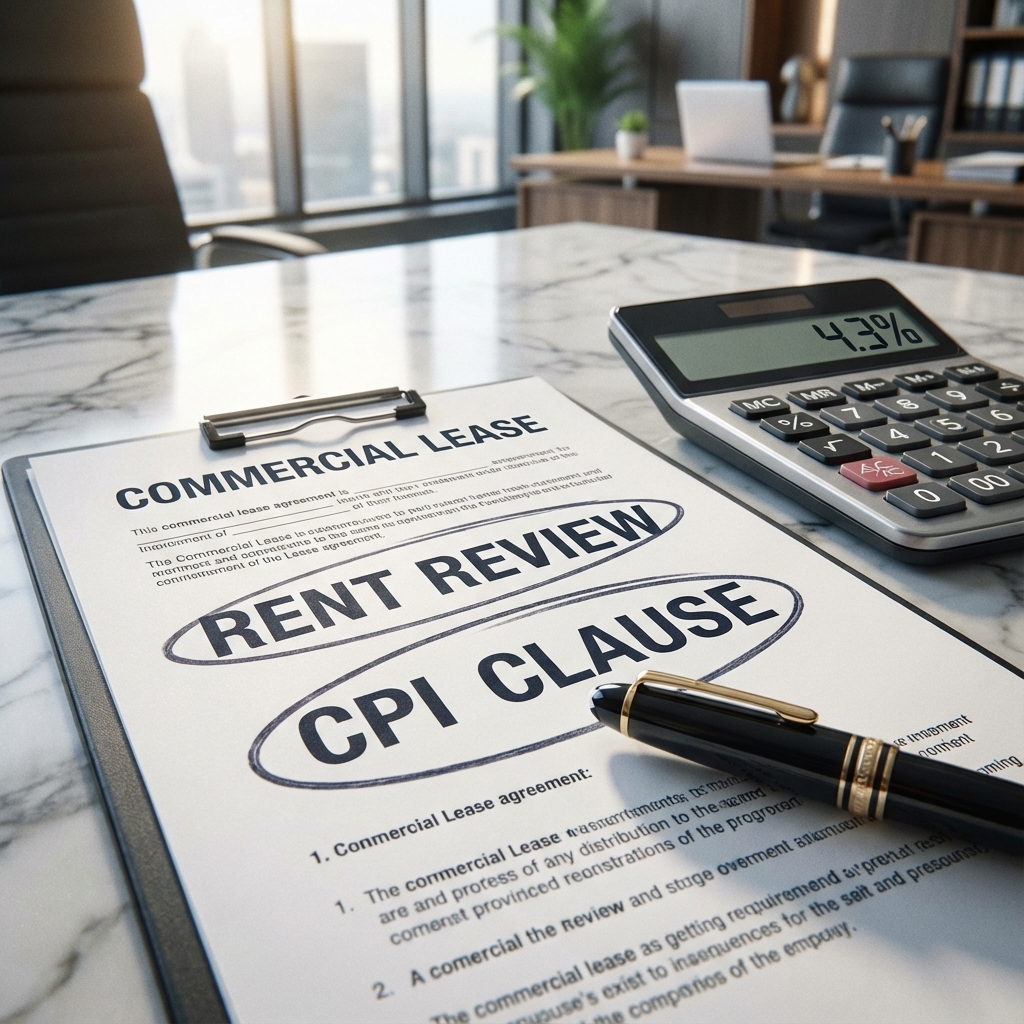
Commercial and retail leases in Queensland typically run for multi year terms (commonly 3-5 years with options for renewal). During this term, rent rarely remains static. Rent review clauses dictate how and when rental increases occur, mechanisms that can profoundly affect long term business viability.37
The Three Common Rent Review Methods
Queensland commercial leases typically employ one or more of three rent review mechanisms:38
1. Fixed Percentage Increases
The lease specifies an annual percentage increase, typically ranging from 2% to 4% (though higher rates exist).39 This provides predictability for both parties. For example, if initial rent is $50,000 per annum with a 3% fixed annual increase, rent in Year 2 will be $51,500, Year 3 will be $53,045, and so forth.
Advantages: Certainty and ease of budgeting for both landlord and tenant.
Disadvantages: Increases occur regardless of economic conditions, market rents, or tenant’s trading performance. In low inflation environments, fixed increases may exceed actual market movements, making the lease uncompetitive.40
2. Consumer Price Index (CPI) Adjustments
Rent increases are linked to the Australian Bureau of Statistics’ Consumer Price Index (CPI), which measures inflation.41 The lease will specify which CPI index applies (commonly “CPI All Groups, Brisbane” or “CPI All Groups, Australia”) and the relevant quarters for calculation.42
The calculation typically divides the CPI for the review quarter by the CPI for the base quarter, then multiplies the current rent by this ratio. For example:43
Current Rent (CPI review quarter ÷ CPI base quarter) = New Rent
Advantages: Tracks inflation, ensuring landlord’s rent maintains real value. In stable economic periods, CPI reviews tend to produce moderate, predictable increases.
Disadvantages: CPI can be volatile, particularly during economic shocks (as seen during 2022-2023 when inflation spiked above 7%).44 Tenants face unpredictable increases. In deflationary periods, some leases prevent rent from decreasing (ratchet clauses), providing asymmetric risk.45
Hybrid approaches combine CPI with fixed minimums. For example, “CPI + 2.5%” or “whichever is higher: CPI or 4%.”46 These clauses protect landlords in low inflation environments but amplify tenant exposure in high inflation periods.
3. Market Rent Reviews
The lease requires rent to be reassessed to reflect current market conditions at specified intervals (commonly every 3-5 years).47 Market rent is determined by reference to what a willing landlord and willing tenant would agree in an arms length transaction for comparable premises.48
Advantages: Rent tracks actual market conditions, ensuring landlord receives fair market value and tenant isn’t overpaying if market rents decline.
Disadvantages: Market reviews are the most likely to cause disputes. Parties often disagree on comparable properties, whether incentives (rent free periods) should be considered, and appropriate adjustments for lease specific factors.49
Well-drafted market review clauses include a dispute resolution mechanism, typically appointment of an independent valuer whose determination is binding. The process usually involves:50
- Landlord provides notice of proposed market rent.
- Tenant has a specified period (e.g., 21 days) to accept or object.
- If objection, parties attempt to agree.
- If no agreement within a further period (e.g., 14 days), either party may refer the matter to an independent valuer.
- Valuer determines market rent, with parties typically sharing costs equally.
Critically, many market review clauses include a ratchet clause preventing rent from decreasing below the previous rent, regardless of market conditions.51 This asymmetric risk heavily favours landlords, particularly in declining markets.
Rent Reviews and Lease Renewals
If a lease includes an option to renew, exercising that option typically triggers a rent review (either market or another specified mechanism).52 Tenants must carefully assess whether renewal rent is commercially viable before exercising options. Once an option is exercised, the tenant is bound to the renewed term even if the rent review results in unaffordable increases.
For retail shop leases, the RSLA requires lessors to provide at least six months’ notice before lease expiry if the lessor does not intend to renew.53 Failure to provide this notice can result in compensation to the lessee.54
Negotiating Rent Review Clauses: Tenant Considerations
Prospective tenants should carefully review and negotiate rent review mechanisms before signing. Key considerations:55
- Prefer CPI reviews over fixed increases during high inflation periods, and vice versa during low inflation.
- Negotiate caps on annual increases (e.g., “CPI but not to exceed 4% per annum”).
- For market reviews, ensure the lease clearly defines market rent determination process, valuer appointment procedures, and cost allocation.
- Seek to remove or modify ratchet clauses to allow rent reductions in declining markets.
- Ensure market review clauses specify that comparable properties should be of similar size, location, quality, and lease terms.
- Avoid vague language that could render the clause unenforceable for uncertainty (courts will not enforce rent review clauses lacking sufficient certainty).56
Make-good Obligations: The End-of-Lease Financial Trap
While tenants naturally focus on rent and outgoings when negotiating leases, one of the most expensive provisions often receives insufficient attention: the make good clause. This clause governs the condition in which the tenant must return premises at lease expiry or termination, and it can carry substantial financial consequences.57

What Is a Make-good Clause?
A make good clause specifies the tenant’s obligation to restore the premises to a defined condition at the end of the lease.58 The required standard varies widely depending on the lease wording. Common formulations include:59
- Base building condition: Removing all tenant fit outs, fixtures, and improvements, returning the premises to the shell or core condition that existed before tenant occupation60
- Original condition as at commencement date: Restoring the premises to the condition documented in an entry condition report (fair wear and tear excepted)
- Good repair and condition: Ensuring the premises are clean, undamaged, and functional, with all tenant installations properly removed or retained as agreed with the lessor
The practical and financial implications vary dramatically depending on which standard applies. Removing extensive fit outs (partition walls, flooring, ceilings, electrical installations) and restoring to base building can cost tens or even hundreds of thousands of dollars, particularly for large or heavily fitted premises.61
The Ambiguity Problem: Common Sources of Dispute
Make-good clauses are among the most frequently disputed provisions in commercial leasing.62 Disputes typically arise from vague language and differing interpretations of key terms:
- What constitutes fair wear and tear? Courts have interpreted this as deterioration from ordinary use over time, but the boundary between acceptable aging and actionable damage remains contested.63
- Which tenant installations must be removed? If the lease states only that non structural improvements must be removed, disputes arise over whether partition walls, ceiling fixtures, or cabling are structural.64
- Does make good extend to capital improvements? Can landlords require tenants to fund upgrades or betterments beyond the original condition?65
For retail shop leases under the RSLA, section 39 prohibits lessors from recovering costs for capital works or betterments under make good unless these costs were disclosed in the disclosure statement at lease commencement.66 Failure to disclose make good obligations may render them unenforceable against retail tenants.67
Pure commercial leases have no such statutory protection. Make-good obligations are determined entirely by the lease terms and common law principles of contract interpretation.68
Cash Settlements vs Physical Restoration
Some leases permit tenants to pay a cash sum to the lessor instead of physically performing make good works.69 This provides flexibility and can be advantageous for both parties, tenants avoid the logistics and cost uncertainty of engaging contractors, while lessors receive funds to complete works to their own specifications or retain improvements.
However, tenants cannot unilaterally elect to pay cash instead of making good unless the lease expressly permits this option.70 If the lease allows cash settlement, it should specify the valuation mechanism (commonly appointment of a quantity surveyor) and payment timing.71
Protecting Yourself: Drafting and Documentation Strategies
Given the expense and dispute risk surrounding make good, both landlords and tenants should take proactive steps at lease commencement and throughout the tenancy:72
For Tenants:
- Negotiate clear make good definitions. Avoid accepting vague language like “original condition” without further specification.
- Insist on preparing a comprehensive entry condition report with detailed photographs and descriptions at lease commencement. This provides objective evidence of the starting condition.73
- Exclude fair wear and tear from make good obligations. Define this term in the lease to avoid disputes.
- Clarify which tenant installations must be removed and which can remain. Obtain landlord’s written consent before installing expensive fit outs, specifying whether removal will be required.74
- Seek to include a cash settlement option with a specified valuation methodology to provide flexibility.
- Budget for make good costs from lease commencement. Set aside provisions annually rather than facing a large lump-sum liability at lease end.
For Landlords:
- Draft make good clauses with precision, specifying the exact condition required and which works are the tenant’s responsibility.
- Incorporate or attach an entry condition report with dated photographs as a schedule to the lease.75
- For retail leases, disclose all make good obligations in the disclosure statement as required by section 39 of the RSLA.76
- Consider including a cash settlement option valued by an independent quantity surveyor to avoid disputes and enforcement costs.77
Assignment and Sublease: Selling or Transferring Your Lease
Business circumstances change. Tenants may wish to sell their business, relocate, or downsize. In these situations, the ability to assign (transfer) the lease to another party or sublease part of the premises can be financially critical. However, both actions require landlord consent, and the PLA 2023 has significantly reformed this process.78
Assignment vs Sublease: Understanding the Difference
- Assignment: The tenant transfers their entire interest in the lease to another party (the assignee), who becomes the new tenant with direct obligations to the landlord. The original tenant typically exits the lease entirely (subject to guarantees or indemnities).79
- Sublease: The original tenant (head lessee) grants a sublease to another party (sublessee) for part or all of the premises. The head lessee remains liable to the landlord under the head lease, while the sublessee pays rent to the head lessee.80
Most Queensland commercial and retail leases prohibit assignment or sublease without the landlord’s consent. The PLA 2023 now governs the consent process.
The New Landlord Consent Process Under PLA 2023
Section 142 of the PLA 2023 introduced a mandatory consent process that applies to all leases (including those entered before 1 August 2025) and cannot be contracted out.81 The process applies when a tenant seeks landlord consent to:82
- Assign the lease
- Sublease or part with possession of the premises
- Change the permitted use
- Mortgage the tenant’s interest in the lease
- Carry out alterations or works to the premises

The statutory process requires:83
-
Proposal Notice: The tenant must give the landlord a proposal notice containing all information required under the lease (or reasonably required by the landlord) to assess the request. This typically includes:84
- The name and background of the proposed assignee/sublessee or nature of proposed alteration use
- Financial position and business experience of the proposed assignee/subtenant (financial statements, references, business plan)
- Proposed terms of the assignment/sublease
- Any changes to permitted use or lease terms
-
Further Information Request: If the landlord considers the proposal notice insufficient, they may give the tenant a notice requiring further information. The one-month response period does not commence until all necessary information is provided.85
-
Decision Notice: The landlord has one month from receiving all necessary information to give the tenant a decision notice that clearly:86
- Grants consent (unconditionally or subject to specified conditions), or
- Refuses consent and states the reasons for refusal
-
Reasonableness Requirement: Section 142(3) of the PLA 2023 provides that the landlord must not unreasonably withhold consent, and this provision cannot be excluded by lease terms.87
-
Court Application: If the landlord refuses consent, fails to respond within one month, or imposes unreasonable conditions, the tenant may apply to the Supreme Court for an order. The Court has broad powers to make appropriate orders, including deeming consent granted.88
What Constitutes Unreasonable Refusal?
The PLA 2023 does not define “unreasonable withholding,” leaving courts to apply common law principles. Factors courts typically consider include:89
- Whether the proposed assignee/sublessee has adequate financial capacity to meet lease obligations
- Whether the proposed use is compatible with the premises and complies with planning and zoning90
- Whether the proposed tenant has relevant business experience
- Whether the assignment/sublease would breach other lease terms or affect other tenancies (in retail shopping centres)
Landlords can refuse consent on reasonable commercial grounds but must provide clear reasons. Arbitrary refusal or failure to respond invites court applications and potential costs orders.91
Release of Original Tenant and Guarantors on Further Assignment
One of the most significant reforms in the PLA 2023 is section 144, which addresses the liability of original tenants and guarantors after further assignment.92
Under the common law prior to 1 August 2025, original tenants who assigned their lease often remained liable for breaches by subsequent assignees (privity of contract principle).93 This created ongoing risk for business owners who had sold their businesses and assigned leases years earlier.
Section 144 now provides that where an assignee effects a further assignment to a subsequent tenant, the original tenant and their guarantors are fully released from liability for any breach by the subsequent tenant.94 This applies even if the lease contains contrary provisions.95
However, the original tenant remains liable for breaches that occurred during their own tenancy and for breaches by the first assignee before further assignment occurs.96
This reform provides significant relief for business sellers and aligns Queensland with other Australian jurisdictions that have abolished privity of contract in leasing contexts.97
Practical Guidance for Tenants Seeking Assignment
Tenants intending to sell their business and assign the lease should:
- Review the lease terms regarding assignment consent requirements and prepare a comprehensive proposal notice.98
- Provide complete information to the landlord to avoid delays from further information requests.
- Ensure the proposed assignee has strong financial credentials, relevant business experience, and can demonstrate ability to meet lease obligations.
- Negotiate reasonable conditions with the landlord (e.g., rent guarantees, deed of covenant, bank guarantees) rather than facing outright refusal.
- Seek legal advice on whether any refused consent is unreasonable and whether a Supreme Court application is warranted.
- Understand that while section 144 releases liability upon further assignment, the original tenant remains liable for the first assignee’s breaches until a second assignment occurs.99
Other Critical Lease Provisions
Beyond outgoings, rent reviews, make good, and assignment, Queensland commercial leases contain numerous other provisions that warrant careful review:
Options to Renew
Many commercial leases grant tenants one or more options to renew for additional terms. These provide security of tenure but must be exercised strictly in accordance with lease terms.100
The PLA 2023 reformed option exercise and refusal. Under section 164, landlords may refuse an option to renew or option to purchase if the tenant has failed to meet a condition precedent (e.g., breached the lease or failed to properly exercise the option).101 However, landlords must give the tenant a breach notice within 10 business days after either the tenant exercises the option or the breach occurs (if after option exercise).102
Section 166 provides tenants and designated persons (e.g., guarantors, mortgagees) a right to apply to the Supreme Court for relief against the landlord’s refusal, effectively seeking a court order requiring the landlord to grant the renewal or sale.103 Applications must be made within one month of receiving the breach notice.104
Repairs and Maintenance
Commercial leases typically impose repairing obligations on tenants, often requiring them to maintain the premises in good repair and condition (fair wear and tear excepted).105 Landlords usually remain responsible for structural repairs, roof, and external walls, though this varies.
Schedule 1(8) of the PLA 2023 now explicitly includes a tenant’s right to quiet enjoyment, ensuring landlords cannot interfere with the tenant’s peaceful occupation.106 However, landlords may enter the premises at reasonable times for inspections, repairs, or showing to prospective tenants/purchasers, provided they do not unreasonably interfere with the tenant’s occupation.107
Insurance Obligations
Tenants must understand their insurance obligations. Landlords typically insure the building, with premiums recovered through outgoings. Tenants must separately arrange:
- Public liability insurance: Covering third-party injury or property damage108
- Contents insurance: Covering the tenant’s stock, fit outs, fixtures, and equipment
- Business interruption insurance (optional but advisable): Covering loss of income if the premises become unusable due to insured events
Leases often require minimum public liability coverage (commonly $10-20 million) and specify that the tenant must provide certificates of currency to the landlord annually.109
Abatement of Rent for Damage or Destruction
Schedule 1(4) of the PLA 2023 provides that if the premises are damaged or destroyed by a relevant cause (fire, storm, earthquake, or other insured event), rent and outgoings can be reduced or suspended until the premises are suitable for the tenant’s use again.110 This is now a standardised term applying to all leases unless specifically excluded.111
Dispute Resolution Pathways
When disputes arise between landlords and tenants, resolution pathways differ depending on whether the lease is governed by the RSLA.
Retail Shop Leases: QSBC Mediation
Parties to retail shop lease disputes must first attempt mediation through the Queensland Small Business Commissioner (QSBC) before commencing legal proceedings.112 QSBC mediation is low-cost, informal, and designed to facilitate negotiated resolution without the expense and formality of litigation.113
If mediation fails, parties may proceed to the Queensland Civil and Administrative Tribunal (QCAT) or courts, depending on the nature and value of the dispute.114
Commercial Leases: Court or Contractual Dispute Resolution
Pure commercial leases (non retail) have no mandatory mediation requirement. Disputes are resolved according to the lease’s dispute resolution provisions (if any) or through court proceedings.115
Many commercial leases include dispute resolution clauses requiring negotiation, mediation, or expert determination before litigation. These clauses are generally enforceable and can provide cost-effective alternatives to court.116
Conclusion: Protecting Your Business Through Informed Leasing
Commercial and retail leasing in Queensland involves complex legal, financial, and commercial considerations. The interplay between the PLA 2023, the RSLA, and negotiated lease terms creates a regulatory landscape that can trap unwary business owners.
Outgoings can add 20-40% to total occupancy costs. Make-good obligations can cost tens of thousands of dollars at lease end. Rent reviews can dramatically increase costs over multi year terms. Assignment restrictions can prevent business exits. These provisions, individually and collectively, present significant financial risks.
Yet these risks are manageable with proper legal advice, careful negotiation, and strategic planning. Prospective tenants should:
- Obtain independent legal advice from a commercial property lawyer before signing any lease.117
- Understand whether the RSLA applies and what protections (or lack thereof) this provides.
- Negotiate unfavourable terms, particularly regarding outgoings caps, rent review mechanisms, make good scope, and assignment consent processes.
- Prepare comprehensive entry condition reports with photographic evidence.
- Budget for total occupancy costs (rent + outgoings + make good provisions) from lease commencement, not just base rent.
- Review lease obligations regularly and plan exits well in advance to ensure smooth assignment or surrender.
For business owners navigating Queensland’s commercial leasing landscape, informed decision-making is the best protection against unexpected liabilities and financial distress. Professional legal advice is not an optional expense, it is a critical investment in your business’s long term viability.
Need Expert Commercial Leasing Advice?
Bell & Senior Lawyers provide experienced advice to Queensland business owners on commercial and retail lease negotiations, disputes, and compliance with the Property Law Act 2023 and Retail Shop Leases Act 1994.
Whether you’re entering a new lease, facing a dispute over outgoings or make good obligations, or seeking to assign your lease, our commercial property lawyers can protect your interests.
Get commercial lease advice from Queensland property lawyers
Need Legal Advice?
Contact us today to discuss your matter. We'll respond within 24 hours.
Enquiry Sent
Thank you for reaching out. A member of our legal team will contact you shortly.
-
Real Estate Institute of Queensland, Commercial Lease Guide (Guide, 2024) 3-5. ↩︎
-
Property Law Act 2023 (Qld) ss 139, 142-144, 153, 164-166, 174-175, sch 1. Queensland Small Business Commissioner, Queensland’s New Property Law Act (Web Page, 3 August 2025). Mills Oakley Lawyers, Queensland’s Property Law Act 2023 – Further Review of Leasing Changes (Web Page, 20 October 2024). ↩︎
-
Retail Shop Leases Act 1994 (Qld) ss 3-4, 7-8, 11-12, 14-15, 22-24, 36-39. Queensland Small Business Commissioner, Retail Shop Leases Factsheets (Web Page, 2025). PD Law, Understanding the Complexities of the Retail Shop Leases Act 1994 (Web Page, 12 September 2023). ↩︎
-
Hillhouse Lawyers, Part 2: Retail Shop Leases in Queensland – What Are the Differences Between a Retail Shop Lease and a Commercial Lease? (Web Page, 14 April 2024). ↩︎
-
Retail Shop Leases Act 1994 (Qld) s 8. ↩︎
-
Retail Shop Leases Act 1994 (Qld) s 9. ↩︎
-
Retail Shop Leases Act 1994 (Qld) s 9(a). This exclusion typically applies to large national retailers and supermarkets leasing extensive floor space. ↩︎
-
Hundt Partners, PLA23 in Practice: What the New Property Laws in Queensland Mean for Your Commercial Lease (Web Page, 2024). ↩︎
-
Retail Shop Leases Act 1994 (Qld) s 22. Queensland Small Business Commissioner, Disclosure Statements (Factsheet, 2025). ↩︎
-
Retail Shop Leases Act 1994 (Qld) s 7(2)(a). Land tax is a significant cost that commercial (non retail) tenants often bear but retail tenants are statutorily protected from. ↩︎
-
Retail Shop Leases Act 1994 (Qld) s 24. Queensland Small Business Commissioner, Outgoings (Factsheet, 27 October 2025). ↩︎
-
Retail Shop Leases Act 1994 (Qld) s 14. ↩︎
-
Retail Shop Leases Act 1994 (Qld) pt 8. Queensland Small Business Commissioner, Dispute Resolution (Web Page, 2025). ↩︎
-
Property Law Act 2023 (Qld) s 139, sch 1. Attwood Marshall Lawyers, Five Key Commercial Leasing Changes Under the New Property Law Act 2023 (Web Page, 2025). ↩︎
-
Servcorp, How Much Are Commercial Lease Outgoings in Australia? (Web Page, 11 September 2025). ↩︎
-
Queensland Small Business Commissioner, Outgoings (Factsheet, 27 October 2025). ↩︎
-
[Queensland Small Business Commissioner](https://qsbc.qld.gov.au/understanding-outgoings-in-your-non retail-lease-in-queensland), Understanding Outgoings in Your non retail Lease in Queensland (Web Page, 21 September 2025). ↩︎
-
Crew Commercial, Everything You Need to Know About Outgoings (Web Page, 3 August 2023). MV Law, Six Things to Know About Commercial Lease Outgoings (Web Page, 11 January 2024). ↩︎
-
Retail Shop Leases Act 1994 (Qld) s 7(2)(a). This statutory protection for retail tenants does not extend to commercial (non retail) leases, where land tax is commonly recovered. ↩︎
-
Body corporate fees apply in strata titled developments where multiple lots share common property. These fees cover maintenance, insurance, and management of common areas. ↩︎
-
Retail Shop Leases Act 1994 (Qld) s 7(1). ↩︎
-
Retail Shop Leases Act 1994 (Qld) s 7(2). ↩︎
-
Retail Shop Leases Act 1994 (Qld) s 38(1). The proportionate share is calculated as: (lessee’s retail area ÷ total retail area in the centre or building) total outgoings. ↩︎
-
[Queensland Small Business Commissioner](https://qsbc.qld.gov.au/understanding-outgoings-in-your-non retail-lease-in-queensland), Understanding Outgoings in Your non retail Lease in Queensland (Web Page, 21 September 2025). ↩︎
-
Queensland Small Business Commissioner, Outgoings Information Sheet (PDF, 2025) 1. ↩︎
-
Retail Shop Leases Act 1994 (Qld) s 36. ↩︎
-
Retail Shop Leases Act 1994 (Qld) s 36(1). ↩︎
-
Retail Shop Leases Act 1994 (Qld) s 24. The auditor must be a registered company auditor under the Corporations Act 2001 (Cth). ↩︎
-
Property Law Act 2023 (Qld) s 139. Standardised terms in Schedule 1 can be negotiated (changed or removed) if both parties agree, unless prohibited by the PLA 2023 or another Act (e.g., the RSLA). ↩︎
-
Property Law Act 2023 (Qld) sch 1(2). ↩︎
-
Queensland Small Business Commissioner, Queensland’s New Property Law Act (Web Page, 3 August 2025). ↩︎
-
Queensland Small Business Commissioner, Outgoings (Factsheet, 27 October 2025) 2. ↩︎
-
This detailed list should specify whether outgoings are calculated on a proportionate basis, gross-up basis (if the building is not fully leased), or fixed contribution basis. ↩︎
-
Queensland Small Business Commissioner, Outgoings (Factsheet, 27 October 2025) 2. If a lease specifies appointing service providers is at the lessor’s sole discretion, it is unlikely the tenant can negotiate who carries out the work. ↩︎
-
Queensland Small Business Commissioner, Outgoings Information Sheet (PDF, 2025) 2. ↩︎
-
Thornton King Lawyers, Rent Reviews in Commercial Leases: Fixed, CPI, and Market Rent (Web Page, 16 November 2025). ↩︎
-
LegalVision, How Does a Market Rent Review Work? (Web Page, 29 October 2023). Lawpath, What Are the Rules Behind Commercial Rent Reviews? (Web Page, 27 May 2025). ↩︎
-
GMC Lawyers, Pitfalls in Lease Rental Review Clauses (Web Page, 26 August 2023). ↩︎
-
Thornton King Lawyers, Rent Reviews in Commercial Leases: Fixed, CPI, and Market Rent (Web Page, 16 November 2025). ↩︎
-
Australian Bureau of Statistics, Consumer Price Index (Web Page, 2025) <https://www.abs.gov.au/statistics/economy/consumer-price-index>. ↩︎
-
Small Business Development Corporation, How CPI is Calculated for Commercial Leases (Web Page, 29 January 2025). ↩︎
-
Small Business Development Corporation, How CPI is Calculated for Commercial Leases (Web Page, 29 January 2025). ↩︎
-
Australian Bureau of Statistics data showed CPI increases above 7% in 2022-2023, the highest levels in over 30 years. Australian Bureau of Statistics, Consumer Price Index, Australia, September Quarter 2023 (Media Release, 25 October 2023). ↩︎
-
Thornton King Lawyers, Rent Reviews in Commercial Leases: Fixed, CPI, and Market Rent (Web Page, 16 November 2025). ↩︎
-
Lawpath, What Are the Rules Behind Commercial Rent Reviews? (Web Page, 27 May 2025). ↩︎
-
Queensland Small Business Commissioner, Annual Rent Increases and Market Reviews (Factsheet, 2025). ↩︎
-
Thornton King Lawyers, Rent Reviews in Commercial Leases: Fixed, CPI, and Market Rent (Web Page, 16 November 2025). ↩︎
-
Ibid. ↩︎
-
LegalVision, How Does a Market Rent Review Work? (Web Page, 29 October 2023). ↩︎
-
Thornton King Lawyers, Rent Reviews in Commercial Leases: Fixed, CPI, and Market Rent (Web Page, 16 November 2025). ↩︎
-
LegalVision, How Does a Market Rent Review Work? (Web Page, 29 October 2023). ↩︎
-
Retail Shop Leases Act 1994 (Qld) s 19. ↩︎
-
Retail Shop Leases Act 1994 (Qld) s 19(3). ↩︎
-
Thornton King Lawyers, Rent Reviews in Commercial Leases: Fixed, CPI, and Market Rent (Web Page, 16 November 2025). ↩︎
-
Meehan v Jones (1982) 149 CLR 571. ↩︎
-
[Prosper Law](https://prosperlaw.com.au/make good-commercial-lease), What Are Make Good Obligations in a Commercial Lease? (Web Page, 11 May 2025). ↩︎
-
[LegalVision](https://legalvision.com.au/make good-clause-commercial-lease), What Is a Make Good Clause in a Commercial Lease? (Web Page, 14 November 2023). ↩︎
-
[Szabo & Associates Solicitors](https://szabosolicitors.com.au/what-is-a-make good-clause-in-a-commercial-lease), What Is a ‘Make Good’ Clause in a Commercial Lease? (Web Page, 8 May 2025). ↩︎
-
[Prosper Law](https://prosperlaw.com.au/make good-commercial-lease), What Are Make Good Obligations in a Commercial Lease? (Web Page, 11 May 2025). ↩︎
-
[Queensland Small Business Commissioner](https://qsbc.qld.gov.au/factsheets/make good), Make Good (Factsheet, 30 July 2025). ↩︎
-
[Prosper Law](https://prosperlaw.com.au/make good-commercial-lease), What Are Make Good Obligations in a Commercial Lease? (Web Page, 11 May 2025). ↩︎
-
[Szabo & Associates Solicitors](https://szabosolicitors.com.au/what-is-a-make good-clause-in-a-commercial-lease), What Is a ‘Make Good’ Clause in a Commercial Lease? (Web Page, 8 May 2025). ↩︎
-
[LegalVision](https://legalvision.com.au/make good-clause-commercial-lease), What Is a Make Good Clause in a Commercial Lease? (Web Page, 14 November 2023). ↩︎
-
[Prosper Law](https://prosperlaw.com.au/make good-commercial-lease), What Are Make Good Obligations in a Commercial Lease? (Web Page, 11 May 2025). ↩︎
-
Retail Shop Leases Act 1994 (Qld) s 39. ↩︎
-
[Prosper Law](https://prosperlaw.com.au/make good-commercial-lease), What Are Make Good Obligations in a Commercial Lease? (Web Page, 11 May 2025). ↩︎
-
Ibid. ↩︎
-
[LegalVision](https://legalvision.com.au/make good-clause-commercial-lease), What Is a Make Good Clause in a Commercial Lease? (Web Page, 14 November 2023). ↩︎
-
[Prosper Law](https://prosperlaw.com.au/make good-commercial-lease), What Are Make Good Obligations in a Commercial Lease? (Web Page, 11 May 2025). ↩︎
-
[LegalVision](https://legalvision.com.au/make good-clause-commercial-lease), What Is a Make Good Clause in a Commercial Lease? (Web Page, 14 November 2023). ↩︎
-
[Enterprise Legal](https://enterpriselegal.com.au/to-make good-or-not-commercial-lease-obligations), To Make Good or Not… Commercial Lease Obligations (Web Page, 27 August 2025). ↩︎
-
[LegalVision](https://legalvision.com.au/make good-clause-commercial-lease), What Is a Make Good Clause in a Commercial Lease? (Web Page, 14 November 2023). ↩︎
-
[Prosper Law](https://prosperlaw.com.au/make good-commercial-lease), What Are Make Good Obligations in a Commercial Lease? (Web Page, 11 May 2025). ↩︎
-
Ibid. ↩︎
-
Retail Shop Leases Act 1994 (Qld) s 39. ↩︎
-
[LegalVision](https://legalvision.com.au/make good-clause-commercial-lease), What Is a Make Good Clause in a Commercial Lease? (Web Page, 14 November 2023). ↩︎
-
Property Law Act 2023 (Qld) s 142. Mills Oakley Lawyers, Queensland’s Property Law Act 2023 – Further Review of Leasing Changes (Web Page, 20 October 2024). ↩︎
-
Ardor Legal, Three Key Steps to Assignment of Lease in Queensland (Web Page, 28 September 2025). ↩︎
-
Under a sublease, the head lessee remains fully liable to the landlord for all lease obligations. ↩︎
-
Property Law Act 2023 (Qld) s 142, s 255(1). ↩︎
-
Property Law Act 2023 (Qld) s 142(1), sch 1(5). ↩︎
-
Queensland Small Business Commissioner, Queensland’s New Property Law Act (Web Page, 3 August 2025). ↩︎
-
Ardor Legal, Three Key Steps to Assignment of Lease in Queensland (Web Page, 28 September 2025). ↩︎
-
Property Law Act 2023 (Qld) s 142(4). ↩︎
-
Property Law Act 2023 (Qld) s 142(5)-(7). ↩︎
-
Property Law Act 2023 (Qld) s 142(3). ↩︎
-
Property Law Act 2023 (Qld) s 142(8). ↩︎
-
Mills Oakley Lawyers, Queensland’s Property Law Act 2023 – Further Review of Leasing Changes (Web Page, 20 October 2024). ↩︎
-
Planning and zoning compliance is critical. ↩︎
-
Queensland Small Business Commissioner, Queensland’s New Property Law Act (Web Page, 3 August 2025). ↩︎
-
Property Law Act 2023 (Qld) s 144. ↩︎
-
Under the doctrine of privity of contract, original parties to a contract remained bound regardless of assignment. ↩︎
-
Property Law Act 2023 (Qld) s 144(1). ↩︎
-
Property Law Act 2023 (Qld) s 144(2). ↩︎
-
Mills Oakley Lawyers, Queensland’s Property Law Act 2023 – Further Review of Leasing Changes (Web Page, 20 October 2024). ↩︎
-
Victoria, NSW, and SA have similar provisions. ↩︎
-
Ardor Legal, Three Key Steps to Assignment of Lease in Queensland (Web Page, 28 September 2025). ↩︎
-
Property Law Act 2023 (Qld) s 144. ↩︎
-
Options must be exercised strictly in accordance with lease terms. ↩︎
-
Property Law Act 2023 (Qld) s 164. ↩︎
-
Property Law Act 2023 (Qld) s 164(2). ↩︎
-
Property Law Act 2023 (Qld) s 166. ↩︎
-
Property Law Act 2023 (Qld) s 166(3). ↩︎
-
Leases typically require tenants to keep premises in good and substantial repair. ↩︎
-
Property Law Act 2023 (Qld) sch 1(8). ↩︎
-
Property Law Act 2023 (Qld) sch 1(10). ↩︎
-
Public liability insurance protects against third-party injury claims. ↩︎
-
Leases commonly require certificates of currency annually. ↩︎
-
Property Law Act 2023 (Qld) sch 1(4). ↩︎
-
Queensland Small Business Commissioner, Queensland’s New Property Law Act (Web Page, 3 August 2025). ↩︎
-
Retail Shop Leases Act 1994 (Qld) pt 8. ↩︎
-
Queensland Small Business Commissioner, Dispute Resolution (Web Page, 2025). ↩︎
-
QCAT has jurisdiction over certain retail lease disputes. ↩︎
-
Commercial lease disputes proceed to District or Supreme Court. ↩︎
-
Many leases include escalating dispute resolution clauses. ↩︎
-
Independent legal advice is critical. ↩︎