
Avoiding Probate and Family Provision Claims in Queensland: What You Need to Know

A detailed Queensland guide to probate, challenging wills, family provision claims, and why common estate planning strategies are not right for everyone.

Estate planning in Queensland is full of good intentions and bad assumptions. People often hear that they should gift assets early, transfer the house into joint names, set up a trust, or move money outside the estate so that probate is easier and claims against the estate are harder. Sometimes those strategies work. Sometimes they create a far worse problem for the person who is still alive.
That is why this topic cannot be reduced to a one-line answer. The law in Queensland does allow some planning steps that may reduce what falls into the estate, but the law also allows eligible people to bring family provision claims, and courts have a wide discretion when deciding whether adequate provision has been made.
This article explains what probate is, what makes a will valid in Queensland, who can challenge a will and on what grounds, the main planning options people look at, how Queensland differs from New South Wales, and why none of these strategies should be treated as general advice for everybody.
SUMMARY – Avoiding Probate and Estate Claims
While there are strategies to reduce the size of your estate and potentially avoid probate (like lifetime gifting, joint tenancy, and superannuation nominations), they carry significant risks:
- You may lose control of your assets while you are still alive.
- You might expose yourself to Centrelink deprivation rules.
- Queensland does not have “notional estate” laws like NSW, making lifetime gifts more effective, but the loss of financial independence is often not worth it. Always seek independent legal advice before stripping yourself of assets.
In This Guide
What Probate Is
Probate is the process by which the Supreme Court of Queensland formally recognises a will as the last valid will of the deceased and confirms that the executor named in it has authority to administer the estate. In practical terms, probate is often the document that allows the executor to call in bank accounts, deal with shares, and transfer or sell real property.
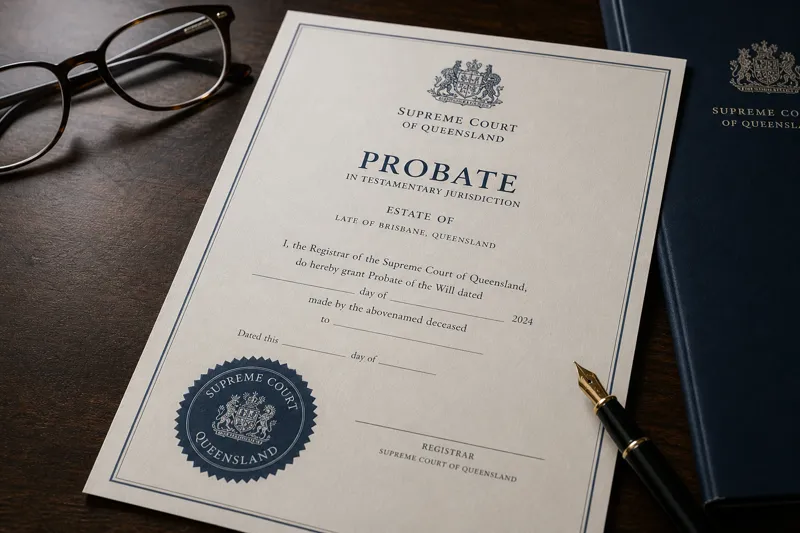
Probate in Queensland
Whether probate is required depends on the nature and value of the assets. Small estates can sometimes be dealt with without a grant if the asset-holders are willing to release funds on their own internal requirements, but real property will usually require a grant of probate before it can be transmitted or sold.
In Queensland, probate applications are made to the Supreme Court of Queensland under the Succession Act 1981 (Qld). The court also deals with letters of administration if there is no valid will or no available executor.
What A Valid Will Requires In Queensland
A valid will in Queensland generally needs to be in writing, signed by the will-maker, and witnessed by two witnesses who are both present at the same time and who also sign. The will-maker must also have testamentary capacity. That means they must understand, in a general way, the nature of making a will, the extent of the property they are dealing with, and the persons who might reasonably expect to benefit from the estate.
The primary formal requirements are set out in the Succession Act 1981 (Qld). Queensland courts may admit an informal document to probate in some circumstances, but that requires a court application and evidence that the document was intended to operate as the deceased’s will. It is not something prudent planning should rely on.
Capacity is often where later disputes begin. That is why, in more contentious family situations, it is often sensible for the will-maker’s wishes to be expressed clearly, for the solicitor to keep a proper contemporaneous file note, and for a doctor to provide a letter or record addressing capacity at the time the will is made. None of those things makes a claim impossible, but they can make it significantly easier to defend the will later.
What It Means To Challenge A Will
People say they want to “challenge a will” as though it is a single process, but legally it usually means one of two very different things.
1. Challenging The Validity Of The Will
This means saying the will should not be accepted as the deceased’s valid will at all. Common grounds include:
- Lack of testamentary capacity
- Undue influence or pressure
- Fraud or forgery
- Lack of knowledge and approval
- Failure to comply with execution requirements
If a validity challenge succeeds, the disputed will may be set aside and an earlier will may operate instead. If there is no earlier valid will, the estate may pass on intestacy.
2. Bringing A Family Provision Claim
A family provision claim is different. The claimant is not necessarily saying the will is invalid. Instead, they are saying that even if the will is valid, it did not make adequate provision for their proper maintenance and support.
In Queensland, family provision claims are brought under Part 4 of the Succession Act 1981 (Qld). Eligible applicants generally include a spouse, child, or dependant of the deceased. Notice of an intended claim ordinarily must be given within six months of death, and proceedings ordinarily must be commenced within nine months of death, although extensions can sometimes be sought with the court’s leave.
The court has a broad discretion when deciding those claims. It will usually consider the claimant’s financial circumstances, age, health, earning capacity, the size of the estate, the competing claims of other beneficiaries, the nature of the relationship with the deceased, and any contributions made by the claimant. Courts do not simply ask whether the deceased had good personal reasons for making the will they did. The question is whether adequate provision was made according to the legal test.

Family provision disputes
That broad discretion is why people are often surprised. The court may be prepared to intervene even where the deceased clearly intended not to benefit a particular person. The law is not solely about giving effect to wishes. It is also about ensuring that certain classes of eligible people are not left without proper provision.
How Queensland Differs From New South Wales
This is one of the most important distinctions in estate planning.
Queensland does not have notional estate legislation. New South Wales does. In New South Wales, the court can in some circumstances designate property that is no longer in the estate, including certain assets transferred before death, as part of the notional estate for the purpose of satisfying a family provision claim. In Queensland, there is no equivalent statutory power of that kind.
That means a genuine lifetime gift in Queensland may, in some situations, move an asset beyond the reach of a later family provision claim in a way that would not necessarily work in New South Wales. But that does not make gifting universally wise. It only means the legal landscape is different.
Estate Planning Options People Commonly Consider
This is the part that needs careful, case-by-case thinking. There are several options a person might consider if they want to reduce probate complexity, reduce the size of the estate, or make a later challenge harder. Some of them may be appropriate for some people. None of them are right for all people.
Lifetime Gifting
A person may simply transfer assets while alive, whether cash, property, shares, or other investments. If the gift is complete, the asset is no longer theirs. It does not fall into the estate when they die, and in Queensland it is generally not available to satisfy a family provision claim in the same way estate property is.
This can be appropriate where the person has surplus wealth, stable family relationships, and no realistic prospect that they will need the asset later. It may also be used where someone has a clear desire to benefit a particular child or family member during life rather than on death.
Why it may not be suitable as general advice:
- The person may live much longer than expected and later need the money for care, accommodation, or health needs.
- Once the asset is given away, the giver usually loses control of it.
- The recipient may divorce, go bankrupt, die, fall into addiction, or simply stop cooperating.
- The gift may affect Centrelink entitlements under deprivation rules.
- The person may reduce their borrowing capacity by stripping assets out of their own name.
- Property transfers may trigger stamp duty, capital gains tax, legal fees, and valuation costs.
Joint Ownership And Survivorship
Real property owned as joint tenants passes automatically to the surviving joint tenant by survivorship. It does not pass under the will. The same can apply, in practical terms, to some jointly held bank accounts depending on how the institution treats them.
This may be appropriate for some couples with a long-standing shared household and aligned intentions. It can simplify what happens on the first death and may reduce the assets that need to move through probate.
Why it may not be suitable as general advice:
- It can unintentionally disinherit children from an earlier relationship.
- It exposes the asset to the other co-owner’s risks, including bankruptcy or family law disputes.
- A person may lose flexibility if circumstances change.
- Not all jointly-held assets are free from later dispute, especially if beneficial ownership is contested.
Superannuation Death Benefit Nominations
Superannuation is not automatically an estate asset. It is held on trust by the fund trustee. A valid binding death benefit nomination can require the trustee to pay the death benefit to the nominated dependant or legal personal representative according to the rules of the fund.

Superannuation death benefit nominations
This can be appropriate where someone wants a defined pool of money directed in a particular way, especially where they want payment to bypass the estate and go straight to a spouse or dependant, or alternatively to their legal personal representative so it can be dealt with under the will.
Why it may not be suitable as general advice:
- Not every person can be nominated. The nomination must fit the superannuation law definition of dependant or legal personal representative.
- Many nominations lapse and must be renewed, often every three years, depending on the fund rules.
- Tax outcomes can differ depending on who receives the death benefit.
- A stale or invalid nomination can produce an entirely different result from what was intended.
Testamentary Trusts Under A Will
A testamentary trust is created by the will and comes into existence after death. Instead of an asset being given outright to a beneficiary, it is held in a trust structure for that beneficiary or a broader class of beneficiaries.
Testamentary trusts can be useful where there are minor children, vulnerable beneficiaries, spendthrift beneficiaries, beneficiaries with disability support considerations, or concerns that a beneficiary’s inheritance might be exposed to bankruptcy or a relationship breakdown. They can also offer tax planning advantages in some circumstances.
Why it may not be suitable as general advice:
- It does not avoid a family provision claim simply because the will contains a trust.
- It creates ongoing administration, accounting, tax return, and trustee decision-making obligations.
- It may be unnecessary complexity for a modest or straightforward estate.
- A poor choice of trustee can create long-running disputes.
Inter Vivos Discretionary Trusts
Some people consider moving assets into a discretionary trust during life. That is a very different exercise from using a testamentary trust under a will. It may be relevant for business owners, investors, or families already operating through trust structures.
This can be appropriate where asset protection and control over distributions are genuine current objectives, not merely post-death objectives.
Why it may not be suitable as general advice:
- Transfer of assets into the trust may trigger tax and duty consequences.
- The structure has ongoing accounting and compliance costs.
- The trust may complicate borrowing, refinancing, or future restructuring.
- If the person needs personal access to the asset later, the trust structure may make that more difficult.
Life Interests And Rights To Reside
A will may give one person a life interest or a right to reside in a property , with the capital then passing to somebody else on that person’s death. This is common in blended families where the will-maker wants a spouse to remain secure in the home while ultimately preserving capital for children from a prior relationship.
This can be appropriate where there is a real need to balance the interests of a current partner and children from an earlier relationship.
Why it may not be suitable as general advice:
- Maintenance, insurance, rates, repairs, and renovation disputes can arise.
- The life tenant and the remainder beneficiaries may not get along.
- The arrangement can be difficult if the life tenant later needs to move into care and the property must be sold.
Clear Reasons, Doctor’s Evidence, And Solicitor File Notes
This is not a separate asset structure, but it is often one of the most practical steps available. Where a will-maker is excluding someone, favouring one child over another, or making a controversial change late in life, clear documentation matters.
A statement of wishes, a detailed solicitor’s note, and where appropriate a doctor’s assessment of capacity can make a significant evidentiary difference if the will is attacked later.

Will signing and witness formalities
Why it may not be suitable as the only advice:
- Good documentation does not prevent a family provision claim.
- It helps defend capacity and intention, but it does not remove the court’s discretion to make provision for an eligible applicant.
- People sometimes treat documentation as though it guarantees the outcome. It does not.
Why These Options Are Not Right For Everyone
This is the part that matters most. A strategy that sounds clever in conversation can leave a person in a much worse position while still alive.
Cost And Compliance
Trusts, property transfers, tailored wills, deeds, valuations, and tax advice all cost money. In some estates, that cost is justified. In others, the structure costs more than the problem it is supposed to solve.
Ongoing Management Costs
Trusts do not look after themselves. They need trustees, records, accounting, tax returns, and ongoing attention. People often underestimate the cost and inconvenience of keeping a structure alive year after year.
Trust In Other People
If you gift an asset away, it is no longer yours. If you add someone to title, they acquire rights. If you appoint someone as trustee, they exercise control. These arrangements all assume a degree of trust, and trust is exactly what tends to break down in estate disputes.
Centrelink And Aged Care Consequences
Gifting can affect pension assessments. Asset ownership can affect means testing. What looks like good estate planning from one angle may create a poor Centrelink or aged care outcome from another.
Reduced Borrowing And Financial Flexibility
A person who has moved assets out of their own name may later find they have less ability to borrow, refinance, or restructure their affairs when circumstances change.
Change Of Mind
A will can usually be changed while a person has capacity. A completed gift usually cannot simply be unwound because the person later regrets it.
Living Longer Than Expected
This is one of the greatest practical risks. People often plan on an assumed timeline. Life does not obey the plan. If someone gives away too much too early and lives another twenty years, the damage may be substantial.
Why We Cannot Give These Options As General Advice
The reason a solicitor cannot responsibly say that everybody should use one of these options is that the legal answer depends on the intersection of family structure, asset mix, health, age, taxation, superannuation rules, Centrelink position, lending needs, and the personalities involved.
For one client, a testamentary trust may be exactly right. For another, it is expensive over-engineering. For one client, gifting a property may remove an asset from a future estate dispute. For another, it may leave them financially vulnerable, unable to borrow, and exposed to the donee’s divorce or bankruptcy. For one blended family, a life interest may be the best compromise available. For another, it may simply postpone the dispute.
That is why these options should be treated as possibilities to discuss, not instructions to follow headlong.
Need Help With Estate Planning or Disputed Estates?
Bell Senior Lawyers advises Gold Coast and South East Queensland residents on complex wills, estate planning, probate, and defending or bringing family provision claims. Call 07 5532 8777 or make an enquiry online .
Frequently Asked Questions
For more on this topic, see our Wills and Estates FAQ and our specific guide to Who Can Bring a Family Provision Claim in Queensland .
What is the difference between challenging a will and making a family provision claim? Challenging a will can mean attacking its validity, for example on capacity, undue influence, fraud, or execution grounds. A family provision claim accepts the will may be valid, but argues that an eligible person was not left with adequate provision for proper maintenance and support.
Who can bring a family provision claim in Queensland? Generally, a spouse, child, or dependant of the deceased may apply under the Succession Act 1981 (Qld), subject to the statutory criteria and time limits.
Does probate mean the will cannot be challenged? No. Probate confirms the court is willing to recognise the will and the executor’s authority, but estates can still be the subject of family provision claims and, in some cases, challenges to validity.
Can giving assets away before death prevent a claim in Queensland? Sometimes. Because Queensland does not have New South Wales style notional estate legislation, a genuine completed lifetime gift may place the asset outside the estate. But gifting can create tax, Centrelink, control, and financial risk issues, so it is not automatically a good idea.
Is a testamentary trust always a good way to protect an inheritance? No. It can be a very useful tool in the right case, especially where there are vulnerable beneficiaries or asset protection concerns, but it also brings ongoing administration and cost.
Related Topics
- Legal Matters Ep 20: Property Settlement and Will Disputes
- Legal Matters Ep 22: Probate, Family Provision Claims & QCAT Consumer Disputes
- When is Probate Required in Queensland?
- Who Can Challenge a Will in Queensland?
- Testamentary Capacity and Dementia in Queensland
- Wills and Estates Practice Area
This article provides general legal information only and does not constitute personal legal advice. Estate planning outcomes depend heavily on individual circumstances, and specific advice should be obtained before any asset transfer, trust structure, nomination, or will change is made.
Need Legal Advice?
Contact us today to discuss your matter. We'll respond within 24 hours.
Enquiry Sent
Thank you for reaching out. A member of our legal team will contact you shortly.