
The Southport Litigant's Handbook: Everything You Need to Know About the Southport Courthouse
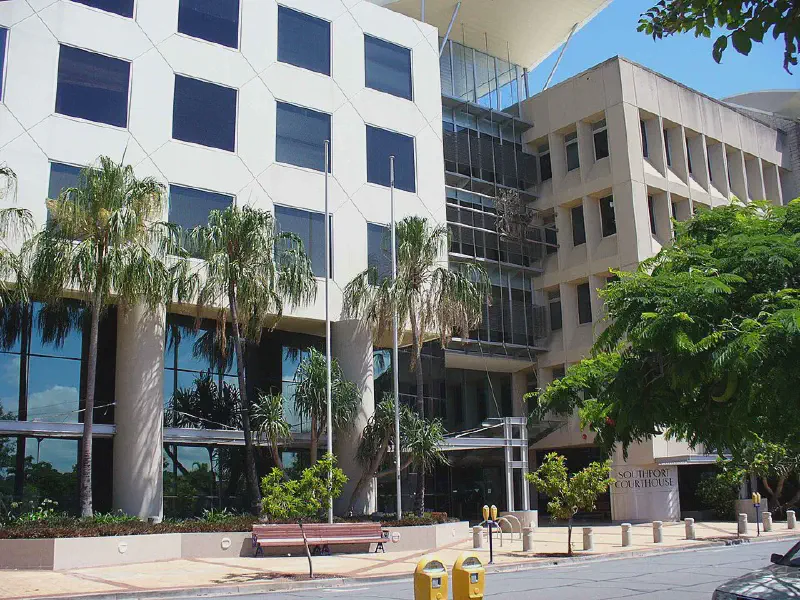
By Bidgee - Own work, CC BY-SA 3.0, Source
Need legal help with this topic?
Get a confidential assessment of your matter today.
The Southport courthouse at Corner Davenport and Hinze Streets is home to the Queensland Magistrates Court, District Court, the Southeastern Coroner’s Court, and handles QCAT matters for the Gold Coast. The Federal Circuit and Family Court of Australia is not at Southport; Gold Coast family law litigants must attend Brisbane or use video link. This handbook covers every court in the precinct: what it hears, what it costs, how long it takes, how to file, what to bring, and practical matters like parking, registry hours, and what to expect on the day.

Walking into the Southport courthouse for the first time (whether you are a business owner chasing an unpaid invoice, a tenant disputing a bond, someone who has been charged with a criminal offence, or a family trying to resolve a parenting dispute) the experience can be confusing and anxiety-inducing in equal measure. Courts operate according to rules and conventions that are not obvious to first-time attendees; the procedural stakes of getting things wrong are high, and the layout and function of the different courts is far from self-explanatory.
This handbook is designed to cut through that confusion. It covers the precise location and hours of the Southport courthouse, which courts actually sit there (and which, importantly, do not), what each court handles, what proceedings cost, how long each stage takes, where to park, what to bring, and a practical step-by-step guide through the civil litigation , criminal, and tribunal processes that most Gold Coast residents and businesses encounter.
In This Guide
The Southport Courthouse: Exact Location, Hours, and Contacts
Address: Corner of Davenport and Hinze Streets, Southport QLD 4215
Postal address: PO Box 103, Southport QLD 4215
Phone: 1300 516 700
Fax: (07) 5675 7108
Email: courthouse.southport@justice.qld.gov.au
Registry hours:
- Monday, Tuesday, Wednesday, Friday: 8:30am to 4:30pm
- Thursday: 8:30am to 4:00pm
- Closed Saturday, Sunday, and all Queensland and national public holidays
The registry is the administrative engine of the courthouse; it is where you file documents, pay fees, obtain sealed copies of orders, and make general enquiries. Registry staff can assist with procedural questions and point you to the correct forms, but they cannot give legal advice.
Which Courts Sit at Southport?
The Southport courthouse houses three courts and one tribunal service:
- Queensland Magistrates Court (Gold Coast): the highest-volume court in the precinct, handling the majority of criminal matters and all civil claims up to $150,000
- District Court of Queensland (Gold Coast): more serious criminal trials, civil claims above $150,000, and appeals from the Magistrates Court
- Coroner’s Court (Southeastern Region): Level 3, Southport Magistrates Court; the Southeastern Coroner investigates reportable deaths and fires in the South East Queensland boundary catchment1
- QCAT (Queensland Civil and Administrative Tribunal): QCAT does not have a separate Gold Coast office; minor civil dispute and other QCAT applications for the Gold Coast are lodged through the Southport Magistrates Court registry2
What Is NOT at Southport
The Federal Circuit and Family Court of Australia (FCFCOA) is NOT located at Southport. Gold Coast residents with federal family law matters (parenting orders, property settlement after separation, or divorce applications) must file at and attend the FCFCOA Brisbane Registry at the Harry Gibbs Commonwealth Law Courts Building, 119 North Quay, Brisbane QLD 4000. Some directions hearings may be conducted by video link from the Gold Coast, but Brisbane is the relevant registry and the location where significant hearings are conducted.[^3]
This is a frequent source of confusion and wasted trips. Do not present at Southport for a family law filing; you will be redirected to Brisbane.
The Supreme Court of Queensland also does not have a permanent presence at Southport. Supreme Court matters arising on the Gold Coast are heard in Brisbane. Occasional Supreme Court sittings may occur at Southport by arrangement, but it is not a permanent registry location.
Getting There: Parking, Public Transport, and Practical Tips
Parking
The Southport courthouse is situated in the Southport CBD, and parking in the immediate vicinity is competitive on busy court days; particularly Monday mornings, when criminal lists are typically heaviest.
Paid on-street parking is available on Davenport Street, Hinze Street, Nerang Street, and Scarborough Street in the surrounding blocks. Time limits apply and are enforced by Gold Coast City Council parking officers. The maximum available on-street time (usually 2P or 4P) may not be sufficient for a contested hearing or a trial that runs through the day. In that case, moving your vehicle during a break or using an all-day parking station is necessary.
Paid parking stations within walking distance of the courthouse include:
- Scarborough Street car park (Southport CBD, several hundred metres from the courthouse)
- Gold Coast City Council and private car parks on Nerang Street and in the broader Southport CBD
Allow a minimum of 30 minutes before your listed appearance time to find parking, locate the correct courtroom, and check in with the registry or duty lawyer service if applicable. On days when you expect proceedings to run all day (a contested hearing or trial), allow more time and consider public transport if parking reliability is a concern.
Public Transport
The Gold Coast light rail (G:link) operates to Southport station, which is approximately 10 to 15 minutes’ walk from the courthouse. Bus services also connect to the Southport bus interchange. For matters where parking stress would add to the pressure of an already difficult day, public transport is a practical alternative.
Accessibility
The Southport courthouse has wheelchair access. If you have a disability or mobility requirement that affects your ability to access the building or courtroom, contact the registry in advance on 1300 516 700 to arrange appropriate facilities.
Understanding the Court Hierarchy: Which Court Hears What?
Before filing anything, confirming the correct court for your dispute is essential. Filing in the wrong court wastes filing fees, delays resolution, and can result in cost consequences.
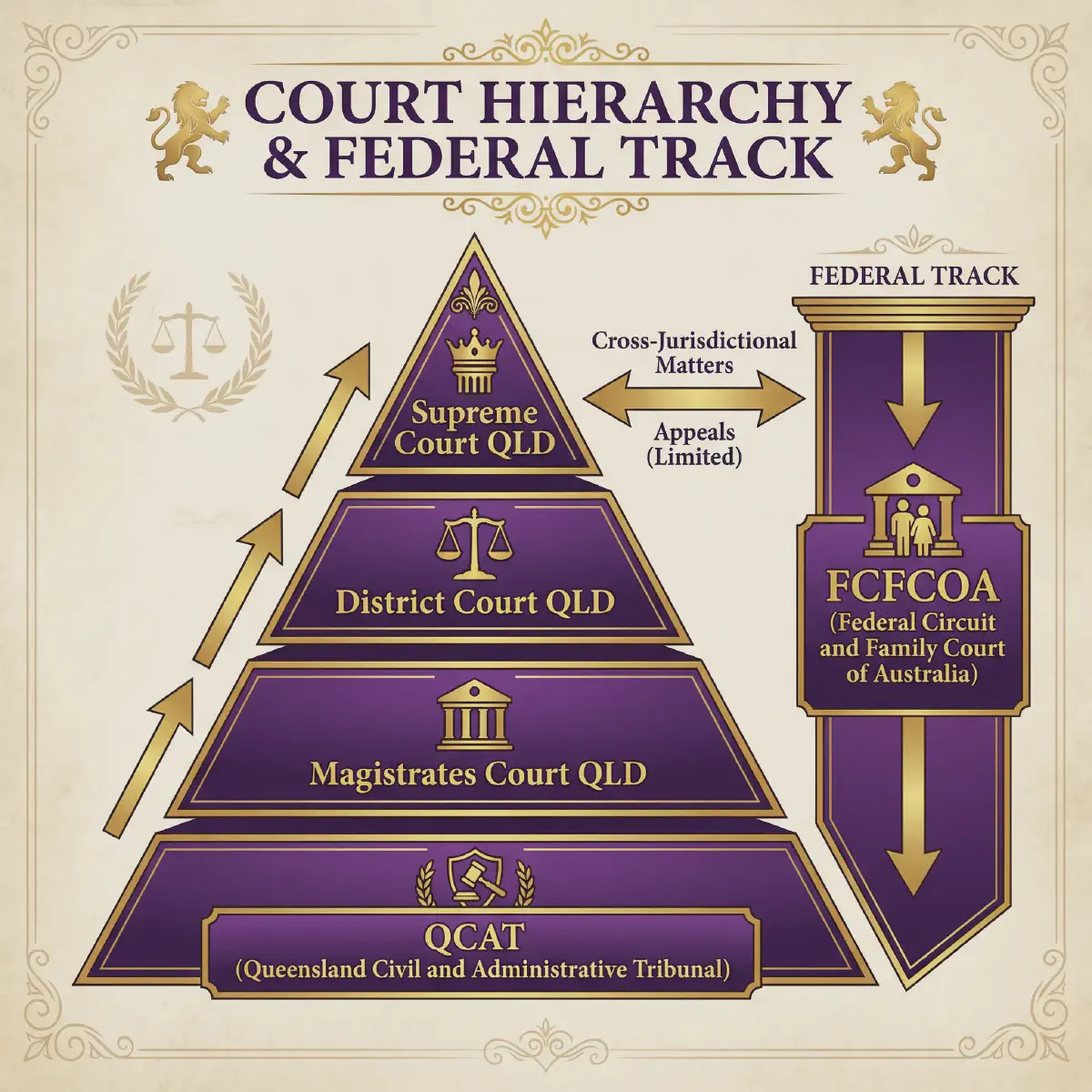
| Court / Tribunal | Civil Jurisdiction | Criminal Jurisdiction |
|---|---|---|
| QCAT (via Southport MC) | Minor civil disputes up to $25,000; tenancy; building; retail leases | None |
| Magistrates Court | Civil claims up to $150,000 | Summary offences; committal of indictable matters |
| District Court | Civil claims $150,001 to ~$750,000; appeals from MC | Serious indictable offences (most trials) |
| Supreme Court (Brisbane) | Claims above ~$750,000; complex matters | Most serious (murder, manslaughter, major drug offences) |
| FCFCOA (Brisbane) | Family law only (parenting, property, divorce) | None |
Note on District Court civil jurisdiction: The Queensland Courts website describes the District Court as handling civil disputes “between $150,000 and $750,000.”3 Matters significantly above that amount and matters of particular complexity are generally commenced in the Supreme Court in Brisbane. If your claim is above $750,000, obtain legal advice about the correct court before filing.
The Queensland Magistrates Court
Civil Jurisdiction and What It Costs
The Magistrates Court has civil jurisdiction for claims up to $150,000.4 This captures the majority of everyday commercial disputes: unpaid invoices, broken contracts, property damage, and goods and services disputes.
Filing fees for a Magistrates Court civil claim are scaled to the claim amount. As an approximate guide based on current Queensland Courts fee structures:
| Claim Value | Approximate Filing Fee (plaintiff) |
|---|---|
| Up to $7,500 | ~$100 to $150 |
| $7,501 to $50,000 | ~$200 to $400 |
| $50,001 to $150,000 | ~$400 to $700 |
Fees are also payable for filing a defence, applying for defaultjudgementt, and scheduling a hearing. Filing fees are recoverable; if you obtain a costs order in your favour, the other side must ordinarily reimburse you for the filing fees paid.
Legal costs: If you are represented by a solicitor, solicitor’s costs in the Magistrates Court are assessed on a party/party basis in accordance with the Magistrates Court scale if costs are ordered. The scale does not fully compensate actual legal fees, but it does provide meaningful recovery.
How Long Does a Magistrates Court Civil Matter Take?
As a general guide for uncontested or straightforward Southport civil matters:
| Stage | Approximate Timeframe |
|---|---|
| File Claim to service on defendant | 1 – 2 weeks (dependent on service) |
| Service to Defence deadline | ~28 days after service |
| Defauljudgementnt application (if no defence) | 1 – 2 weeks after deadline passes |
| Filing to first directions hearing (if contested) | 4 – 8 weeks |
| Directions hearing to disclosure/affidavit exchange | 4 – 12 weeks (set by directions) |
| Hearing listing (from directions) | 3 – 9 months (dependent on list length) |
| Total: uncontested/default | ~6 – 12 weeks |
| Total: contested to hearing | ~9 – 18 months |
These are indicative figures. Actual listing times depend on the current Southport court list, the complexity of the matter, and how diligently each party complies with directions.
Summary Criminal Jurisdiction
The Magistrates Court deals with all summary offences (offences heard entirely by a Magistrate without a jury) and conducts committal proceedings for indictable offences to determine whether there is sufficient evidence to send the accused for trial in the District or Supreme Court.
Summary offences heard at Southport include: traffic offences (drink driving, dangerous driving, or driving while disqualified), public nuisance, offensive language and behaviour, common assault, unlawful possession of drugs (personal use quantities), theft (lower value), wilful damage, and a range of regulatory offences.
Sentencing range: A Magistrate’s sentencing powers are capped. The maximum for a single offence is three years’ imprisonment. The total for multiple offences arising from the same circumstances is also capped. Serious offending above these limits is sentenced in the District Court.
Typical timeframes for criminal summary matters at Southport:
| Stage | Approximate Timeframe |
|---|---|
| First mention to plea (if requiring legal advice adjournment) | 2 – 6 weeks |
| Guilty plea + sentence (straightforward) | 2 – 8 weeks from first mention |
| Not guilty, contested hearing listing | 3 – 9 months from first mention |
| Committal (indictable matter) | 3 – 12 months from first mention to committal decision |
The District Court at Southport
The District Court of Queensland at Southport sits above the Magistrates Court in the hierarchy and deals with more serious matters.5
Civil Matters
Civil claims between approximately $150,001 and $750,000 are generally commenced in the District Court. Proceedings follow the same framework as the Magistrates Court (claim, defence, disclosure, and hearing) under the Uniform Civil Procedure Rules 1999 (Qld), but with a more rigorous timetabling regime and greater complexity.
Filing fees in the District Court are higher than in the Magistrates Court and are published on the Queensland Courts website. As an indicative guide, fees for commencing proceedings in the District Court typically range from approximately $500 to $1,500 depending on the claim value and the type of originating process.
Typical timeframes, District Court civil at Southport:
| Stage | Approximate Timeframe |
|---|---|
| Filing to first directions | 6 – 10 weeks |
| Directions to trial listing | 6 – 18 months (dependent on complexity) |
| Total: simple contested matter | ~12 – 24 months |
| Total: complex commercial matter | 18 – 36+ months |
Criminal Trials
The District Court at Southport conducts criminal trials and sentences for serious indictable offences including most armed robberies, sexual offences, serious drug offences, fraud, grievous bodily harm, and other major criminal matters. Trials are heard before a Judge and jury of twelve. The burden is on the prosecution to prove guilt beyond reasonable doubt.
Criminal trials are demanding, lengthy proceedings. A matter of average complexity at the Southport District Court (from committal completion to trial date) may take 12 to 24 months or more depending on the nature of the case and the current trial list. Representation by a criminal law solicitor and barrister is essential for District Court criminal trials.
Appeals from the Magistrates Court
The District Court hears civil and criminal appeals from the Magistrates Court. An appeal is not a re-run of the original hearing; it is a review for legal error, error in the exercise of a discretion, or a finding of fact that was not open on the evidence. New evidence is not generally admitted on appeal.
QCAT: The Accessible Tribunal for Everyday Disputes
The Queensland Civil and Administrative Tribunal (QCAT) provides a lower-cost, less-formal alternative to the courts for defined categories of dispute.6 On the Gold Coast, QCAT applications are lodged through the Southport Magistrates Court registry; there is no separate QCAT Gold Coast building.
How to Apply to QCAT on the Gold Coast
- Download the correct QCAT application form from qcat.qld.gov.au
- Complete and sign the form (include all supporting documents)
- Lodge at the Southport Magistrates Court registry, Corner Davenport and Hinze Streets, during registry hours
- Pay the applicable QCAT filing fee (scaled to the type and value of the dispute)
- The registry will stamp and process the application and advise the listing date
QCAT phone enquiries: 1300 753 228 (8:30am to 3:00pm Monday to Thursday; 8:30am to 12:00pm Friday)
What QCAT Handles
Minor civil disputes (up to $25,000): Unpaid debts, consumer and trader disputes, property damage claims, and simple contract disputes. QCAT adjudicators hear these matters informally. Legal representation is not permitted as of right in the minor civil dispute jurisdiction; a party wishing to be represented must obtain the tribunal’s leave, which requires showing it would not disadvantage the other side.7
Residential tenancy disputes: Disputes between landlords and tenants under the Residential Tenancies and Rooming Accommodation Act 2008 (Qld), including bond claims, compensation applications, repair orders, and termination applications.
Building disputes: Disputes between homeowners and contractors where the amount falls within QCAT’s jurisdiction.
Retail shop lease disputes: Matters under the Retail Shop Leases Act 1994 (Qld) between retail tenants and landlords.
Administrative review: Applications to review decisions of Queensland Government agencies affecting licences, planning approvals, and regulatory authorisations.
QCAT filing fees are lower than court filing fees and are published on the QCAT website. Minor civil dispute fees range from approximately $50 to $200 depending on claim value. Tenancy application fees are typically in the range of $30 to $100.
Typical timeframes, QCAT on the Gold Coast:
| Proceeding Type | Approximate Time to Hearing |
|---|---|
| Minor civil dispute (straightforward) | 6 – 14 weeks from application |
| Residential tenancy (urgent) | Days to 2 weeks (urgent listing available) |
| Residential tenancy (standard) | 4 – 10 weeks |
| Building dispute | 3 – 9 months |
| Administrative review | 3 – 12 months |
The Coroner’s Court at Southport
The Southeastern Coroner is located at Level 3, Southport Magistrates Court, Hinze Street, Southport QLD 4215.8 The Southeastern Coroner investigates reportable deaths and fires in the South East Queensland boundary catchment, which includes the Gold Coast and surrounding regions.
Coronial proceedings are not civil or criminal litigation in the conventional sense. A coroner does not attribute criminal guilt. The purpose of an inquest is to determine the identity of the deceased, when and where death occurred, what caused the death, and in some cases: how the death occurred and whether any changes to practice, policy, or law could prevent similar deaths in the future.
Most people do not interact with the Coroner’s Court as litigants. However, if you are the family of someone whose death is under coronial investigation, you may:
- Be contacted by the Coroner’s Office to provide information or a statement
- Be an interested party entitled to appear at an inquest
- Require legal representation at the inquest; particularly where findings could affect insurance claims, civil litigation, or professional regulation of individuals involved
General coronial enquiries for the Southeastern region: (07) 3738 7050 or Southeastern.Coroner@justice.qld.gov.au
Federal Family Law Matters: You Must Go to Brisbane
This is worth stating plainly because it is one of the most common misconceptions about the Gold Coast court system.
If your matter involves:
- Parenting orders (arrangements for children after separation)
- Property settlement or financial orders under the Family Law Act 1975 (Cth)
- Divorce applications
- De facto relationship property or maintenance orders under federal law
- Child support enforcement
- International parenting or relocation disputes
You must file at and attend:
Federal Circuit and Family Court of Australia, Brisbane Registry Harry Gibbs Commonwealth Law Courts Building 119 North Quay, Brisbane QLD 4000 Phone: 1300 352 000
The FCFCOA Brisbane Registry is the correct filing location for all Gold Coast residents with federal family law matters. Some procedural hearings (particularly telephone and video directions) may be conducted remotely, but the Brisbane registry is where documents must be filed and where substantive hearings are listed.
For detailed guidance on what this means for Gold Coast family law litigants, including the step-by-step property settlement process and how the mediation/family dispute resolution requirement applies, see:
- Gold Coast Property Settlement: A Step-by-Step Timeline
- Mediation vs Court: Which is Faster in QLD Family Law?
The Civil Litigation Process: Step by Step
The following guide covers civil proceedings in the Magistrates Court, which is where the majority of Gold Coast civil disputes are resolved. The District Court follows the same foundational framework under the Uniform Civil Procedure Rules 1999 (Qld) but with additional procedural rigour appropriate to the higher value and complexity of matters.
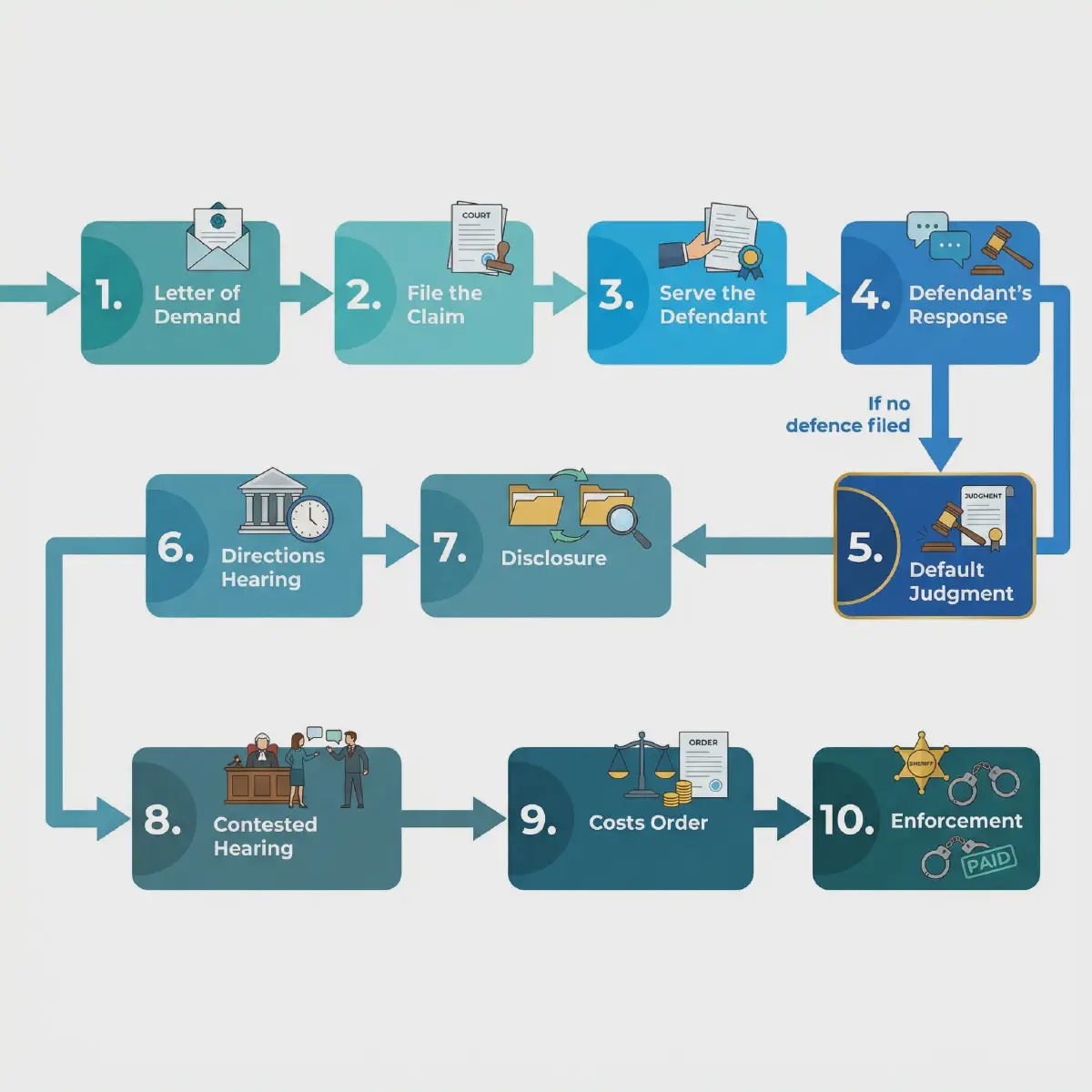
Step 1 — Pre-Litigation: Send a Proper Letter of Demand
Before filing anything, you must comply with the pre-litigation requirements in Chapter 9 of the Uniform Civil Procedure Rules 1999 (Qld).9 These require a prospective plaintiff to give the defendant genuine notice of the intended claim and a reasonable opportunity to respond before proceedings are commenced.
A compliant letter of demand should:
- Identify the parties by full legal name
- State clearly the basis of the claim and the amount sought
- Provide reasonable supporting documentation (such as an invoice, contract, photos, or quotes)
- Give a reasonable deadline for payment or response (14 to 30 days is standard for most debt claims)
- State that proceedings will be commenced if payment or a satisfactory response is not received by the deadline
Step 2 — File the Claim
Documents required:
- Completed Claim (Form 2)
- Filing fee (confirm current amount before attending the registry)
- Copies for each defendant plus one copy for yourself
- Statement of Claim (setting out the facts of your claim in numbered paragraphs)
- Any documents you intend to attach to the Claim as exhibits
Step 3 — Serve the Defendant
The sealed Claim must be personally served on the defendant.10 You cannot serve it yourself; it must be served by someone other than you (such as a process server or a friend over 18). Personal service means physically handing the documents to the defendant.
After service, the server must prepare a sworn Affidavit of Service stating: who they are, when and where they served the documents, and how they identified the defendant. This affidavit is filed with the court before applying for defaujudgementent.
Step 4 — The Defendant’s Response
After service, the defendant has a prescribed time to file:
- A Notice of Intention to Defend (Form 6)
- A Defence (Form 16) addressing each allegation
The response period is typically 28 days from service for defendants served in Queensland (longer for interstate or overseas service).
Step 5 — DefaJudgementment (If No Defence Filed)
If the deadline passes without a filed Defence, you may apply for defjudgementgment by filing an Application for DeJudgementdgment (Form 9) and attaching a filed Affidavit of Service confirming proper service.
Default Judgments Can Be Set Aside If You Cut Corners Many people rush to get a default judgment only to have it set aside weeks later because the service was ’not quite right’. If the court sets aside the judgment, you may have to pay the other party’s legal costs for the application to set it aside. Do not take shortcuts on service.
Contact our litigation team for assistance with proper service and default judgment applications. Call (07) 5532 8777.
Step 6 — Directions Hearing (If Defended)
Where a Defence is filed, the matter is listed for a directions hearing before a Magistrate or Registrar. This is a brief administrative hearing (typically 5 to 15 minutes) at which the court issues directions for the management of the proceedings to trial.
Step 7 — Disclosure
Disclosure (formerly called discovery) is the process by which each party provides the other with access to all documents relevant to the matters in dispute; including documents that help the other side’s case.11 The obligation is ongoing throughout proceedings.
Step 8 — Contested Hearing
A contested hearing in the Magistrates Court is conducted before a Magistrate without a jury. The general sequence includes opening submissions, the plaintiff’s case, the defendant’s case, closing submissions, and fjudgementjudgment.
You Do Not Get a ‘Do Over’ for a Poorly Run Hearing The hearing is your only opportunity to present evidence and cross-examine the other side. If you are not prepared, if your exhibits are disorganized, or if you miss a key point, you cannot ask the court to ’re-open’ the matter later. The decision made at the end of the hearing is final, subject only to a difficult and expensive appeal process.
Speak to a trial lawyer before your Southport hearing date. Preparation is the difference between winning and losing. Call (07) 5532 8777.
Step 9 — Costs
The general rule is costs follow the event; the successful party is usually entitled to a costs order requiring the unsuccessful party to pay their legal costs.12
Step 10 — EnfoJudgement
Judgment does not automatically result in paymenjudgemente judgment debtor does not pay voluntarily, enforcement steps include:
- Enforcement warrant for seizure and sale: Authorises a bailiff to seize and sell personal property.
- Redirection of earnings: Directs the debtor’s employer to redirect wages.
- Redirection of debts: Redirects money owed to the debtor by a third party (such as a bajudgementhe judgment creditor.
- Examinajudgementthe judgment debtor: Summons the debtor to court to answer questions under oath about assets and income.
Winning the Case Is Not the Same As Getting Your Money A court judgment is a piece of paper confirming you are owed money. It is not a cheque. If the debtor refuses to pay, you must take proactive enforcement action. Delaying enforcement gives the debtor time to hide assets or file for bankruptcy.
Contact our enforcement team as soon as your judgment is entered. Call (07) 5532 8777.
Criminal Proceedings: First Mention to Sentence
Before Your First Mention: Getting Legal Advice
If you receive a Notice to Appear, are issued a summons, or are given bail to appear at the Southport Magistrates Court, the single most important step is to obtain legal advice before your first appearance; not on the morning of it.
The First Mention
At the first mention, the Magistrate will confirm your details, read the charges, and ask about your representation and plea. You do not have to enter a plea at the first mention. Asking for an adjournment to obtain legal advice is common practice and is routinely granted.
Guilty Plea and Sentence
If you decide to plead guilty, the Magistrate will sentence you after hearing the prosecution’s outline, your history, and your submissions in mitigation (such as remorse, early plea, or rehabilitation steps). A Magistrate’s maximum term of imprisonment for a single offence is three years.13
Not Guilty: The Contested Hearing
A not guilty plea results in the case being adjourned for a contested hearing. Between the plea and the hearing, the prosecution must provide the defence with all the evidence (the QP9 brief).
Indictable Matters: Committal and Trial
For serious indictable offences, the Magistrates Court is only the first venue. The Magistrate conducts committal proceedings to determine if there is sufficient evidence for trial in the District or Supreme Court.14
The Day of Court: Your Complete Practical Checklist

The Night Before
- Check the daily court list online at courts.qld.gov.au to confirm your courtroom and listed time.
- Organise all your documents in folder chronological order.
- Prepare a one-page written summary of the orders you seek.
- Charge your phone but set it to silent before entering the courtroom.
- Arrange parking or confirm your public transport route.
Getting Ready
- Dress conservatively and professionally; avoided shorts, thongs, or singlets.
- Eat before you go; proceedings can run past their listed time.
- Arrive at the courthouse at least 30 minutes before your listed time.
What to Bring
- All filed court documents (minimum three copies).
- Any physical exhibits, numbered and tabulated.
- Photo identification.
- A notepad and two pens.
- Enough cash or a card for parking.
Legal Aid and Free Legal Assistance
- Legal Aid Queensland: Duty lawyer service at Southport (1300 651 188).
- Gold Coast Community Legal Centre: Free advice for eligible clients (07 5532 7500).
- Bell & Senior Lawyers: Civil litigation, commercial disputes, and criminal law (07 5532 8777).
Quick Reference: Which Path Is Right for You?
| Situation | First Step | Venue |
|---|---|---|
| Unpaid debt under $25,000 | QCAT application | QCAT (via Southport MC) |
| Civil claim $25,001 – $150,000 | File Claim (Form 2) at Southport MC | Magistrates Court, Southport |
| Civil claim over $150,000 | File Claim at Southport District Court | District Court, Southport |
| Residential tenancy dispute | QCAT tenancy application | QCAT (via Southport MC) |
| Parenting orders or property settlement | File at FCFCOA Brisbane | Brisbane, not Southport |
| Divorce | File at FCFCOA Brisbane | Brisbane, not Southport |
Related Topics
- Mediation vs Court: Which is Faster in QLD Family Law?
- Gold Coast Property Settlement: A Step-by-Step Timeline
- Criminal Law Practice Area
- Commercial Law Practice Area
- Southport Commercial Law FAQ
Appearing at Southport courthouse and need a lawyer? Bell & Senior Lawyers acts for Gold Coast clients across all courts and tribunals in the Southport precinct. Call (07) 5532 8777 or make an enquiry online .
Footnotes
Speak With a Lawyer
Contact our Gold Coast team for a confidential discussion about your matter.
Enquiry Sent
Thank you for reaching out. A member of our legal team will contact you shortly.
-
Coroners Court of Queensland, ‘Contact us’ https://www.coronerscourt.qld.gov.au/contact-us . ↩︎
-
QCAT, ‘Contact us’ https://www.qcat.qld.gov.au/about-qcat/contact-us . ↩︎
-
Queensland Courts, ‘District Court’ https://www.courts.qld.gov.au/courts/district-court . ↩︎
-
Civil Proceedings Act 2011 (Qld) s 45; Southport registry telephone: 1300 516 700. ↩︎
-
District Court of Queensland Act 1967 (Qld). ↩︎
-
Queensland Civil and Administrative Tribunal Act 2009 (Qld). ↩︎
-
Queensland Civil and Administrative Tribunal Act 2009 (Qld) s 43. ↩︎
-
Coroners Court of Queensland (n 1). ↩︎
-
Uniform Civil Procedure Rules 1999 (Qld) Chapter 9. ↩︎
-
Uniform Civil Procedure Rules 1999 (Qld) Chapter 4; personal service required. ↩︎
-
Uniform Civil Procedure Rules 1999 (Qld) Chapter 7. ↩︎
-
Uniform Civil Procedure Rules 1999 (Qld) r 681. ↩︎
-
Magistrates Courts Act 1921 (Qld) s 52. ↩︎
-
Justices Act 1886 (Qld) Part 5. ↩︎