
Legal Risks of AI for Business – Australia, US and UK

AI is now embedded in everyday business operations, but the legal risks sit across privacy, consumer law, intellectual property, discrimination and security. This guide compares how Australia, the United States and the United Kingdom regulate business use of AI, and sets out practical questions and escalation pathways for Queensland businesses deploying generative and automated decision-making systems.

Why AI Legal Risk Is Now a Front-Line Business Issue
For Queensland business owners in 2026, AI is no longer experimental. It sits in everyday operations: customer support chatbots, document drafting, marketing content, credit and risk scoring, hiring filters and internal analytics.1 The commercial upside is clear, but regulators in Australia, the US and UK have all emphasised that existing laws apply directly to AI-driven processes, and that businesses remain responsible for what their systems do.234
Across these jurisdictions, common themes emerge: privacy obligations when feeding personal information into AI systems; consumer law risk where AI tools mislead or make unfair decisions; IP and copyright exposure from training and outputs; discrimination and bias in automated decision-making; and governance failures where AI is deployed without proper controls.256
SUMMARY – Key AI Legal Risks for Businesses
Deploying AI in your business creates new points of legal exposure across multiple statutes and regulators. Common risk scenarios include:
- Staff feeding confidential or personal information into public AI tools, breaching confidentiality and the Privacy Act 1988 (Cth).
- Chatbots and recommendation engines making misleading claims or omitting key facts, breaching the Australian Consumer Law.
- AI systems producing biased hiring, lending or workplace management decisions that amount to unlawful discrimination.
- Generative tools producing outputs that infringe copyright or misappropriate third-party content.
- Unsecured AI integrations becoming attack paths for ransomware and data exfiltration, triggering Cyber Security Act 2024 (Cth) and Notifiable Data Breaches obligations.
- From 10 December 2026, failing to properly disclose AI-involved decisions under new Privacy Act amendments (APP 1.7 to 1.9).
In This Guide
Core Legal Risk Categories – Australia, US and UK Compared
| Risk category | Australia | United States | United Kingdom |
|---|---|---|---|
| Privacy and data protection | Privacy Act 1988 (Cth), APPs, OAIC guidance; new APP 1.7–1.9 disclosure rules from 10 December 202627 | Fragmented state privacy laws plus FTC enforcement of unfair/deceptive AI data practices; no comprehensive federal AI statute89 | UK GDPR, Data (Use and Access) Act, ICO AI and data protection guidance1011 |
| Consumer law and fairness | Australian Consumer Law; ACCC and National AI Plan approach of applying existing law312 | FTC Act and state consumer statutes; scrutiny of deceptive AI claims and opaque decisions8 | Consumer Rights Act; CMA guidance on AI agents (2026)13 |
| Intellectual property and copyright | Copyright Act 1968 (Cth); disputes over training data and generated content ownership614 | US copyright and trade mark law; active litigation on training data and output liability9 | UK copyright law and passing off; ICO stresses outputs can still infringe or mislead10 |
| Discrimination and bias | Anti-discrimination statutes; NSW Digital Work Systems Act (2026) for workplace AI1516 | US civil rights and equal opportunity laws applied to algorithmic decisions89 | Equality Act 2010; ICO fairness and profiling guidance; FCA Mills Review for financial services1017 |
| Security and confidentiality | Cyber Security Act 2024 (Cth); Essential Eight; OAIC security obligations1819 | Sector-specific cybersecurity rules; FTC enforcement for unreasonable security8 | UK NCSC, AI Security Institute and ICO guidance on secure AI deployment1720 |
Privacy and Data Protection
The OAIC’s guidance on commercially available AI products confirms organisations must still comply with the Privacy Act 1988 (Cth) and the Australian Privacy Principles when using third-party or public AI tools, including having a lawful basis for collection, limiting use and disclosure, and implementing adequate security.2 From 10 December 2026, new amendments to APP 1.7, 1.8 and 1.9 will require businesses to more clearly disclose when automated or AI-assisted processes are used to make decisions affecting individuals.7
In the UK, AI is addressed under UK GDPR and the Data (Use and Access) Act, with the ICO publishing detailed guidance on fairness, transparency, accountability and avoiding opaque or discriminatory automated decisions.10 US businesses face a more fragmented regime, but the FTC has signalled it will treat unfair or deceptive AI data practices as enforceable misconduct under existing consumer protection powers.8
Consumer Law, Misleading Conduct and AI Agents
Misleading or deceptive claims about AI capabilities, accuracy or safety can breach the Australian Consumer Law, for example overstating how “fully automated” or “bias-free” a system is.12 The National AI Plan confirms Australia will rely on the ACCC and existing consumer law rather than a bespoke AI statute for now.3
The UK’s Competition and Markets Authority issued 2026 guidance making clear that if an AI agent your business deploys misrepresents refund rights or applies unfair terms, your business is responsible.13 The US FTC has taken a similar position: AI branding does not excuse deceptive marketing or unfair practices.8
Intellectual Property and Copyright
Generative AI tools are trained on vast datasets that may include copyrighted material, raising infringement risk under Australian, US and UK copyright regimes for both training and outputs.614 Businesses face exposure if they publish AI-generated content that closely tracks existing works or reuses protected material without licence.9
Discrimination, Bias and Automated Decision-Making
AI systems used for hiring, credit, pricing and workplace management can embed and amplify bias, leading to unlawful discrimination under Australian, US and UK law.910 In NSW, the Digital Work Systems Act, effective from February 2026, imposes specific obligations on employers using algorithmic systems to manage or monitor staff, adding a state-level layer on top of federal anti-discrimination and privacy law.16 In the UK, the FCA’s Mills Review considers fairness and bias risk in AI used by financial services firms specifically.17
Security, Confidentiality and Incident Response
Feeding sensitive information into poorly secured AI systems creates new attack surfaces for ransomware and data breaches.1921 Australian guidance highlights risks including data leakage, privacy breaches and safety impacts where AI systems are not properly secured.12 For Queensland businesses, these risks intersect directly with Cyber Security Act 2024 (Cth) ransomware reporting obligations and the Notifiable Data Breaches scheme, meaning an AI-related incident can trigger 72-hour ransomware payment reporting and 30-day data breach assessment duties.1819
How Regulators Are Responding
Australia – Existing Laws, New Guardrails and a December 2026 Deadline
Australia has confirmed, through the National AI Plan (2 December 2025), that it will not introduce a standalone AI Act for now, relying instead on existing laws, sector regulators, and the voluntary AI6 Framework (which has succeeded the earlier Voluntary AI Safety Standard).322 The newly established Australian AI Safety Institute leads safety research and policy coordination.22 Businesses should be aware of three concrete dates:
- 10 December 2026 – Privacy Act amendments (APP 1.7 to 1.9) requiring disclosure of AI-involved decisions come into force.7
- February 2026 – NSW Digital Work Systems Act obligations for employers using AI in workplace management took effect.16
- 15 June 2026 – APS AI Policy v2.0 compliance deadline for federal agencies, relevant to businesses contracting with government.23
United States – Enforcement Through the FTC, Sector Regulators and a Shifting Federal Posture
The US has no comprehensive federal AI statute. The FTC has stated that existing consumer protection and unfair/deceptive practices powers apply fully to AI systems, including misleading capability claims and inadequate data security.8 Federal policy is currently shaped by Executive Order 14179, and there have been proposals to limit state-level AI enforcement for a period, creating real uncertainty about which state laws (such as those in California, Colorado and Utah) currently bind a given business.924
United Kingdom – A Principles-Led, Regulator-Distributed Model
The UK has no dedicated AI Act. Instead, AI is regulated through existing frameworks: UK GDPR and the Data (Use and Access) Act for privacy, the ICO for data protection and fairness, the CMA for consumer law and AI agents, the FCA (via the Mills Review) and PRA (SS1/23) for financial services, and the new AI Security Institute for security-specific guidance.10131720
Takeaway: Key Questions to Ask and Where to Go
Questions Every Business Should Ask
- Do we have a current register of every AI tool in use, including staff-adopted tools, and do we know what personal or client data flows into them?
- Will our AI-influenced decisions (hiring, credit, eligibility, customer service) need to be explained to affected individuals once APP 1.7–1.9 takes effect on 10 December 2026?
- If we operate in NSW, have we assessed obligations under the Digital Work Systems Act for AI used in workplace systems?
- Are our AI vendor contracts clear on data use, training rights, and who bears liability for outputs?
- If we have US or UK customers or operations, which state (US) or regulator-specific (UK) rules currently apply to us?
- Is “human oversight” in our AI-assisted decisions genuinely meaningful, or just a token sign-off?
- Have we tested whether an AI-related incident would trigger our existing data breach response plan?
Where Businesses May Need to Go
| Issue | Likely body or pathway |
|---|---|
| Privacy or data breach involving AI | OAIC (Australia); ICO (UK); state Attorney-General or FTC (US) |
| Misleading AI marketing claims | ACCC under the Australian Consumer Law; CMA (UK); FTC (US) |
| Discriminatory AI decisions | Australian Human Rights Commission / state anti-discrimination bodies; EHRC (UK); EEOC or state civil rights agencies (US) |
| Workplace AI systems in NSW | SafeWork NSW under the Digital Work Systems Act |
| Government-contracted AI use | Relevant Commonwealth agency under APS AI Policy v2.0 |
| Legal advice on deployment risk | A specialist technology and privacy lawyer, recommended as the first step before any regulator contact |
Get Ahead of the December 2026 Deadline
If your business uses AI to inform hiring, lending, pricing or customer service decisions, now is the time to review your privacy documentation and disclosure practices ahead of the 10 December 2026 Privacy Act amendments. Waiting until the deadline significantly increases both compliance risk and cost.
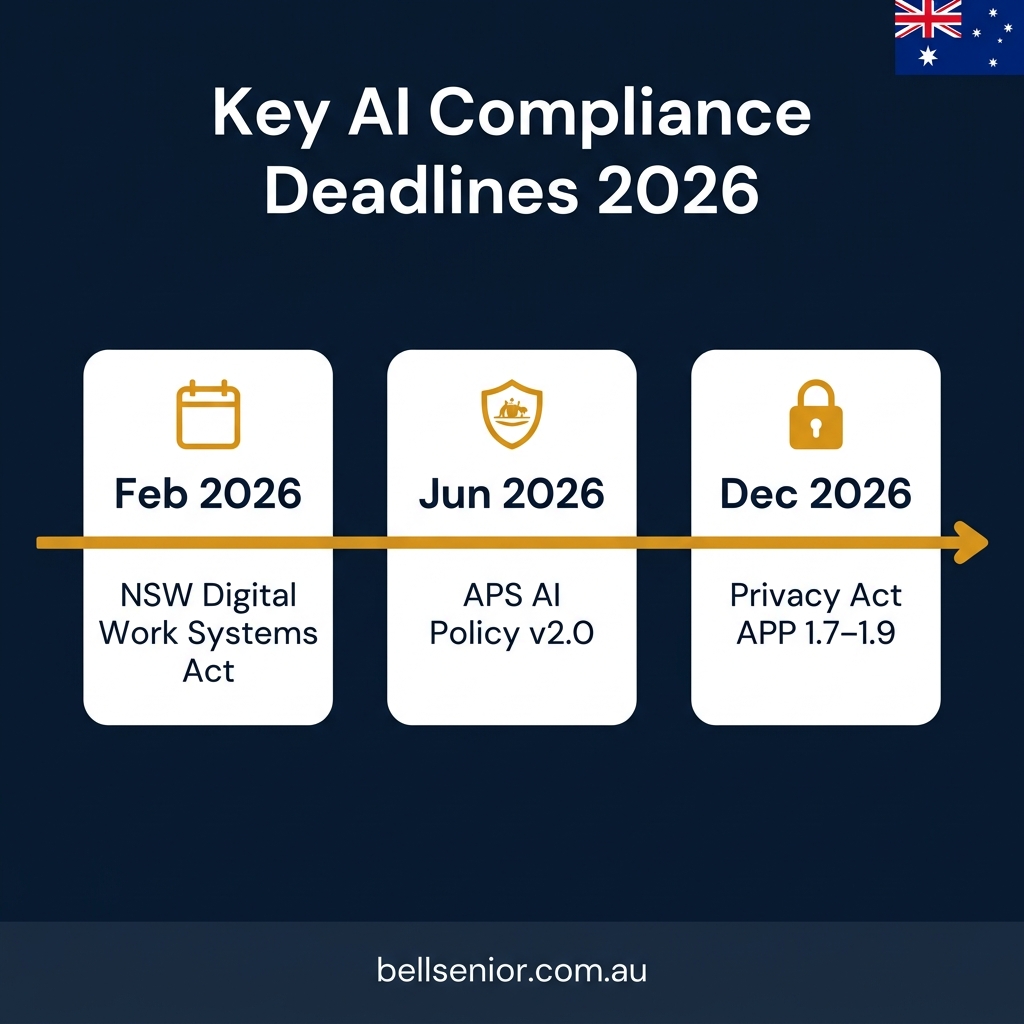
Key 2026 AI legal compliance dates for Australian businesses. The December 2026 Privacy Act amendments are the most broadly applicable deadline for Queensland businesses.
When to Get Legal Advice on AI Deployment
You should seek advice before:
- Rolling out AI tools that will access significant volumes of client or employee personal information.
- Deploying AI agents in customer-facing roles where they will give information about rights, refunds or eligibility.
- Relying on AI to make or heavily influence hiring, credit, insurance or eligibility decisions.
- Publishing large volumes of AI-generated marketing, technical or legal content under your brand.
- Operating or managing staff in NSW using algorithmic monitoring or management systems.
Bell Senior Lawyers advises Gold Coast and South East Queensland businesses on technology law, privacy, cyber risk and AI governance, including cross-border issues for operations and customers in the US and UK.
Need AI Governance or Compliance Advice?
Get AI risk advice from Queensland technology lawyers. Call 07 5532 8777 or make an enquiry online .
Related Topics
- Is Your Business Data Breach Ready? The NDB Scheme Checklist for Queensland Businesses
- Why Your Cyber Insurance Claim Could Be Denied in Queensland
- Navigating Tech Startups
- Commercial Lease Essentials
- Technology Law Practice Area
Need Legal Advice?
Contact us today to discuss your matter. We'll respond within 24 hours.
Enquiry Sent
Thank you for reaching out. A member of our legal team will contact you shortly.
-
National AI Centre, AI and Australian Law (Web Page, Department of Industry, Science and Resources) https://www.ai.gov.au/staying-safe-and-responsible/ai-and-australian-law . ↩︎ ↩︎
-
Office of the Australian Information Commissioner, Guidance on Privacy and the Use of Commercially Available AI Products (Guidance, 14 October 2024) https://www.oaic.gov.au/privacy/privacy-guidance-for-organisations-and-government-agencies/guidance-on-privacy-and-the-use-of-commercially-available-ai-products . ↩︎ ↩︎ ↩︎ ↩︎ ↩︎
-
SafeAI-Aus, Current Legal Landscape for AI in Australia (Web Page) https://safeaiaus.org/safety-standards/ai-australian-legislation/ (independent commentary, not a government or regulatory source; cross-check against the National AI Plan and OAIC). ↩︎ ↩︎ ↩︎ ↩︎
-
Office of the Australian Information Commissioner, ‘GenAI Tools in the Workplace: Balancing Protection of Personal Information and Business Efficiencies’ (Blog Post, 2 December 2025) https://www.oaic.gov.au/news/blog/GenAI-tools-in-the-workplace-balancing-protection-of-personal-information-and-business-efficiencies . ↩︎
-
Reed Smith, ‘Australia in Focus: Data Protection and AI in Australia’ (Blog Post, 24 February 2026) https://www.reedsmith.com/our-insights/blogs/viewpoints/102mk8i/australia-in-focus-data-protection-and-ai-in-australia/ . ↩︎
-
Ashurst, Navigating the Legal Landscape: AI in Australia (Report, 2025) https://www.ashurst.com/-/media/Ashurst/Documents/Campaigns/Ashurst-Navigating-the-legal-landscape---AI-in-Australia.pdf . ↩︎ ↩︎ ↩︎
-
AI Avenue, ‘AI Compliance Deadline Australia 2026’ (Article, 5 February 2026) https://aiavenue.com.au/insights/ai-compliance-australia-2026 . ↩︎ ↩︎ ↩︎
-
Federal Trade Commission (US), discussed in Office of the Australian Information Commissioner, ‘GenAI Tools in the Workplace’ (Blog Post, 2 December 2025) https://www.oaic.gov.au/news/blog/GenAI-tools-in-the-workplace-balancing-protection-of-personal-information-and-business-efficiencies ; see also Alston & Bird, ‘Midyear Review of U.S. AI Regulation, Enforcement & Policy Trends’ (Article, 17 June 2026) https://www.alston.com/en/insights/publications/2026/06/us-ai-regulation-enforcement-policy-trends . ↩︎ ↩︎ ↩︎ ↩︎ ↩︎ ↩︎ ↩︎
-
Stevens & Bolton, ‘AI Regulation: A Comparative Overview of the UK, EU and US’ (Article, 1 June 2025) https://www.stevens-bolton.com/insights/102kd49/ai-regulation-a-comparative-overview-of-the-uk-eu-and-us/ . ↩︎ ↩︎ ↩︎ ↩︎ ↩︎ ↩︎
-
Information Commissioner’s Office (UK), Guidance on AI and Data Protection (Guidance, 21 September 2025) https://ico.org.uk/for-organisations/uk-gdpr-guidance-and-resources/artificial-intelligence/guidance-on-ai-and-data-protection/ . ↩︎ ↩︎ ↩︎ ↩︎ ↩︎ ↩︎
-
Glacis, Mapping Glacis to UK AI Regulation (Web Page, 31 December 2025) https://www.glacis.io/guide-uk-ai-regulation . ↩︎
-
Treasury (Cth), Review of AI and the Australian Consumer Law (Report, October 2025) https://treasury.gov.au/sites/default/files/2025-10/p2025-702329-fr.pdf . ↩︎ ↩︎
-
Competition and Markets Authority (UK), Complying with Consumer Law When Using AI Agents (Guidance, 8 March 2026) https://www.gov.uk/government/publications/complying-with-consumer-law-when-using-ai-agents . ↩︎ ↩︎ ↩︎
-
PwC Australia, Real Laws for Artificial Intelligence (Report) https://www.pwc.com.au/services/artificial-intelligence/regulating-ai-article.pdf . ↩︎ ↩︎
-
SafeAI-Aus, International AI Legal Landscape (Web Page, 31 March 2026) https://safeaiaus.org/safety-standards/international-ai-legal-overview/ (independent commentary; cross-check against primary UK/AU sources). ↩︎
-
Digital Work Systems (Artificial Intelligence) Amendment Act 2025 (NSW), discussed in David & Goliath, ‘AI Governance Australia 2026’ (Article, 24 May 2026) https://davidandgoliath.ai/resources/ai-governance-australia-2026 . ↩︎ ↩︎ ↩︎
-
Glacis, Mapping Glacis to UK AI Regulation (Web Page, 31 December 2025) https://www.glacis.io/guide-uk-ai-regulation . ↩︎ ↩︎ ↩︎ ↩︎
-
Bell Senior Lawyers, ‘Is Your Business Data Breach Ready? The NDB Scheme Checklist for Queensland Businesses’ (Blog Post, 25 March 2026) https://bellsenior.com.au/blog/data-breach-ndb-checklist-queensland-business/ . ↩︎ ↩︎ ↩︎
-
Raedan Institute, ‘UK AI Regulation in 2026: Where We Stand and What It Means for Businesses’ (Article, 11 May 2026) https://raedan-institute.co.uk/uk-ai-regulation-2026-policy-businesses-citizens/ . ↩︎ ↩︎
-
Bell Senior Lawyers, ‘Why Your Cyber Insurance Claim Could Be Denied in Queensland’ (Blog Post, 8 January 2026) https://bellsenior.com.au/blog/cyber-insurance-denied-qld/ . ↩︎
-
Inspirepreneur Magazine, ‘AI Regulation in Australia 2026’ (Article, 31 March 2026) https://inspirepreneurmagazine.com/technology/ai-regulation-australia-2026/ . ↩︎ ↩︎
-
David & Goliath, ‘AI Governance Australia 2026’ (Article, 24 May 2026) https://davidandgoliath.ai/resources/ai-governance-australia-2026 . ↩︎
-
Presenc AI, AI Policy and Regulation Tracker 2026 (Web Page, 21 May 2026) https://presenc.ai/research/ai-policy-regulation-tracker-2026 . ↩︎