
Retail Leasing Pitfalls for Queensland Small Businesses: What to Check Before You Sign

Need legal help with this topic?
Get a confidential assessment of your matter today.
Signing a retail shop lease is one of the highest-stakes commitments a small business owner makes. The Retail Shop Leases Act 1994 (Qld) provides important protections, but only if the lease qualifies and only if you understand your rights before signing. This guide covers how to identify your lease type, the most costly pitfalls in Queensland retail leasing, the breach notice process, and how disputes are resolved across QCAT and the courts.

For most Queensland small business owners, signing a retail shop lease is one of the most significant financial commitments they will ever make. A five-year lease on a Gold Coast retail tenancy, even at a modest rent, represents a total commitment of hundreds of thousands of dollars. Fitout costs, make good obligations, rent reviews, outgoings, personal guarantees, and potential breach scenarios extend that exposure further still. Yet the majority of small business tenants sign retail leases without obtaining independent legal advice, without properly reviewing the Disclosure Statement, and without negotiating terms that could protect them significantly over the life of the tenancy.
The Retail Shop Leases Act 1994 (Qld) (“the Act”) exists precisely to correct the power imbalance between institutional landlords and small business tenants. It imposes disclosure obligations, cooling-off rights, dispute resolution access through QCAT, and a range of prohibited practices. However, these protections operate within a carefully defined scope. They apply only to leases that qualify as retail shop leases. They do not apply to commercial office leases, industrial leases, or warehouse leases. Plus, two size-based exclusions mean that premises above a prescribed rent threshold or above 1,000 square metres of floor area fall entirely outside the Act’s protection regardless of the business conducted there.
This guide starts where every retail leasing engagement should start: identifying which type of lease applies to your premises. It then works through the Act’s most important protections, the most costly pitfalls Queensland tenants encounter, the breach notice process under the Property Law Act 2023 (Qld) that governs all lease terminations, and the dispute resolution landscape across QCAT and the courts. Throughout, it identifies the specific moments at which you must speak to a lawyer or an accountant before proceeding.
In This Guide
Step One: What Kind of Lease Is It?
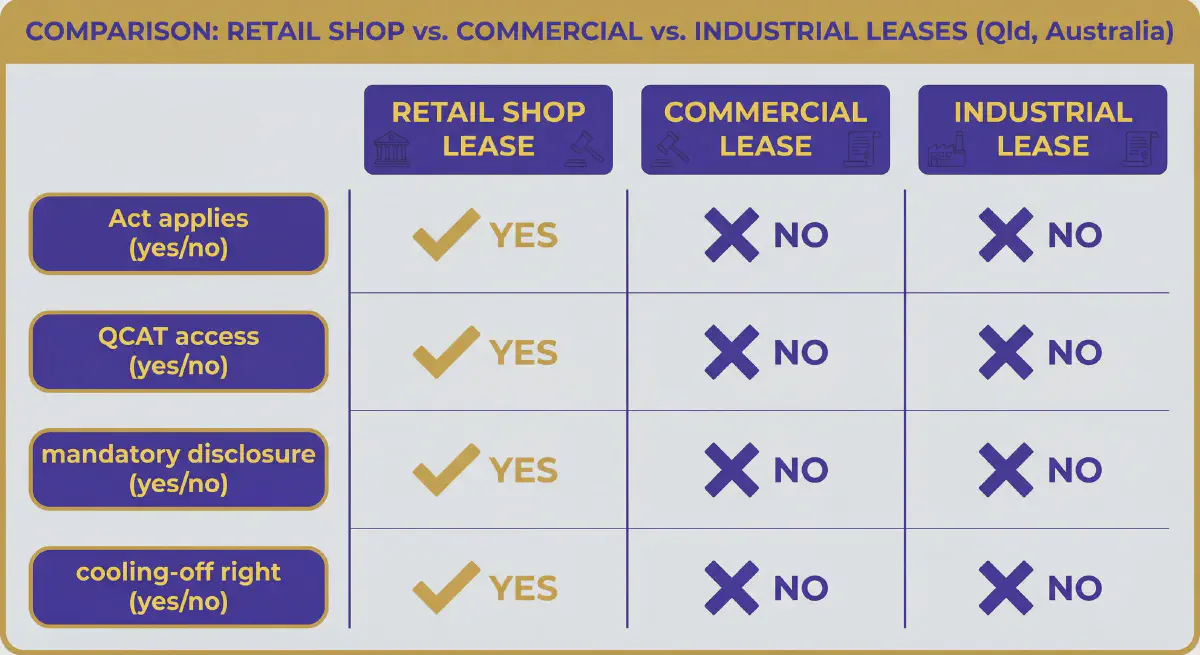
Before any of the Act’s protections are relevant, the first question is whether your proposed lease is a retail shop lease at all. Queensland business tenancies fall into three broad categories, each governed by a different legal framework, and the protections available to a tenant differ dramatically between them.
Retail Shop Leases
A retail shop lease is a lease of premises that are used wholly or predominantly for the carrying on of a retail business.1 A retail business is broadly defined: it encompasses any business that sells goods or services directly to the public, including food and hospitality, clothing and footwear, health and beauty services, pharmacies, newsagencies, gyms, florists, and a wide range of other consumer-facing businesses.
The Act applies to retail shop leases subject to two exclusions discussed below. Where the Act applies, the tenant receives the full suite of statutory protections: mandatory disclosure, cooling-off rights, QCAT dispute resolution, prohibited practices, and regulated assignment and make good processes.
Commercial Leases
A commercial lease is a non-residential lease of premises used for purposes that are not retail, most commonly office space, professional services premises, and mixed commercial tenancies. Commercial leases are governed by the terms of the lease document itself and the general framework of the Property Law Act 2023 (Qld) and common law. The Act does not apply, and the tenant has none of the statutory protections it provides.
The distinction between retail and commercial is not always obvious. A law firm, accounting practice, or financial planning business could be either, depending on where the premises are located.2 The same professional services business conducted from a commercial office building with no retail activity is likely a commercial lease. The same business conducted from premises within a retail shopping centre, where members of the public walk in off the shopping centre floor, is likely a retail shop lease. Location matters as much as the nature of the business.
Industrial and Warehouse Leases
Industrial leases cover factories, warehouses, storage facilities, manufacturing premises, and distribution centres. These are the furthest removed from the Act’s protections. An industrial tenant has no statutory cooling-off right, no mandatory disclosure obligation imposed on the landlord, and no access to QCAT for dispute resolution. All disputes go to the courts. The lease document governs almost everything, making proper legal review before signing even more critical than for retail tenancies where the Act provides a safety net.
The Two Size Exclusions
Even where a business is genuinely retail in character, two exclusions may take the lease outside the Act.
The rent threshold: The Act does not apply to leases where the annual rent exceeds the prescribed threshold, currently set at $1 million per annum.3 This exclusion targets large high-end premises where the negotiating position between the parties is more balanced. The great majority of Gold Coast small business retail leases fall well below this threshold.
The 1,000 square metre floor area limit: Under section 5A of the Act, if the total floor area of the leased premises exceeds 1,000 square metres, the lease is excluded from the Act regardless of the business conducted there.4 This exclusion was the subject of two significant 2025 QCAT decisions. In Farmers Arms Tavern Pty Ltd v Barns [2025] QCAT 134, a tenant brought a dispute to QCAT alleging the landlord had breached the lease. The application was struck out because the total leased area exceeded 1,000 square metres, making the lease ineligible under section 5A. The same outcome was reached in Suttons Beach Pavilion Pty Ltd v Moreton Bay City Council [2025] QCAT 135, where QCAT found it had no jurisdiction for the same reason.5
These decisions confirm that the 1,000 square metre limit applies to the total leased area, not just the retail trading floor. A tenant with 900 square metres of retail floor and 200 square metres of attached storage, loading dock, or amenities is likely to be excluded from the Act altogether. If your premises approach or exceed this threshold, obtain specific legal advice about whether the Act applies before relying on any of its protections.
Retail Shop Leases: The Act’s Key Protections
The Disclosure Statement
The Disclosure Statement is the cornerstone of the Act’s pre-signing protection regime. Before a retail shop lease is entered into, the lessor must provide the prospective tenant with a Disclosure Statement in the prescribed form under section 21 of the Act.6
The 7-day rule: The Disclosure Statement must be provided at least 7 days before the lease is entered into (that is, before it is executed by both parties). This 7-day window is the tenant’s primary opportunity to read the document, compare it against the draft lease, obtain legal advice, negotiate changes, and ask questions before committing.
What the Disclosure Statement must cover:
The prescribed form requires the lessor to disclose accurately and completely the following information about the proposed tenancy:
- The base rent, any incentive amounts (rent-free periods, lessor fitout contributions), and the rent commencement date
- The exact method for each rent review throughout the term and any option periods
- The permitted use of the premises
- A detailed estimate of all outgoings the tenant will be required to pay or contribute to, and the basis of calculation
- Any fitout works required by the lessor and who bears the cost
- The make good obligations at end of lease
- Any demolition or relocation clause (which must be prominently disclosed as a separate item)
- Required trading hours, for shopping centre tenants
- Details of any personal guarantee or security deposit required
The cooling-off right: If the lessor fails to provide a compliant Disclosure Statement at least 7 days before execution, or if the Disclosure Statement contains materially false or misleading information, the tenant has a right under section 22 of the Act to terminate the lease within 7 days of execution.7 The tenant is entitled to a refund of any money paid under the lease in these circumstances.
The cooling-off right is lost if the tenant has already taken possession of the premises. This makes timing critical: do not accept keys or commence fitout works before the cooling-off period has expired if you have any concerns about the adequacy of the Disclosure Statement.
Comparing the Disclosure Statement to the lease: One of the most consistent mistakes made by unrepresented tenants is reading the Disclosure Statement but not cross-referencing it against the actual lease. The lease is the legally operative document. If the lease says something different from the Disclosure Statement, the lease will generally govern the parties’ rights, and the inconsistency may not be apparent until a dispute arises. Key inconsistencies to identify include:
- Does the rent review mechanism in the lease match what the Disclosure Statement describes?
- Does the outgoings schedule in the lease match the Disclosure Statement estimate?
- Does the permitted use clause in the lease match the permitted use in the Disclosure Statement?
- Is there a ratchet clause on a market rent review that is mentioned in the lease but not prominently disclosed in the Disclosure Statement?
- Is there a demolition or relocation clause in the lease that is not separately and prominently disclosed?
Rent Review Mechanisms: The Longest-Running Source of Leasing Disputes
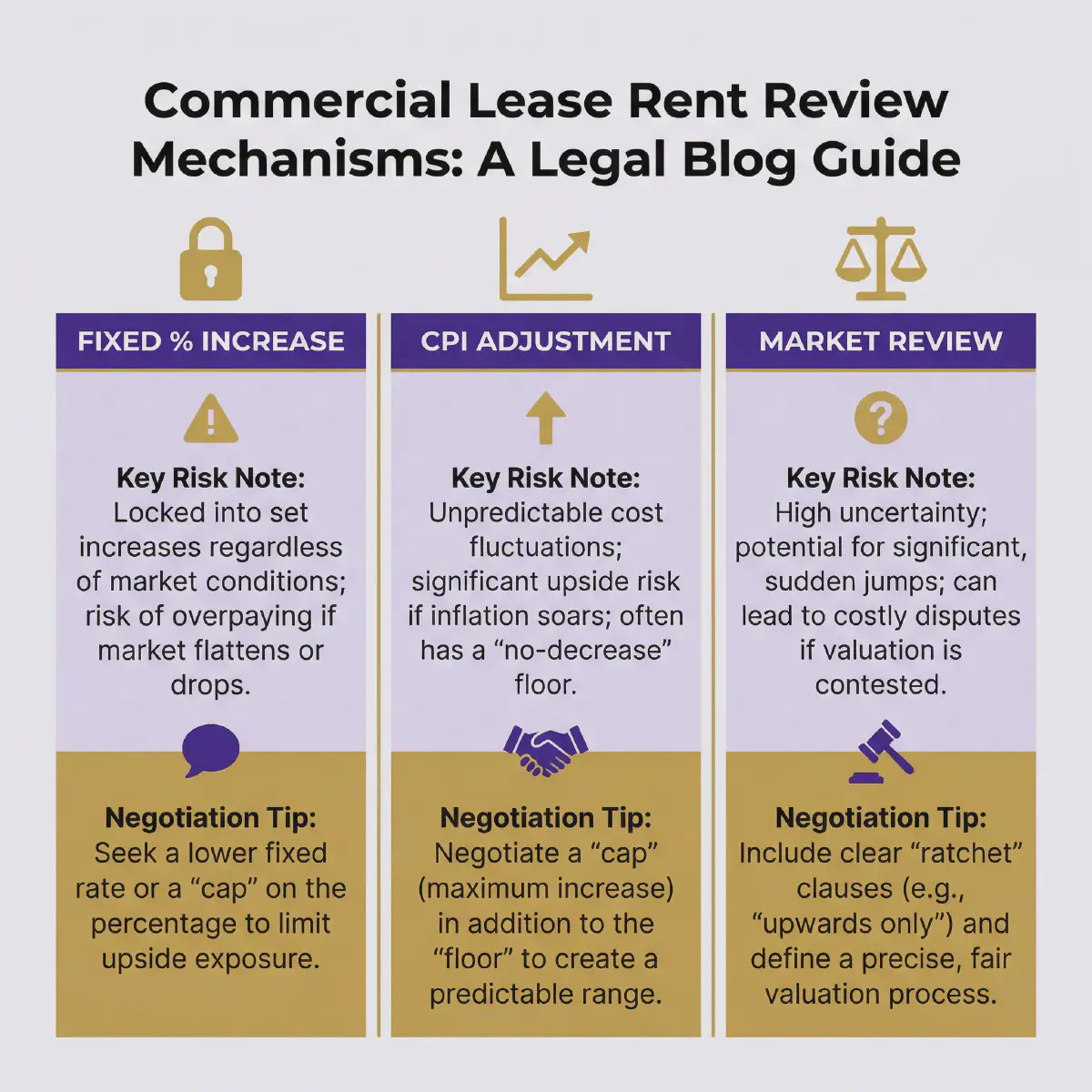
Rent reviews are the provisions in the lease that determine how your rent changes over time. Getting this wrong in a 5-year or 10-year lease can make the difference between a profitable and an unprofitable tenancy. There are three principal mechanisms used in Queensland retail leases, each with different risk profiles.
Fixed Percentage Reviews
A fixed percentage review increases the rent by a set percentage at each review date, commonly annually. Typical rates are 3 per cent, 4 per cent, or CPI plus a fixed margin.
The compounding trap: Fixed percentage reviews compound over time. A 4 per cent annual review on a 5-year lease increases base rent by approximately 22 per cent by the end of the term. On a 10-year lease (including a 5-year option at the same review rate), the compounding effect produces rent increases that may bear no relationship to actual market conditions or to the performance of the business. In periods of weak retail trading, a lease with aggressive fixed reviews can strand a tenant in premises they cannot afford to occupy but cannot afford to vacate.
Negotiation approach: Where a fixed review is proposed, negotiate for an annual cap at CPI so the tenant benefits if CPI is lower than the fixed rate. Also negotiate for a market review at the commencement of any option period so rent is reset to actual market value, not to a compounded figure that may significantly exceed market.
CPI Reviews
A CPI review increases the rent in line with the Consumer Price Index, tracking general price inflation. CPI reviews are generally the most tenant-friendly mechanism because they reflect economic reality rather than an arbitrarily fixed escalation rate.
The high-inflation period trap: Tenants who agreed to CPI reviews on the assumption that CPI would remain at 2 to 3 per cent found themselves with significantly higher-than-expected rent increases during the 2022 to 2024 period when CPI exceeded 7 per cent in some quarters. Never assume CPI will remain at historical averages. Model the full-term rent exposure across a range of CPI scenarios including stressed high-inflation environments before agreeing to a CPI review mechanism.
Market Rent Reviews
A market rent review requires an independent valuer to assess the current market rent for the premises, and the lease rent is adjusted to the valuer’s determination at the review date.
The ratchet clause trap: Many Queensland retail leases contain a ratchet clause, a provision that rent on a market review cannot fall below the rent payable immediately before the review date.8 A ratchet clause makes the review entirely asymmetric. If the market has gone up, rent goes up. If the market has gone down, rent stays the same. The practical result is that a market review with a ratchet clause is not a genuine market review at all. It is a floor with an uncapped ceiling.
The Act does not prohibit ratchet clauses but requires them to be disclosed. Seek removal of ratchet clauses during negotiation. A market review should be capable of moving in both directions.
What QCAT can and cannot determine about market reviews: This is a point that surprises many tenants. QCAT cannot determine the actual dollar amount of rent on a market review dispute.9 QCAT can only determine whether the valuation process has been conducted in compliance with the Act’s procedural requirements. The valuer determines the actual rent figure. If the valuer has not followed the prescribed procedure, QCAT can set aside the review and order a fresh determination, but the dollar outcome remains the valuer’s decision, not QCAT’s. For disputes about the dollar amount of rent determined on a market review, the parties’ recourse is to the valuer appointment process in the lease and, if procedural compliance is in question, to QCAT.
Turnover Rent
Turnover rent links rent (or a component of rent) to the tenant’s gross turnover, commonly calculated as a percentage of gross turnover with a minimum base rent. Turnover rent is most common in larger shopping centre leases and aligns the lessor’s return with the tenant’s trading performance.
The reporting and audit trap: Turnover rent leases impose detailed reporting obligations: monthly or quarterly statutory declarations of gross turnover, annual audited accounts, and broad audit rights in favour of the lessor. Failure to report correctly, or to comply with audit requirements, constitutes a lease breach. Disputes about how gross turnover is calculated (what is included and excluded) are common and can be expensive.
Outgoings: The Cost That Surprises Most Tenants
Outgoings are the costs of occupying and operating the building that the lease passes on to the tenant in addition to base rent. In a large shopping centre, outgoings can represent 30 to 50 per cent of total occupancy cost, a figure that substantially changes the economics of a retail tenancy compared to the base rent alone.
What Outgoings Can Include
Common outgoings categories in Queensland retail leases include:
- Council rates and water and sewerage charges, typically apportioned across tenants on a pro-rata floor area basis
- Building and public liability insurance, the lessor’s insurance premium for the building and common areas
- Land tax in some circumstances (see below)
- Body corporate or strata levies where the premises are in a strata-titled building or complex
- Common area maintenance (“CAM”) costs including cleaning, maintenance, and repair of shared areas, car parks, and public spaces
- Centre management fees, including the salary costs of centre management staff (which can be substantial in large regional centres)
- A promotion and advertising levy requiring a contribution to the shopping centre’s marketing activities (commonly 1 to 2 per cent of annual turnover or a fixed annual amount)
- Energy costs for common area lighting, air conditioning, and utilities
What the Act Prohibits on Outgoings
The Act provides that a lessor cannot recover outgoings that are not disclosed in the Disclosure Statement or in the lease.10 This is an important protection. However, it only protects against the recovery of undisclosed categories of outgoing. If a category was disclosed but the estimate in the Disclosure Statement was lower than the actual amount, the tenant is generally still liable for the actual amount, not just the estimate. This is why comparing the Disclosure Statement estimates to recent actual outgoings figures for the centre or building is essential before signing.
Capital expenditure: Outgoings cannot lawfully include capital expenditure. The cost of replacing or upgrading the building structure, roof, lifts, or major mechanical plant and equipment is a capital cost that falls on the landlord as building owner, not on tenants. Check the outgoings definition in the draft lease carefully and seek to exclude all capital expenditure items.
Land tax: The inclusion of land tax as an outgoing is a significant exposure for retail tenants and is one of the areas most frequently challenged. The Act imposes restrictions on how land tax can be calculated and passed through to retail tenants. If the draft lease includes land tax as an outgoing, seek specific advice about whether the method of calculation proposed complies with the Act’s requirements.
Centre management fees: In shopping centre leases, centre management fees are often expressed as a percentage of the centre’s gross rentable area. Negotiate a cap expressed as a dollar amount per square metre per annum to limit the exposure as the centre’s management structure evolves over the lease term.
Make Good Obligations: The Liability You Will Not Encounter Until the End
The make good clause requires the tenant, at the end of the lease including at the end of any option term, to restore the premises to a specified condition. Make good is consistently one of the most underestimated liabilities in retail leasing and one of the most bitterly contested obligations at lease end. It receives little attention during lease negotiation because it seems distant and abstract, but it becomes concrete and expensive on the last day of the tenancy.
What Make Good Typically Requires
In a standard retail fitout lease, make good obligations commonly require the tenant to:
- Remove all fixtures, fittings, and shopfronts installed during the tenancy, including custom-built counters, shelving, point-of-sale equipment, and refrigeration units
- Remove all partitions and internal walls added during the tenancy
- Repair all damage caused by the installation and removal of the fitout, including filling fixing holes, patching surfaces, and repairing ceilings
- Repaint all internal surfaces in a neutral colour
- Replace floor coverings where damaged or worn beyond fair wear and tear
- Return the premises to “shell condition” in the most onerous formulations, stripping back to the original landlord-delivered state
For a typical Gold Coast food tenancy with a commercial kitchen, custom counter, refrigeration equipment, and shopfront, strict compliance with a make good clause can cost $40,000 to $150,000 or more depending on the fitout complexity and the scope of the obligation.11 For a larger tenancy with an extensive fitout, the cost can exceed this significantly.
Make Good Is a Liability You Cannot See Until It’s Too Late Most small business owners don’t realise how exposed they are until the lease ends and the landlord hands them a make good schedule. Negotiating the make good clause before signing is the only time you have real leverage.
Contact our commercial lawyers before you sign to review the make good clause and negotiate appropriate limitations. Call (07) 5532 8777.
Negotiating Make Good Before You Sign
Make good is far more effectively negotiated before signing than at lease end, when the tenant is under time pressure and the dispute costs are already accumulating. Key negotiation positions:
Condition report at commencement: Insist on a condition report signed by both parties and supported by photographs at the start of the lease. This documents the exact state of the premises on day one and prevents the lessor from claiming at lease end that damage pre-dating the tenancy must be remedied by the outgoing tenant.
Fitout remains election: Negotiate a clause permitting the lessor to elect, at a defined point before lease expiry (typically three to six months out), whether to require removal of the fitout or to accept it as a gift to the premises at no cost to the tenant. Many lessors prefer to receive a quality fitout rather than bear the cost of re-fitting a bare shell for the next tenant. If the lessor elects to retain the fitout, the tenant’s make good obligation is substantially reduced.
Fair wear and tear: Confirm expressly in the lease that the make good obligation is limited to damage beyond fair wear and tear. Normal deterioration from ordinary use should not be the tenant’s liability. This limitation should be stated as an express exclusion, not merely implied.
Cash make good payment: Some transactions are better resolved by agreeing in advance that in lieu of physical make good works, the tenant will pay a fixed and agreed sum to the lessor at end of lease. This provides certainty for both parties and avoids the time pressure and cost disputes that arise from make good works conducted in the final days of a tenancy.
Capital cost exclusion: The make good obligation should not require the tenant to upgrade the premises to a standard better than the premises were in at the start of the lease, and should not require the tenant to address defects or deterioration attributable to the lessor’s failure to maintain the building structure and services.
When to speak to your lawyer: Make good must be addressed specifically during lease negotiation before signing. It is not adequate to rely on general protective language in the Act. Once you have signed a lease with a broad make good clause, your options at lease end are compliance, negotiation with the lessor, or a QCAT dispute about the scope of the obligation. None of these is as effective as having negotiated appropriate limitations before execution.
When to speak to your accountant: Ask your accountant to include a make good provision in your business’s accounts from the start of the lease, accruing the estimated cost of make good over the lease term. A business that reaches lease end without having set aside funds for make good faces a large unbudgeted liability at the worst possible time.
Personal Guarantees: What You Are Actually Signing
Most institutional landlords require the directors or principals of a corporate tenant to provide a personal guarantee of the tenant’s obligations under the lease. A personal guarantee for a retail lease makes the guarantor personally liable for all rent obligations, all outgoings and other charges, all make good costs, and damages for any breach including early vacation of the premises.
If the tenant company fails and the lease is surrendered midway through a five-year term, the guarantor can be pursued personally for the remaining rent for the full unexpired term, plus outgoings, plus make good costs. The lessor is not required to exhaust its remedies against the company before pursuing the guarantor. A five-year lease with three years unexpired at $80,000 per annum base rent, plus outgoings of $30,000 per annum, plus make good of $50,000, represents a personal guarantee exposure exceeding $300,000 in that scenario.
A Personal Guarantee on a Retail Lease Can Expose Your Home An unlimited personal guarantee for a 5-year retail lease means your personal assets — including your family home — are on the line if the business fails. Many business owners don’t understand the scope of what they are signing until it’s too late.
Contact our commercial lawyers before signing any guarantee to understand your exposure and negotiate appropriate limitations. Call (07) 5532 8777.
Negotiating Guarantee Limitations
Duration cap: Negotiate to limit the personal guarantee to the initial lease term only, not to any option periods. If you exercise an option to renew, a fresh guarantee negotiation should occur at that point rather than the original guarantee extending automatically.
Amount cap: Some lessors will accept a guarantee capped at a fixed dollar amount, commonly six to twelve months of total occupancy cost (rent plus outgoings), rather than an open-ended guarantee for the full unexpired term.
Release conditions: Negotiate for automatic or elective release of the guarantee after a defined period of satisfactory trading: for example, after 24 months of on-time rent payments the guarantee reduces to a capped amount, and after 36 months it is released entirely.
Bank guarantee as an alternative: Where a lessor requires a personal guarantee primarily as security for the tenant’s performance, a bank guarantee from a financial institution for a fixed amount may be an acceptable alternative. This limits the guarantor’s personal exposure to the guaranteed amount and provides the lessor with liquid security.
Release on assignment: Confirm specifically whether the personal guarantee is released on a valid assignment of the lease to a qualified assignee. The Act provides some protection here (see the assignment section below), but the lease document may contain provisions that modify or override the Act’s default position.
When to speak to your lawyer: A personal guarantee for a lease is a significant personal financial commitment that should never be signed without legal advice. The guarantee document (which is separate from the lease) will contain its own terms that affect the scope of the obligation, the circumstances in which the guarantee can be called upon, and the rights of a guarantor who is called upon to pay. Review both the guarantee and the lease with a solicitor before signing either.
When to speak to your accountant: Disclose the personal guarantee obligation to your accountant so it can be reflected in your personal financial position. If the guarantee is unlimited, it is a contingent liability of potentially very large size that should be considered in your personal financial planning and in any application for personal credit.
Demolition and Relocation Clauses
Demolition Clauses
A demolition clause gives the lessor the right to terminate the lease before the end of the term by giving a specified notice period, where the lessor proposes to demolish, substantially refurbish, or redevelop the building or a substantial portion of it.
The Act requires demolition clauses to be prominently and separately disclosed in the Disclosure Statement.12 A demolition clause that is buried in the general conditions of the lease and not separately disclosed in the Disclosure Statement may not be enforceable, or may give rise to a right in the tenant to seek compensation or to terminate the lease for the disclosure failure.
Where a demolition clause is validly exercised, the tenant is entitled to compensation from the lessor for losses caused by the early termination. Compensation may include fitout costs (on a depreciated basis), relocation costs, wasted lease establishment costs, and losses from goodwill disruption. The amount is negotiable or, if not agreed, determinable by QCAT. However, recovery is uncertain and contested, and in many cases will not fully cover the tenant’s actual loss, particularly where significant fitout investment is involved.
For tenants considering a substantial fitout: if the lease contains a demolition clause and the building is old, located in a development zone, or owned by a major property developer, the risk of the clause being exercised before the lease term expires is real. Carry out due diligence on the building and its development potential before committing to a fitout investment.
Relocation Clauses
A relocation clause gives the lessor the right to move the tenant to alternative premises within the same centre, typically with a specified notice period. In large shopping centres, relocation clauses allow the centre to reconfigure its tenancy mix without being bound by existing lease positions.
The Act regulates relocation by requiring the lessor to offer the tenant comparable alternative premises and to bear all reasonable costs of the relocation.13 However, the definition of “comparable” is frequently contested. A relocated tenant may face materially different foot traffic, visibility, and trading conditions. The loss of customer familiarity with a specific location within a centre can be significant for businesses that depend on regular customers finding them by memory.
Negotiate to exclude or limit relocation clauses during pre-signing negotiation, particularly where your business model depends on a specific position within a centre.
Lease Assignment: Selling Your Business
When you sell your business, you will in almost all cases need to transfer (assign) the retail lease to the purchaser. The Act provides the framework for this process, and misunderstanding it can cause business sale transactions to collapse.
The Lessor Cannot Unreasonably Withhold Consent
Under the Act, the lessor cannot unreasonably withhold consent to an assignment of a retail shop lease.14 Reasonable conditions the lessor may impose include:
- Requiring the proposed assignee to demonstrate sufficient financial capacity to meet the lease obligations
- Requiring the proposed assignee to demonstrate relevant retail experience or industry knowledge
- Requiring the assignee to execute a deed of covenant acknowledging and agreeing to be bound by the lease terms
- Requiring reasonable legal and administrative costs of the consent to be met by the outgoing tenant
What constitutes an unreasonable ground for withholding consent includes refusal based on the nature of the business being sold rather than the assignee’s capacity, refusal on pretextual grounds, or imposition of conditions that go beyond protecting the lessor’s legitimate interests and are designed to frustrate the assignment.
Release of the Outgoing Tenant
The Act provides that where the lessor consents to an assignment and the assignee has been approved on the basis of the assignee’s own financial capacity and business experience, the lessor cannot require the original tenant to remain as guarantor for the assignee’s obligations.15
This is an important protection for business sellers who would otherwise face continuing guarantee exposure after completing a sale. However, the protection is not automatic: it depends on the basis on which the assignee’s consent was granted. If the assignee was approved partly because the original tenant remained as guarantor, the protection may not apply. Obtain legal advice before executing any deed of assignment and confirm specifically whether the guarantee is being released.
Assignment Timeline and Business Sale Contracts
The assignment process typically takes 4 to 8 weeks from the lodgement of the consent application to execution of the deed of assignment. This timeline must be factored into the business sale contract. A sale contract with a 30-day settlement period that is conditional on lease assignment consent will almost certainly fail to settle on time.
Prohibited Practices Under the Act
The Act prohibits practices by lessors that would undermine the tenant protections the legislation provides. Key prohibited practices include:
Key money: The lessor cannot require the payment of key money, a premium, or a gift as a condition of entering or renewing a retail shop lease.16 This does not prevent a business purchaser from paying an outgoing tenant for the value of the business including the fitout and goodwill, but it does prohibit the lessor from extracting a payment for the grant or renewal of the lease itself. If you are asked to pay anything described as key money, a grant premium, or a “fee for the lease” payable to the landlord (as distinct from payment to the outgoing business operator for the fitout and business assets), obtain legal advice immediately.
Unilateral variation: The lessor cannot unilaterally vary the terms of the lease during the term except in accordance with the lease’s review and adjustment mechanisms.
Recovery of undisclosed outgoings: The lessor cannot recover from the tenant outgoings that were not disclosed in the Disclosure Statement or in the lease.
Interference with the tenant’s business: The lessor cannot take steps designed to interfere with the conduct of the tenant’s business as leverage in a dispute. This prohibition has relevance in circumstances where a landlord and tenant are in dispute and the landlord takes action that disrupts the tenant’s trading, such as restricting access to common areas or interfering with signage, outside the processes provided in the lease and the Act.
Breach Notices, Forfeiture, and Termination: The Property Law Act Framework
When a tenant falls into breach of a lease, and when a landlord wishes to act on that breach by terminating the lease and recovering the premises, a specific statutory framework governs the process. This framework applies to all Queensland leases, not just retail shop leases. It applies equally to commercial leases, industrial leases, and retail shop leases.
Section 131 of the Property Law Act 2023 (Qld): The Formal Breach Notice Requirement
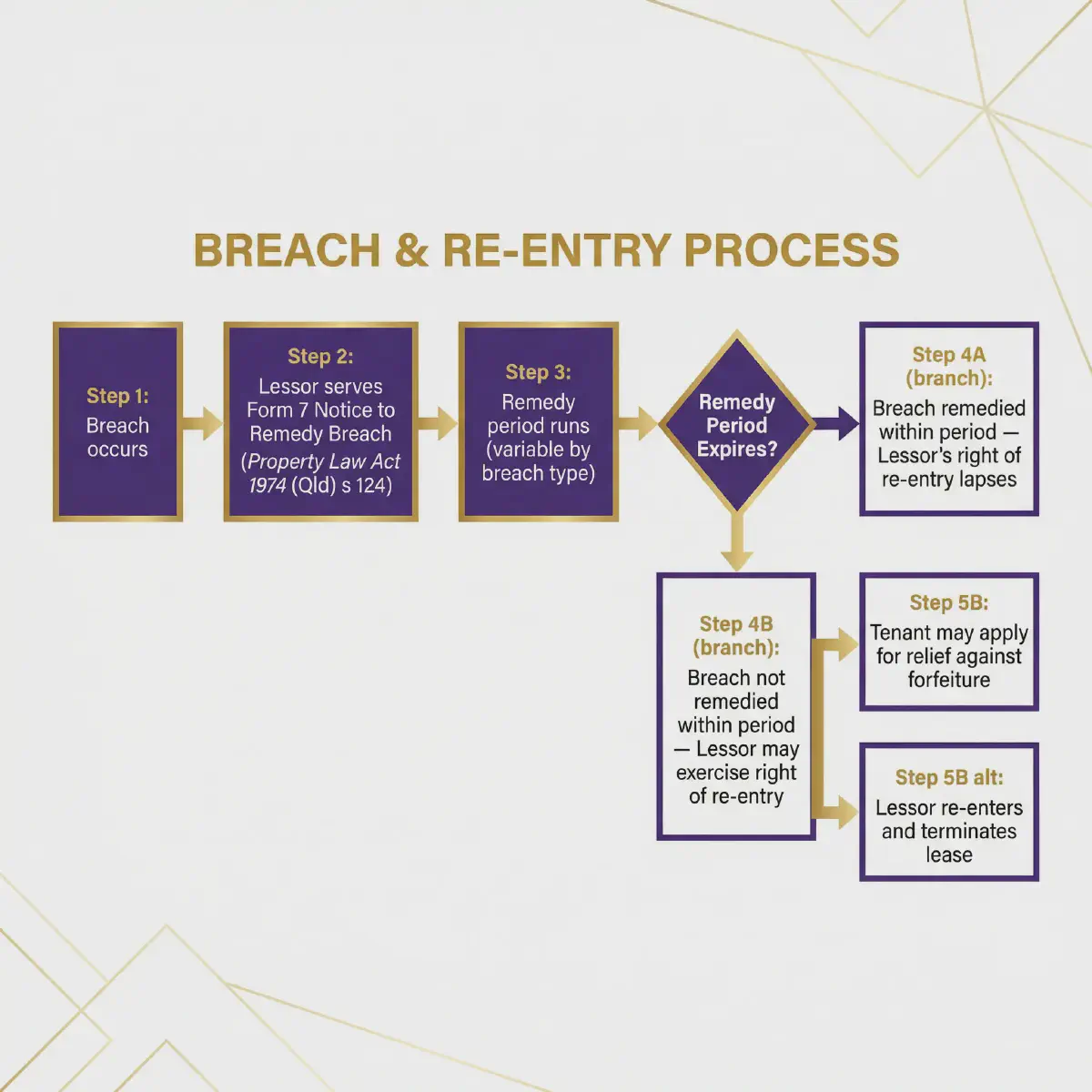
Under section 131 of the Property Law Act 2023 (Qld), a lessor’s right of re-entry or forfeiture for breach of a lease cannot be enforced unless the lessor has first served the tenant with a notice that complies strictly with the section’s requirements.17 This section replaced the long-standing section 124 of the 1974 Act.
The breach notice must:
- Be in the prescribed form (known as a Form 7 Notice to Remedy Breach of Covenant)
- Specify the breach clearly and accurately
- Where the breach is capable of remedy, require the tenant to remedy the breach
- Specify a reasonable time within which the breach must be remedied
- State that the lessor has a right to re-enter and terminate the lease if the breach is not remedied within the specified time
- Reference section 131 of the Property Law Act 2023 to bring the serious consequences of non-compliance to the tenant’s attention
The Form 7 Must Strictly Comply
Queensland courts have been strict about compliance with section 131 (and its predecessor section 124). A breach notice that omits required elements, uses equivocal language, or fails to specify the remedy required within the time given is invalid, and any subsequent re-entry or purported termination based on it is unlawful. In one reported Queensland decision, a breach notice was found defective because it stated that the tenant “may” be liable to forfeiture and termination rather than stating that the lessor “has a right to” re-enter and terminate. The conditional language was considered insufficient to bring the serious consequences home to the tenant.18
The consequences of a defective breach notice are significant for both parties. For a lessor who relies on a defective notice and physically re-enters the premises, the re-entry may itself constitute an unlawful breach entitling the tenant to damages and reinstatement. For a tenant who receives a breach notice, understanding whether the notice is formally valid is the first question to answer before deciding how to respond.
What Counts as a Reasonable Time to Remedy
The breach notice must give the tenant a reasonable time to remedy the breach. What is “reasonable” depends on the nature of the breach. A failure to pay rent may be remedied in a matter of days. A structural breach of an obligation to repair premises may require weeks or months. A conduct breach (such as a noise, licensing, or compliance issue) may require a longer period. There is no fixed statutory minimum and the courts assess reasonableness case by case.
Breaches That Are Not Capable of Remedy
Some breaches are not capable of remedy in any practical sense: for example, where the tenant has unlawfully sublet the premises, has carried on a prohibited use, or has committed a serious act that cannot be undone. Where a breach is not capable of remedy, the notice must still be served but need not specify a remedy period. The question of whether a specific breach is capable of remedy is a legal question and one that should be resolved with advice before a lessor takes any enforcement action.
Relief Against Forfeiture
Even where a breach has been established and a valid notice served, a tenant in Queensland has a right to apply to the court for relief against forfeiture. A court may grant relief where the breach has been remedied, where the tenant can demonstrate that the forfeiture would be grossly disproportionate to the lessor’s loss, or where the breach was inadvertent and has not caused material prejudice to the lessor. Relief against forfeiture is an equitable remedy and the court has broad discretion.
When to speak to your lawyer (as a tenant): If you receive a Form 7 Notice to Remedy Breach of Covenant, contact a solicitor immediately. The notice will specify a time period within which the breach must be remedied. Once that period expires without remedy, the lessor may be entitled to re-enter. You need to know whether the notice is formally valid, whether the alleged breach is correctly described, whether the time given is reasonable, and whether you have grounds to apply for relief against forfeiture if matters escalate.
When to speak to your lawyer (as a lessor): Before serving a breach notice, obtain legal advice to ensure the Form 7 strictly complies with section 124 and the prescribed form. An invalid notice wastes time and, if followed by physical re-entry, exposes the lessor to a damages claim. The cost of getting the notice right is trivial compared to the cost of getting it wrong.
Dispute Resolution: QCAT, the District Court, and the Supreme Court
The forum for resolving a lease dispute in Queensland depends on the type of lease, the nature of the dispute, and the amount of money involved. The hierarchy is not always obvious.
Retail Shop Lease Disputes: The QCAT Jurisdiction
For leases covered by the Act, QCAT has jurisdiction to hear retail tenancy disputes under section 94 of the Act.19 QCAT’s retail lease jurisdiction has a monetary limit of $750,000: disputes involving amounts above that limit must be resolved in the Supreme Court of Queensland.20
What QCAT can determine in a retail tenancy dispute includes:
- Whether the Act applies to a particular lease (including the section 5A 1,000 sqm exclusion question)
- Disclosure failures and their consequences, including compensation claims
- Outgoings disputes including whether an outgoing category was properly disclosed and correctly calculated
- Make good disputes about the scope and cost of the tenant’s obligation
- Assignment consent disputes including whether consent was unreasonably withheld
- Compensation claims for breach of the Act or the lease
- Termination disputes
- Disputes about key money and other prohibited practices
What QCAT cannot determine: QCAT cannot determine the actual dollar amount of rent payable on a market rent review. It can determine only whether the valuation procedure was conducted in compliance with the Act and the lease.21 For the dollar outcome, the parties are bound by the valuer’s determination through the lease’s valuation process.
QCAT’s Exclusive Jurisdiction Once Filed
Section 94 of the Act gives QCAT exclusive jurisdiction over a retail tenancy dispute once that dispute has been filed with QCAT.22 Where a tenant files a retail tenancy dispute with QCAT, the landlord cannot commence parallel proceedings in a court about the same substantive issue. In Queensland litigation, this principle has been applied firmly: even where a landlord argues that it needs remedies available only in the Supreme Court (such as rectification, orders under the Land Title Act 1994 (Qld), or relief involving complex equitable claims), the courts have declined to accept jurisdiction over the “real dispute” when it has already been commenced in QCAT.
For tenants, this means that filing with QCAT first can be a strategically important step in protecting the dispute from being moved to a more expensive court forum.
The Mediation Requirement
Before QCAT will list a retail tenancy dispute for hearing, the parties are generally required to attempt mediation through the dispute resolution process administered by the Office of Fair Trading Queensland.23 Mediation is without-prejudice and confidential. A significant proportion of retail tenancy disputes settle at mediation, avoiding the time and cost of a QCAT hearing.
Where mediation fails or is inappropriate (for example, where urgent relief is needed, where the lessor is seeking immediate re-entry, or where one party is acting in bad faith), QCAT can proceed without mediation being completed.
Urgent Applications in QCAT
Where a lessor is seeking to re-enter the premises in circumstances the tenant considers unlawful, or where the tenant needs to restrain threatened action by the lessor, QCAT can hear urgent applications for interlocutory relief. Tenants who face an immediate threat of unlawful re-entry (such as lock change without a valid process) should seek urgent legal advice and be prepared to file an urgent QCAT application the same day.
Commercial Lease Disputes: The Courts
For commercial leases and industrial leases that are not covered by the Act, there is no QCAT pathway. Disputes are resolved in the Queensland courts depending on the amount in dispute:
| Amount in Dispute | Court |
|---|---|
| Up to $25,000 | QCAT (minor civil dispute jurisdiction, noting this is the general civil jurisdiction, not the retail lease jurisdiction) |
| $25,001 to $150,000 | Queensland Magistrates Court |
| $150,001 to approximately $750,000 | District Court of Queensland |
| Above approximately $750,000 | Supreme Court of Queensland |
For commercial lease disputes, the procedural framework is the Uniform Civil Procedure Rules 1999 (Qld), the hearing is before a judge or magistrate (not a QCAT adjudicator), and the level of procedural formality and legal cost is correspondingly higher.
When Retail Lease Disputes Go to the Supreme Court
A retail tenancy dispute goes to the Supreme Court (rather than QCAT) where:
- The amount in dispute exceeds $750,000 (QCAT’s monetary limit)24
- The dispute involves relief that QCAT cannot grant: rectification of a lease document, orders under the Land Title Act 1994 (Qld), injunctions involving third parties, or complex equitable relief
- The dispute involves matters outside the Act: where the claim is based on misleading or deceptive conduct under the Australian Consumer Law, unconscionable conduct, or fraud rather than breach of the Act or the lease, the Supreme Court may be the appropriate forum
- Insolvency intersects with the tenancy: where a tenant is in receivership or liquidation, the Supreme Court and the Federal Court (for matters arising under the Corporations Act 2001 (Cth)) will be relevant
The Interaction Between Breach Notices and Dispute Resolution
The interplay between a breach notice under section 131 of the Property Law Act and a retail tenancy dispute filed with QCAT is an area where legal advice is essential. A tenant who receives a breach notice and then files with QCAT is not automatically protected from the lessor acting on the notice if the breach period expires. QCAT can grant injunctive relief to restrain re-entry, but this requires an application and the exercise of QCAT’s discretion. It does not happen automatically on filing.
Equally, a lessor who serves a breach notice while a QCAT dispute is already on foot needs to understand the relationship between the notice process and the proceedings before taking enforcement action. Getting this wrong can result in adverse findings and an order to pay the tenant’s costs.
The Pre-Signing Checklist
The following checklist covers the minimum steps every Queensland small business owner should complete before executing any lease for business premises. It applies whether the lease is a retail shop lease, a commercial lease, or an industrial lease.

Confirm the Lease Type
- Have you confirmed whether the Act applies to this lease (retail, commercial, or industrial)?
- Is the annual rent below $1 million per annum?
- Is the total floor area of the premises below 1,000 square metres?
- If the premises are in a shopping centre, have you confirmed they are classified as a retail shop lease?
- If the lease is commercial or industrial (not covered by the Act), have you obtained specific legal advice about the absence of statutory protections?
Documentation and Disclosure
- Have you received the Disclosure Statement at least 7 days before you are being asked to sign?
- Have you read the Disclosure Statement in full, including all schedules?
- Has your lawyer reviewed both the Disclosure Statement and the draft lease together and confirmed they are consistent?
- Does the rent review mechanism in the lease match what the Disclosure Statement describes?
- Does the outgoings schedule in the lease match the Disclosure Statement estimate?
- Is there a ratchet clause on any market rent review and have you sought its removal?
- Is there a demolition or relocation clause and has it been prominently disclosed as a separate item in the Disclosure Statement?
- Does the permitted use clause in the lease cover how you intend to operate the business now and how it might reasonably evolve over the lease term?
Financial Modelling (With Your Accountant)
- Has your accountant modelled the total occupancy cost (base rent plus all outgoings) for each year of the term under at least three rent review scenarios (conservative, expected, and aggressive)?
- Has your accountant confirmed the tenancy is financially viable at each scenario across the full lease term including any option periods?
- Have you obtained actual outgoings figures from the lessor for the most recent 12-month period and compared them to the Disclosure Statement estimate?
- Has your accountant reviewed the fitout budget and confirmed it is consistent with the business plan and the lease term?
- Has your accountant established a make good accrual in the business accounts from the start of the lease, spreading the estimated cost over the term?
- Has your accountant noted the personal guarantee obligation in your personal financial position?
Negotiation Points to Address Before Signing
- Make good scope: condition report at commencement confirmed, fair wear and tear exclusion expressly stated, fitout remains election right for lessor included
- Rent review mechanism: ratchet clause removed or limited, market review mechanism bilateral and clear
- Outgoings: capital expenditure excluded, land tax passthrough reviewed by solicitor, centre management fee capped, audit right included
- Personal guarantee: duration cap (initial term only), amount cap or release conditions negotiated, bank guarantee as alternative considered, release on valid assignment confirmed
- Assignment provision: process clear, grounds for withholding consent limited to reasonable criteria, timeline workable for a business sale
- Demolition and relocation clauses: assessed for risk and negotiated or excluded where possible
The Day of Signing
- Both the lease and the guarantee (if required) have been reviewed and explained by your solicitor
- You understand the total financial commitment including base rent, outgoings, fitout, make good, and personal guarantee exposure
- You have your accountant’s written confirmation that the lease economics are consistent with the business plan
- You are signing the lease as the correct legal entity (confirm whether you are signing as an individual, as a company, or as a trustee for a trust, and confirm the guarantee obligations that flow from each structure)
- You have retained copies of the signed lease, the Disclosure Statement, the condition report, and the fitout schedule
Common Mistakes That Cost Queensland Retail Tenants the Most
In advising Gold Coast and South East Queensland businesses on retail leasing matters and disputes, these are the mistakes that generate the largest financial consequences:
Focusing on the headline rent and ignoring outgoings. A tenant who negotiates the base rent carefully but does not read the outgoings schedule in the same detail regularly discovers, after signing, that actual occupancy cost is 30 to 50 per cent higher than budgeted. Total occupancy cost is base rent plus all outgoings plus promotion levies. This is the only figure that matters for financial planning purposes.
Treating the make good clause as distant and abstract. Make good sits at the back of the lease where it receives little attention during negotiation. It becomes concrete and expensive on the last day of the tenancy when the landlord delivers a schedule of required works. Tenants who have not negotiated the scope of make good, documented the commencement condition, or accrued funds for make good costs face an unbudgeted liability at the worst possible time.
Signing the standard form without negotiation. Standard form retail leases are prepared by the lessor’s lawyers to favour the lessor. They are a starting point for negotiation, not a final document. Tenants who treat the standard form as non-negotiable because they are told “all our leases are on these terms” leave significant value and protection on the table without realising it.
Not understanding the personal guarantee before signing it. A business principal who signs an unlimited personal guarantee for a retail lease without taking advice may not fully appreciate that the guarantee exposes their personal assets, including the family home, to a claim for the full unexpired rent and make good costs if the business fails. This is not a theoretical risk. It is a frequent consequence of business failure.
Failing to act immediately on receipt of a breach notice. A Form 7 Notice to Remedy Breach specifies a time period. Once that period expires without remedy, the lessor’s right of re-entry may crystallise. Tenants who put a breach notice aside because they believe it is a negotiating tactic, or because they intend to deal with it later, lose the time they need to take advice, challenge the notice’s validity, remedy the breach, or file with QCAT to seek injunctive relief.
Not accounting for the assignment timeline in a business sale contract. A business seller who agrees to a 30-day settlement without obtaining advice about the lease assignment process will almost certainly find that settlement cannot be achieved on time. The consent application, financial assessment, lessor’s consideration period, deed execution, and registration process do not fit within 30 days in any but the simplest cases.
Relying on the Act without confirming it applies. A tenant who assumes their premises are covered by the Act without confirming the section 5A floor area limit or the annual rent threshold, or who assumes a commercial or industrial lease carries the same protections as a retail shop lease, may discover in a dispute that they have no access to QCAT and no statutory protections at all.
Already Signed? It’s Not Too Late to Get Advice If you’ve recently signed a retail or commercial lease, or are in a dispute with your landlord about a breach notice, rent review, outgoings, or make good obligation — legal advice now can save you significantly more than it costs. Many disputes are won or lost in the early decisions made by the parties.
Contact Bell & Senior Lawyers today to have your lease or dispute reviewed by our commercial team. Call (07) 5532 8777.
Related Topics
- Commercial Law Practice Area
- Commercial Law FAQ: Business Contracts and Disputes
- The Southport Litigant’s Handbook: A Guide to the Southport Courts
- What Is QCAT and How Do I Apply on the Gold Coast?
- Retail Shop Lease Disputes: QCAT FAQ
Reviewing a retail lease on the Gold Coast? Bell & Senior Lawyers advises retail and commercial tenants and landlords across the Gold Coast and South East Queensland. Contact us before you sign. Call (07) 5532 8777 or make an enquiry online .
Footnotes
Speak With a Lawyer
Contact our Gold Coast team for a confidential discussion about your matter.
Enquiry Sent
Thank you for reaching out. A member of our legal team will contact you shortly.
-
Retail Shop Leases Act 1994 (Qld) s 5 (definition of “retail shop”); s 6 (definition of “retail business”) (a business that sells goods or services directly to the public). ↩︎
-
The location test for premises in a shopping centre: Retail Shop Leases Act 1994 (Qld) s 5(1)(b) (a shop in a retail shopping centre is a retail shop regardless of whether the business carried on there would otherwise satisfy the retail business definition). See also QSBC, “What is a Retail Shop Lease in Queensland?” (2026) https://qsbc.qld.gov.au/what-is-a-retail-shop-lease-in-queensland/ . ↩︎
-
Retail Shop Leases Act 1994 (Qld) s 8(1)(b) (Act does not apply where annual rent exceeds the prescribed threshold, currently set at $1 million per annum by regulation). ↩︎
-
Retail Shop Leases Act 1994 (Qld) s 5A (premises with a total floor area exceeding 1,000 square metres are excluded from the definition of retail shop regardless of use). ↩︎
-
Farmers Arms Tavern Pty Ltd v Barns [2025] QCAT 134; Suttons Beach Pavilion Pty Ltd v Moreton Bay City Council [2025] QCAT 135. Both decisions confirmed that s 5A applies to the total area of the leased premises including non-retail areas such as storage, and that QCAT has no jurisdiction under the Act where the total floor area exceeds 1,000 square metres. ↩︎
-
Retail Shop Leases Act 1994 (Qld) s 21 (lessor’s disclosure obligations) (prescribed form Disclosure Statement must be provided at least 7 days before the lease is entered into; prescribed form is contained in the Retail Shop Leases Regulation 2006 (Qld)). ↩︎
-
Retail Shop Leases Act 1994 (Qld) s 22 (cooling-off period) (tenant may terminate within 7 days of execution if Disclosure Statement not provided at least 7 days before execution, or if Disclosure Statement contains materially false or misleading information; tenant entitled to refund of any amounts paid under the lease on termination under this section). ↩︎
-
A ratchet clause is a lease provision preventing rent from falling below the immediately preceding level on a market rent review. Not prohibited by the Retail Shop Leases Act 1994 (Qld) but subject to the mandatory disclosure requirements in s 21. ↩︎
-
CGW Lawyers, “Resolving Disputes over Market Rent Pursuant to the Retail Shop Leases Act 1994 (Qld)” (2023) https://cgw.com.au/publications/resolving-disputes-market-rent-pursuant-retail-shop-leases-act-1994-qld/ . QCAT’s jurisdiction in a market rent dispute is limited to determining procedural compliance; QCAT cannot substitute its own assessment of market rent for that of the appointed valuer. ↩︎
-
Retail Shop Leases Act 1994 (Qld) s 35 (outgoings not disclosed) (lessor cannot recover from tenant outgoings not disclosed in the Disclosure Statement or in the lease; definition of recoverable outgoings categories). ↩︎
-
Make good cost estimates based on professional experience with Gold Coast retail tenancy make good disputes. Specific costs must be assessed by a qualified builder or fitout contractor against the specific lease make good obligation and the actual fitout in question. ↩︎
-
Retail Shop Leases Act 1994 (Qld) s 21(3) (prominent disclosure requirement) (the Disclosure Statement must separately and prominently disclose the existence of any demolition, substantial refurbishment, or relocation clause in the lease, as a distinct item and not merely as part of the general lease description). ↩︎
-
Retail Shop Leases Act 1994 (Qld) s 46 (relocation of tenant) (lessor must offer comparable premises; must bear all reasonable relocation costs; tenant entitled to compensation for any loss caused by the relocation that is not covered by the relocation payment). ↩︎
-
Retail Shop Leases Act 1994 (Qld) s 49 (assignment of lease) (lessor must not unreasonably withhold consent; permitted conditions for consent; process and timeframe for application). ↩︎
-
Retail Shop Leases Act 1994 (Qld) s 50 (release of outgoing tenant) (where lessor consents to assignment and the assignee is approved on the basis of the assignee’s own financial capacity and retail experience, the lessor cannot require the original tenant to remain as guarantor for the assignee’s obligations under the lease). ↩︎
-
Retail Shop Leases Act 1994 (Qld) s 47 (key money prohibited) (lessor must not require key money or a gift as a condition of entering or renewing a retail shop lease). ↩︎
-
Property Law Act 2023 (Qld) s 131 (restriction on re-entry or forfeiture) (a right of re-entry or forfeiture under a lease for breach of a covenant may not be enforced unless the lessor has served a notice specifying the breach, requiring remedy if the breach is capable of remedy, and requiring compensation for the breach; the prescribed form is Form 7 under the Property Law Regulation 2023 (Qld)). ↩︎
-
The principle that a breach notice under s 124 must clearly state the consequences of non-compliance (rather than merely suggesting possible consequences) has been applied in Queensland decisions including Koss v Vamvoukakis [1994] 2 Qd R 166. The Form 7 prescribed form reflects this requirement. ↩︎
-
Retail Shop Leases Act 1994 (Qld) s 94 (QCAT jurisdiction) (disputes between lessors and lessees under the Act are determined by QCAT; QCAT’s jurisdiction is exclusive once a dispute is filed with it, preventing concurrent court proceedings about the same dispute). ↩︎
-
QLD Business and Property Lawyers, “Tribunal Jurisdiction Extended: Retail Lease Suit Validly Commenced But Cannot Be Heard” (2011) https://qldbusinesspropertylawyers.com.au . The QCAT monetary limit for retail tenancy disputes under the Act is $750,000. Amounts above this must be pursued in the Supreme Court of Queensland. ↩︎
-
Refer to CGW Lawyers (footnote 9). ↩︎
-
Retail Shop Leases Act 1994 (Qld) s 94 (exclusive jurisdiction) (once a retail tenancy dispute is filed with QCAT, the tribunal has exclusive jurisdiction and a court cannot exercise jurisdiction in respect of the same dispute). ↩︎
-
Retail Shop Leases Act 1994 (Qld) ss 68 to 70 (dispute resolution) (parties must attempt mediation through the Office of Fair Trading before QCAT will list a retail tenancy matter for hearing; QCAT may proceed without completed mediation in urgent circumstances or where mediation has broken down irretrievably). ↩︎
-
Where a retail tenancy dispute involves an amount exceeding $750,000 or relief QCAT cannot grant, proceedings must be commenced in the Supreme Court of Queensland under the Act’s general provisions: Retail Shop Leases Act 1994 (Qld) s 94(3); Supreme Court of Queensland Act 1991 (Qld) s 58 (unlimited civil jurisdiction of the Supreme Court). ↩︎