
Sausage Law: Council Rules, Legal Problem Solving and Listener Questions

A butcher sets up a free community barbecue on the footpath outside his shop, the way he has every weekend for a couple of years. Then a council officer arrives, and the barbecue stops: no permit for the barbecue, no permit for the roadside dining, no permit for the table with the bread and onions. A fine of up to $1,600 may be following by mail.
You may never run a sausage sizzle. The feeling, though, is familiar territory: something ordinary, something small, and a wall of rules that apparently nobody knew about until they were enforced. A neighbour’s stormwater, a dog complaint, a signage warning that somehow becomes a shutdown. Small disputes like this have a habit of swallowing months of your life.
So Episode 36 of Legal Matters, broadcast on 4CRB on 20 October 2026, uses the sausage sizzle the way Andrew Bell uses any matter that walks in his door: not for the sausages, but as a working example of how to take a dispute that feels emotional and take the emotion out of it. Establish what the facts actually are. Work out which rules apply. Separate the outcome you are trying to reach from the argument you are attracted to having. Then find a workable solution rather than a legal win that costs two years and delivers a knockback. Listener questions follow in the same spirit, from estate documents and inherited property through to why a coroner might hold a release for a funeral.
Below is what the episode covered, in the order it unfolded. The recording itself is untouched; the notes simply tidy up the legal detail, flagging where on-air shorthand was answered more precisely afterwards.
Key Topics
- The reported community sausage sizzle shutdown and the facts to establish.
- Food licensing, promotional giveaways and permission to occupy a site.
- A four-step approach to solving a legal problem.
- Advance health directive originals, certified copies and a missing document.
- Transfer duty on inherited property and the role of probate.
- Coronial release delays and practical questions for families.
Important clarification about advance health directives
The broadcast suggested that an original advance health directive was required for it to be binding or lodged with Queensland Health. That explanation was too broad.
Queensland Government guidance says there is no compulsory registration requirement and recommends giving certified copies to relevant people and health providers. Queensland Health also recognises originals and certified copies when checking a directive.
An ordinary emailed scan is not automatically a certified copy. If the original cannot be found, check what properly executed or certified records exist before assuming the directive must be replaced.
Read: Is a copy of an advance health directive legally binding in Queensland? .[^ahd]
For help reviewing your documents, contact Bell & Senior Lawyers on (07) 5532 8777.
Listener FAQ Highlighted in This Episode
- Does a free sausage sizzle need a food licence?
- What should I do if council shuts down my event?
- Can I rely on a certified copy of an advance health directive?
- Why might a coroner delay releasing a body?
Key Takeaways
- Establish the precise facts before deciding who is right.
- Separate the outcome you want from the anger the dispute creates.
- Check food requirements and site permissions separately.
- Do not assume an informal discussion extends a formal deadline.
- Keep estate planning documents safe and understand the recognised role of certified copies.
- Distinguish release for a funeral from completion of a coronial investigation.
Annotated Transcript
The following topic summaries follow the broadcast and caller sequence. They are editorial paraphrases, not reconstructed speaker quotations. No chapter timestamps are supplied because the publication audio may be tempo-adjusted.
Segment 1: The sausage sizzle
Topic: A community barbecue, food regulation and site permissions.
Relevant law: Food Act 2006 (Qld) .
The starting point is a reported council intervention at a community barbecue outside a Gold Coast butcher.
Andrew uses the story to explain the questions a lawyer would ask before reaching a conclusion. Where was the barbecue? Who controlled the land? What food approvals existed? What did the council officer actually direct, and under what power?
The episode does not establish the complete circumstances of the reported incident. It should not be read as a finding that the business or council acted unlawfully.
Free food is not automatically exempt
The Food Act 2006 (Qld) gives “sell” a wider meaning than an ordinary purchase. It includes certain promotional giveaways and food given away from a food business.1
That does not mean every free barbecue needs exactly the same licence. The operator, food, preparation arrangements and applicable exemptions all matter. Food licensing and permission to occupy a particular site are separate questions.
A butcher’s existing approval should not be assumed to cover every cooked-food activity conducted outside the shop.
The footpath question
A shopfront does not establish the legal boundary of the premises.
The relevant area might be private land, common property or part of a public road reserve. Identify the boundary, owner and responsible authority rather than assuming the business owns the area it sweeps or maintains.
Moving a barbecue onto private land may resolve one issue, but it does not automatically resolve food safety, planning, access, insurance or other approval requirements.
See also: Free sausage sizzles and food licences | Responding to council .
Segment 2: Four practical steps
Topic: Separating facts, emotion, law and workable solutions.
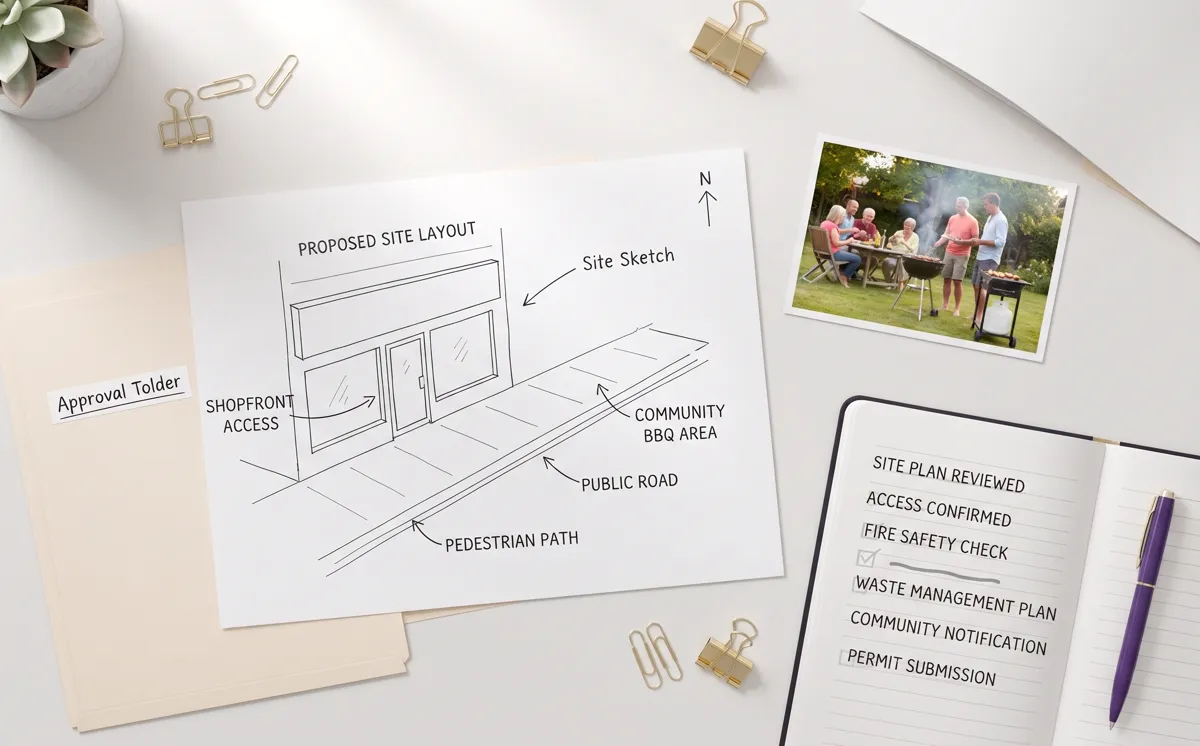
A useful first step is to separate the location, the activity and the approval requirements.
Andrew’s central message is to separate the desired outcome from the argument.
- Establish the facts. Gather the direction, approvals, photographs, boundary information and relevant correspondence.
- Manage the emotion. Frustration may explain why the issue matters, but it does not identify the legal answer.
- Apply the relevant rules. Check the actual activity, decision-making power and available response or review process.
- Look for a workable solution. Consider whether an approved location, amended preparation arrangement or appropriate application could achieve the objective.
Cooking indoors, using a different site or obtaining an approval are possibilities to investigate, not guaranteed workarounds.
If the objective is to restart a community barbecue, the most useful outcome may be a safe, lawful arrangement rather than a long argument about who was right.
Do not let negotiations consume a deadline
A conversation with an officer or councillor does not necessarily suspend a fine, response period or review deadline. Identify the formal document and its deadline first. If you need advice, contact Bell & Senior Lawyers on (07) 5532 8777.
For the broader background, see our episodes on challenging government decisions and non-court strategies for resolving government disputes .

Sausage law. Best served with a practical solution.
See also: What to do if council shuts down an event .
Segment 3: Caller John, documents and inheritance
Topic: An advance health directive, enduring power of attorney and leaving a home to a daughter.
Relevant law: Powers of Attorney Act 1998 (Qld) and Duties Act 2001 (Qld) .
John asks about a missing advance health directive, an enduring power of attorney and leaving a home to his daughter.
These documents serve different purposes. Their execution, storage and production requirements should not be treated as interchangeable.
Advance health directives and EPOAs
Keep originals securely and make sure the appropriate people know where they are.
For advance health directives, follow the clarification above: compulsory registration is not required, and certified copies have an important recognised role. If there is uncertainty about a missing document, seek advice about locating, verifying or replacing it rather than immediately revoking it.
For an enduring power of attorney, certified copies are commonly used, but the institution and transaction may have additional requirements.
Inherited property and transfer duty
Queensland provides an exemption for qualifying distributions of a deceased estate under a will or the intestacy rules.2
That is not a blanket exemption for every transaction between beneficiaries. A later purchase, variation or rearrangement needs separate assessment.
A later sale also does not simply make the inheriting beneficiary liable for transfer duty as seller. Transfer duty, capital gains tax and estate administration costs are different issues.
Probate is not a fixed-price inheritance tax
Probate is a court process concerning the will and the executor’s authority. It is not an inheritance tax, and it is not required for every estate.3
Court charges, advertising, professional fees and other administration expenses should be distinguished. The approximate figure mentioned in the broadcast was not a fixed statutory fee or a quote for every estate.
The executor should check which asset holders require a grant and obtain an estimate suited to the estate.
See also: Advance health directive originals and copies | Advance health directive guide | Enduring power of attorney | Stamp duty in Queensland .
Segment 4: Caller Susan, coronial questions
Topic: A distressing delay before release for a funeral, and what a family can actually do about it.
Relevant law: Coroners Act 2003 (Qld) .
Susan’s daughter died in hospital, in circumstances the family understood to be natural causes, and her body was held for about two weeks before release. On air, Andrew commiserated with the family before explaining what the coronial process involves, and Colin encouraged Susan to put her question in writing rather than relying on phone calls.
Without the coronial file the program could not explain that particular delay, but the process itself explains why holds like this happen.
Why a body is not always released straight away
The coroner releases a body once the coronial process has established what happened. Even when a death in hospital seems natural to a family, the coronial system can still be engaged: hospitals and doctors are required to report certain deaths, and a death is sometimes reported pending confirmation of the medical cause of death.
Common reasons a release waits include:
- an autopsy or further pathology testing, which can take longer than families hope;
- waiting on the treating doctor’s cause-of-death paperwork or certifications;
- procedural checks while the death is formally classified; and
- simple workload in the registry.
Two points of correction from the broadcast. The coroner’s jurisdiction is statutory: it covers reportable deaths, not every Queensland death, and it is not correct that the coroner is “above” other courts.4 Release for a funeral is also a different stage from a completed investigation or final coronial findings, as our release delays FAQ explains.
Andrew’s own answer was to hold open what he could do: he told Susan he would investigate how the registry handles family enquiries and report back, since he could not speak to the specific case.
What a family in Susan’s position can actually do
A family member can contact the investigating coronial registry directly, without a lawyer, and ask:
- whether the death was reported and why;
- whether an examination or autopsy is required and how long it is expected to take; and
- what has been scheduled next in the process.
Formal, written requests work better than phone calls, which Susan had already discovered after three calls that went to a secretary. Quote the file reference, ask who is handling the matter and how to ask for a reason for the delay in writing. Access to unpublished coronial documents is a separate process and can require an application with supporting material.5
When release is authorised, the coroner will usually release the body promptly so the funeral can proceed. It is the preceding confirmation that takes time, not the release itself.
This page provides general legal information only; it is not personal legal advice. Everyone’s situation is different, so please seek independent legal advice for your own circumstances.*
Related Episodes
- Episode 35: Self-defence, defending others and estate planning
- Challenging government decisions
- Non-court strategies for government disputes
Related Guides and FAQs
- Free sausage sizzles and food licensing
- Responding to a council event shutdown
- Advance health directives: originals and copies
- Coronial release delays and family enquiries
For advice about your circumstances, contact Bell & Senior Lawyers on (07) 5532 8777.
Relevant Law and Resources
The program used a reported council shutdown at a Gold Coast butcher in Palm Beach as its case study. The article below is news reporting about a disputed event; no council file has been inspected, and nothing in it should be taken as an established finding.
Law and council pages
- Food Act 2006 (Qld) , including the extended meaning of “sell”
- City of Gold Coast: roadside dining permit , the permit regime for outdoor dining or seating on a public footpath
- City of Gold Coast: food business licences for fixed, mobile and temporary premises
- City of Gold Coast: roadside vending permit for selling from a roadside area
Government food safety guidance for sausage sizzles and outdoor cooking
- Queensland Government: food safety for fundraising events
- Queensland Health pocketbook guide for fundraising events (PDF)
- Queensland Government: licences and exemptions for non-profit organisations
- Queensland Government: eating outdoors and barbecue food safety
- Safe Food Queensland: food safety guide for parties and barbecues
The reported story
- News.com.au: Council shuts down butcher’s free sausage sizzle (18 October 2026)
Footnotes
-
Food Act 2006 (Qld) ss 19, 48–49, including the extended meaning of selling and the distinction between a food business and a licensable food business: https://www.legislation.qld.gov.au/view/whole/html/current/act-2006-003 . Queensland Government, “Fundraising events”: https://www.qld.gov.au/health/staying-healthy/food-pantry/food-safety-for-consumers/food-safety-at-home/fundraising-events . ↩︎
-
Queensland Revenue Office, “Deceased person’s estate exemption (s.124) toolkit”: https://qro.qld.gov.au/duties/self-assessors/toolkits/section-124/ . ↩︎
-
Queensland Courts, “Wills and estates (probate)”: https://www.courts.qld.gov.au/types-of-cases/about-grants-of-administration . Current Supreme Court fees: https://www.courts.qld.gov.au/going-to-court/court-resources/fees/fees-in-the-courts/supreme-court-fees . ↩︎
-
Coroners Act 2003 (Qld), including provisions concerning reportable deaths, investigations, examinations and release for burial: https://www.legislation.qld.gov.au/view/html/inforce/current/act-2003-013 . ↩︎
-
Coroners Court of Queensland, “Accessing coronial documents”: https://www.coronerscourt.qld.gov.au/resources/accessing-coronial-documents . ↩︎