
A Creator's Guide to YouTube Copyright Claims, Takedowns, Strikes, Appeals and Counter-Notifications
Need legal help with this topic?
Get a confidential assessment of your matter today.

Your YouTube channel is a business asset. A copyright notice can affect more than one video.
For a working creator, a YouTube copyright problem is rarely confined to a platform setting. It can affect the income from content you made, a sponsor’s campaign timetable, the right to use content again, your reputation with the audience and the security of the channel itself.
This guide explains what a creator, influencer manager, agency or production company needs to do when a claim, takedown or strike arrives. It is deliberately practical and detailed. Use it to create a record, make a commercial decision and know when a formal response needs more than a template.
In This Guide
1. Protect four things at once
| Asset | Why it matters | Practical response |
|---|---|---|
| Your work | The video may contain your research, production skill, performance and original material, but also third-party assets. | Preserve original files and identify every asset used. |
| Your income | A claim can redirect or hold revenue and reduce value in a back catalogue. | Record revenue, expected views, affiliate income and replacement cost. |
| Your sponsor | A campaign can be delayed, blocked or require a make-good. | Read the deliverables, notice obligations, approval and reuse clauses. |
| Your channel and reputation | A strike, public fight or repeated poor response can affect long-term credibility. | Centralise communications and avoid unsupported allegations. |
A creator should treat the notice as an incident affecting both intellectual property and commercial operations. Influencer marketing also involves advertising and consumer-law considerations: paid, gifted and affiliate relationships should be clearly disclosed, and product claims should be supportable.
2. Identify what YouTube did
| Status | What it is | What can happen | What you do first |
|---|---|---|---|
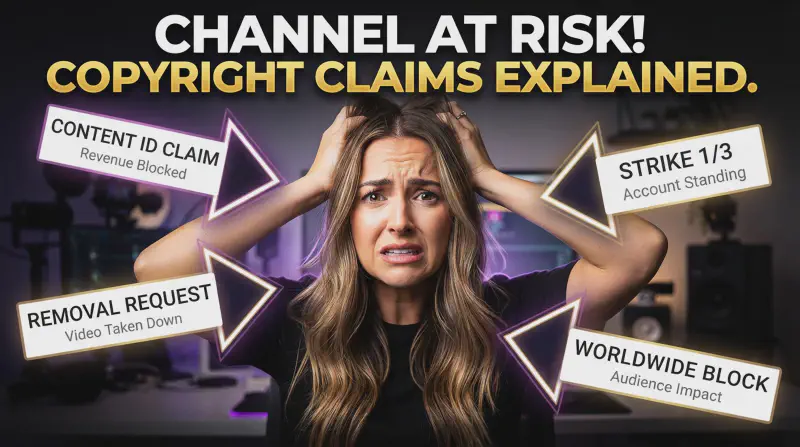
| Content ID claim | A rights holder or manager has matched a reference asset to content. | Monetisation, tracking, territory restriction or block. | Identify the timecode, claimed asset and evidence of rights. |
| Copyright removal request | A formal legal request to remove content. | Video can be removed and a strike may follow. | Preserve evidence and investigate ownership, licence and claimant identity. |
| Copyright strike | Channel consequence after removal. | Channel standing and termination risk. | Check strike history, preserve records and centralise response. |
| Rejected dispute | Claimant maintained an initial Content ID claim. | Appeal may be available. | Recalculate evidence, value and escalation risk. |
| Counter-notification | Formal restoration request after removal. | May lead to legal action or reinstatement process. | Obtain tailored advice unless evidence is unusually clear. |
YouTube distinguishes Content ID claims from copyright removal requests and strikes. A claim does not ordinarily mean that the channel has a strike. YouTube: What is a claim?
3. The first 24 hours: your incident file
Create one folder, one timeline and one authorised responder. The file should include:
- the full YouTube email, Studio screen, video URL, channel URL, claim ID and deadline;
- claimant name, claimed work, affected timecode, territories and current restriction;
- revenue data, analytics, affiliate data and active sponsor campaign details;
- original upload, raw footage, project file, exports, source media and metadata;
- licences, receipts, subscription details and the historic provider terms;
- contributor, editor, producer, guest, brand, agency and commissioning agreements;
- distribution, label, publisher, music-library and Content ID whitelist records;
- every message already sent to YouTube, the claimant, sponsor, agency or brand;
- a running decision log with date, time, sender and reason.
The record protects you if an editor leaves, a sponsor asks what happened, a distributor gives a different explanation, or months later you need to show why the video used an asset.
4. Income: decide whether the claim is worth fighting
Ignore the emotional first reaction long enough to do a business calculation. A Content ID claim may be a minor administrative nuisance or a material loss.
YouTube says eligible revenue can be held while a timely dispute or appeal is decided. Where no dispute is filed, held revenue is generally released to the claimant after five days. YouTube: Monetisation during copyright claim disputes
Revenue questions
- Is advertising revenue currently being claimed, held or lost?
- Does the video create affiliate, membership, merchandise or client leads?
- Is the video evergreen, ranked in search or supported by paid traffic?
- Is the claim recurring across an archive or a series?
- How much will a replacement edit, new music or reshoot cost?
- Will the delay cost more than the claimed revenue?
Decision factors
| Situation | Usually sensible first option |
|---|---|
| Low-value video, unclear music licence, easily replaceable track | Preserve evidence, then consider replacement or mute. |
| Clear licence, wrongly claimed asset, useful continuing revenue | Submit a concise, evidence-led dispute. |
| Sponsor launch, high traffic, clear rights, urgent deadline | Preserve evidence, coordinate commercial communications and seek prompt advice on dispute or other resolution. |
| Rejected dispute, unclear evidence, existing strike exposure | Do not automatically appeal. Reassess risk, re-edit and claimant communication options. |
| Removal, strike, legal letter or repeated claims | Treat as urgent channel and commercial risk. Seek advice. |
5. Sponsors and brands: protect the relationship without making admissions
A sponsor needs information, a workable plan and confidence that you are managing the issue. It does not need a rushed theory about who is at fault.
Review the agreement
Check:
- deliverable and publication dates;
- notice and approval obligations;
- replacement, re-shoot and make-good provisions;
- payment milestones and whether payment depends on publication or views;
- permitted music, clips, brand assets and supplied materials;
- creator warranties and indemnities;
- who owns the finished content;
- the brand’s right to repost, run paid ads, edit, boost or reuse it;
- territory, duration, exclusivity and takedown requirements.
A paid creator campaign is not merely a post. The agreement should allocate rights and commercial consequences. Paying a creator does not automatically transfer the creator’s copyright or give a brand unlimited permission to run the content in paid ads, on its website or indefinitely.
Sponsor communication protocol
- Tell the correct person promptly if the agreement requires it or the campaign deadline is affected.
- State the known facts: the video status, planned next step and next update time.
- Do not accuse a claimant of fraud or admit infringement before evidence is reviewed.
- Offer realistic alternatives: re-edit, replacement asset, revised date or temporary unlisted solution if appropriate.
- Keep all messages. A sponsor dispute can later turn on what was said and promised during the incident.
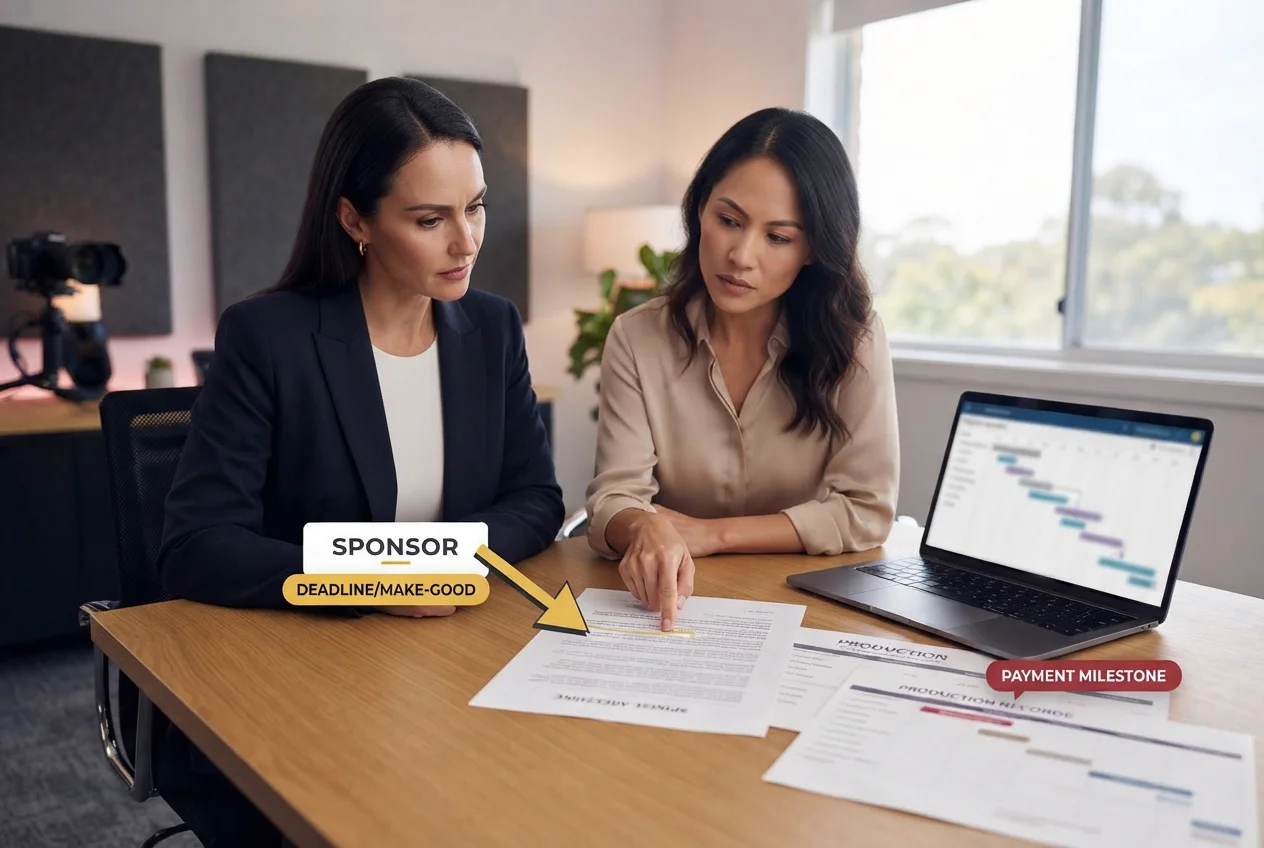
Sponsorship agreements should allocate rights, deliverables and commercial consequences clearly.
6. Attribution, ownership and licences
Creators often say, “I gave them credit,” “I bought the song,” or “the brand sent it.” Each may explain how the asset arrived in the project. None automatically proves a right to publish it in a commercial YouTube video.
Attribution is not permission
A credit line may be ethically appropriate or contractually required. It does not usually substitute for the owner’s permission.
Buying is not licensing
Buying access to music, imagery or video does not necessarily provide synchronisation rights, monetised YouTube rights, Content ID clearance, global use, perpetual use or the right to use the asset for a client.
The person who made it may still own it
A creator, editor, photographer or contractor may own copyright in original material unless a contract says otherwise. Employment, commissioning and contractor arrangements can have different results. Do not assume the party who paid for the work owns every right.
See Does giving credit avoid YouTube copyright infringement? , Can I use music I bought in a YouTube video? and Who owns video content made by an editor or contractor? .
7. Disputes: use evidence, not slogans
A Content ID dispute is usually strongest if it identifies the claimed section and explains a specific reason supported by the record. Possible reasons can include ownership, a licence, factual mismatch, a rights-manager error, public-domain status or a relevant exception.
A dispute should not merely say:
- “I worked hard on this video.”
- “I gave credit.”
- “It is only 10 seconds.”
- “I bought it.”
- “It is educational.”
- “Fair use intended.”
Those statements may be relevant facts in a wider analysis, but they do not establish a complete legal basis.
YouTube says a claimant generally has 30 days to respond to an initial Content ID dispute. YouTube: Dispute a Content ID claim
8. Appeals: the speed can conceal the risk
If the dispute is rejected, an appeal may be available. YouTube says the claimant generally has seven days to respond. A claimant may release the claim, but YouTube warns it may also submit a copyright removal request. YouTube: Appeal a Content ID claim
Before appealing, record why the initial dispute failed, whether fresh evidence exists, what revenue and sponsor value are at stake, whether an edit is acceptable, whether a claimant retraction is possible and what the channel stands to lose if a strike follows.
9. Strikes, removal and counter-notifications
YouTube says a strike may expire after 90 days if Copyright School is completed and the channel has fewer than three active strikes. Three active copyright strikes within 90 days may result in channel termination. YouTube: Understand copyright strikes
Deleting the video does not itself remove a strike. A claimant may retract a removal request. A counter-notification can also be an option where removal resulted from mistake or misidentification, but it is a formal legal request and may be shared with the claimant.
YouTube says a claimant has 10 US business days to provide evidence of legal action after a counter-notification; if it does not, YouTube may reinstate the content, subject to its process. YouTube: Submit a copyright counter notification
Before counter-notifying, review ownership, licence, identity, address, jurisdiction, service and litigation risk. Do not use it as an automatic next step after every removal.
10. Fair use, fair dealing and commentary
Fair use is principally a US doctrine. Australian copyright law contains specific fair dealing exceptions, including criticism or review, parody or satire, reporting news, research and study. Labels such as “fair use intended” and “for educational purposes” do not decide whether an exception applies.
Examine the actual work, purpose, amount used, commercial context and jurisdiction. Platform processes, Australian law and US law can overlap without being identical. See Is fair use the same as fair dealing in Australia? .
11. Build the rights register before it is urgent
For each important upload, retain:
- project and publication details;
- raw footage and project locations;
- every third-party asset and licence;
- contributor and editor agreements;
- brand and agency approval records;
- sponsorship deliverables and reuse rights;
- music, distributor and rights-manager details;
- Content ID whitelist information;
- claims and response outcomes;
- the person authorised to respond to notices.
This is not paperwork for paperwork’s sake. It protects the value of content you have already paid to make.
12. When to seek tailored assistance
Obtain advice promptly if a video was removed, a strike issued, an appeal or counter-notification is proposed, a sponsor campaign is affected, a claimant or lawyer contacted you, ownership is unclear, a label or distributor is involved, claims repeat across the catalogue, or the channel is commercially significant.
Bell & Senior Lawyers assists creators, agencies and brands with creator agreements, copyright licences, YouTube claims, takedowns, strikes, sponsor-risk communications and digital-content ownership. We do not guarantee that YouTube will release a claim, restore a video, pay revenue or remove a strike.
Request a YouTube claim assessment .
See also
- Why does sponsor-supplied music still get a YouTube claim?
- How long does a YouTube revenue hold last?
- Should I dispute or just replace the music?
- Who owns my YouTube channel if an editor or agency built it?
- Is my business liable if an employee posts copyright material?
- YouTube Copyright Claim or Strike? Protect Your Income, Sponsor and Channel First
- Is a YouTube Content ID claim the same as a copyright strike?
- What should I do after a YouTube copyright claim?
- What happens to my revenue after a YouTube copyright claim?
- Should I appeal a rejected YouTube copyright dispute?
- What is a YouTube copyright counter-notification?
- Does deleting a YouTube video remove a copyright strike?
- What should I do if my sponsored YouTube video gets a copyright claim?
- Do I need music licences for YouTube videos in Australia?
- Who owns copyright in influencer and sponsored content?
- Can I rely on fair dealing for commentary or review on YouTube in Australia?
- Copyright assignment agreements in Australia
- Do I need to register my copyright in Australia?
- Australia’s implied freedom of political communication
This guide provides general legal information only. It is not personal legal advice. Platform processes, copyright outcomes and response options depend on the evidence, claimant, jurisdiction, contract terms and the facts of each matter. Obtain tailored advice before lodging a dispute, appeal or counter-notification that may affect your channel, income, sponsor relationship or business.
Speak With a Lawyer
Contact our Gold Coast team for a confidential discussion about your matter.
Enquiry Sent
Thank you for reaching out. A member of our legal team will contact you shortly.