
Legal Matters: Non-Legal Strategies for Challenging Government Decisions — Ombudsman, Human Rights, Petitions & Community Action

In this episode of Legal Matters on 4CRB, Andrew Bell concludes the two-part administrative law series by turning to the non-legal toolkit available when court action is impractical or unaffordable. As the Ep 13 discussion made clear, a Supreme Court judicial review can cost hundreds of thousands of dollars and may simply result in the same decision being remade. This week Andrew explains the tools that anyone can use, for free, without a lawyer: the Ombudsman, the Queensland Human Rights Commission, formal parliamentary petitions, direct engagement with elected representatives, and well-run community campaigns.
Andrew opens with an important correction and expansion of the advice given to Rod last week, setting out in detail how the FORM 3 process works and what Rod can do to protect himself if a notice is ever served.
Live caller questions cover a stolen Australia Post parcel and who should lodge the insurance claim, a travel company that cancelled a $10,000 overseas tour and withheld more than $1,000 in alleged supplier charges without providing any breakdown, and a listener who wants to understand whether drink driving on private property carries any legal risk in Queensland.
Helpful Resources for This Episode
- Queensland Ombudsman : 07 3005 7000
- Commonwealth Ombudsman : 1300 362 072
- Queensland Human Rights Commission : 1300 130 670
- Queensland Legislative Assembly e-Petitions
- Find Your Queensland State MP
- Find Your Federal MP
- Queensland Fair Trading : 13 74 68
- QCAT : 1300 753 228
- Australia Post — Make a Claim
- Legal & Government Contact Directory
Key Topics
- Rod Update — Form 3 Clarification: The FORM 3 notice must include a written contractor quotation to be validly issued. Once Rod responds by nominating a contractor and dates, he acquires the right to enter the neighbouring property and do the work himself — avoiding the $300 liability entirely.
- The Ombudsman: What it is, what it can and cannot do, how to find the right one, and why it was so effective at forcing accountability in the telecommunications industry.
- Queensland Human Rights Commission: The Human Rights Act 2019 (Qld) requires all Queensland government entities to act compatibly with 23 protected human rights. Cultural rights under s 28 are particularly significant for planning, environmental, and native title decisions.
- Petitions: The critical difference between an online petition (no legal force) and a formal Queensland Legislative Assembly e-petition (requires ministerial response once tabled).
- Writing to Elected Representatives: Why specificity matters — a letter with factual questions and identifiable impacts gets past the letter writer and may reach the member directly.
- Community Facebook Groups and Defamation: The Voller (2021) High Court decision and why Facebook page administrators can be treated as publishers of third-party comments; parliamentary privilege and why it does not protect ordinary citizens.
- Caller William: Stolen Australia Post parcel — who claims, the $100 default cover, the Extra Cover product, and the ACL position.
- Caller Peter: Cancelled Dubai/Five Stans tour — ACL consumer guarantees, unfair contract terms, Fair Trading and QCAT escalation, and the credit card insurance point.
- Caller Malcolm: Drink driving on private property, the road related area definition, and Jovanovic v Lucas [2009] QDC 138.
Listener FAQ Highlighted in This Episode
- What can an Ombudsman do about a government decision?
- What does the Queensland Human Rights Act 2019 add to an administrative law challenge?
- Does an online petition have any legal force in Queensland?
- What are my rights if a travel company cancels my tour and keeps my money?
- Who should lodge the Australia Post insurance claim — buyer or seller?
- What are the defamation risks for community Facebook pages opposing a development?
- Can I be charged with drink driving on private property in Queensland?
- Who is responsible for overhanging tree branches in Queensland?
Listen to the full discussion above.
Defamation Is the Most Underestimated Risk for Community Campaigners
Following the High Court’s decision in Fairfax Media Publications Pty Ltd v Voller (2021) 275 CLR 91, the administrators of a Facebook community page can be held liable as publishers of third-party comments posted on their page — not just their own posts. Sharing another group’s unverified allegation into your group is also potential publication. Parliamentary privilege protects statements made in parliament by parliamentarians. It does not protect the same statement made on Facebook, at a public meeting, or in a community newsletter by an ordinary member of the public.
Before your community group publishes anything about a named developer, applicant, or other individual, apply a three-part test: is it true, can you prove it, and is it clearly framed as a substantiated fact or a stated opinion with identified sourcing? If you cannot answer yes to all three, do not publish it.
Contact Bell & Senior Lawyers on (07) 5532 8777 before publishing material about named parties in a community campaign.
Key Takeaways
-
The legal pathway is not the only pathway — and is often not the most effective one. Administrative law gives you formal court-based rights, but the Ombudsman, the Human Rights Commission, petitions, and elected representatives are often faster, free, and more politically effective than a Supreme Court challenge costing hundreds of thousands of dollars.
-
Ombudsmen cannot overturn decisions but can force them to be remade and hold agencies publicly accountable. The Queensland Ombudsman investigates whether agencies followed the rules. A finding against an agency is a public document and can be used in subsequent court proceedings. The service is free. For telecommunications, energy, financial services, and health insurance matters, a sector-specific ombudsman applies — find the correct one before lodging.
-
The Human Rights Act 2019 (Qld) adds an important additional lever. Under the Human Rights Act 2019 (Qld) , all Queensland government entities must act compatibly with 23 protected human rights. Cultural rights under s 28 are particularly powerful in challenges involving Aboriginal and Torres Strait Islander communities — traditional owner support (or its absence) can be a threshold condition, not simply a factor to be weighed.
-
A formal e-petition forces a ministerial response on the parliamentary record. An online petition has no legal force. A formal Queensland Legislative Assembly e-petition sponsored by an MP that meets the requirements may be tabled in parliament, requiring the responsible minister to provide a formal written response that becomes a public document.
-
Be specific when writing to your MP. A generic letter gets a generic reply. A letter with specific factual questions — dates, site details, failure modes, named impacts on the community — may reach the member directly and require them to go on record with their position.
-
Community groups can be sued for defamation, even when advancing a legitimate cause. Following Fairfax Media Publications Pty Ltd v Voller (2021) 275 CLR 91, Facebook page administrators can be publishers of third-party comments. Parliamentary privilege protects parliamentarians in parliament — not the public anywhere.
-
Australia Post’s default cover is $100 — and the ACL may provide additional rights. The seller is the contracting party with standing to claim. Extra Cover of up to $5,000 must be purchased at lodgement. Importantly, Australia Post’s own terms state that the $100 statutory limit does not extinguish rights under the Australian Consumer Law : if Australia Post’s own negligence caused the loss, an ACL claim above $100 is theoretically available, though it requires evidence of fault.
-
A travel company that cancels a tour cannot simply rely on its contract to withhold your money. Under the ACL consumer guarantees (ss 60–62), a supplier-initiated cancellation may constitute a major failure entitling you to a full refund under s 259(3) ACL — not merely a credit. The unfair contract terms regime (ss 23–28 ACL) can render void a standard form term permitting deductions the supplier cannot itemise. A refusal to provide a written breakdown of deductions is consistent with misleading conduct under s 18 ACL. Escalate to Queensland Fair Trading (13 74 68) or QCAT (1300 753 228).
-
Section 79 contains no location restriction — the offence applies anywhere. Section 79(11) of the Transport Operations (Road Use Management) Act 1995 (Qld) expressly provides that all drink and drug driving offences under subsections (1) to (2L) apply to any person who drives, is in charge of, or attempts to put a motor vehicle in motion “on a road or elsewhere.” The words “or elsewhere” appear four times in s 79(11) and attach directly to the offence provisions. The offence applies in a car park, on a private driveway, in a paddock, or on any other land without qualification. There is one narrow statutory defence under s 79(6), available for the “in charge of” limb only, requiring proof of a manifested intention to refrain from driving, a safely parked vehicle, and no prior conviction in the preceding year.
-
Rod’s FORM 3 update: respond within 30 days and you can do the work yourself. A valid FORM 3 notice must be accompanied by a written contractor quotation — without it, the notice is not validly issued under s 57(3)(d) of the Neighbourhood Disputes (Dividing Fences and Trees) Act 2011 (Qld) . If validly served, responding within 30 days with a nominated contractor and dates gives Rod the legal right to enter the neighbouring property and carry out the work, avoiding all liability for the $300 removal cost. The $300 is the maximum the neighbour can recover from Rod if they do the work — it is not a cap on Rod’s own costs if he does it himself.
Annotated Transcript
Topic: Rod Update — FORM 3 Tree Branch Clarification
Applying the Neighbourhood Disputes (Dividing Fences and Trees) Act 2011 (Qld) , ss 55–59.
📎 See also: Who is responsible for overhanging tree branches in Queensland? | QCAT & Neighbourhood Disputes (Ep 7) | Ep 13 — Rod’s original call
Colin Balewski: We did have a caller last week that you would like to update some information on.
Andrew Bell: We did. Rod called twice about trees growing over the fence. I have clarified this week — dusted off the textbooks. A FORM 3 notice can be given where the neighbour says you have 30 days to do something about this or they will include a quote and you will be liable for up to $300 of removing those branches. You can respond to that notice by stating when you are going to remove them and which contractor you are going to use. You have to nominate some dates, and that gives you the right to go onto their property and remove the branches, so they do not charge you the $300. If you are worried about the cost of branches overhanging the fence, offer to clean them up; otherwise wait to see if a notice is served and then respond within the time frame.
What Rod Can Do If a Valid FORM 3 Is Served on Him
For a FORM 3 notice to be validly issued under the Neighbourhood Disputes (Dividing Fences and Trees) Act 2011 (Qld) , it must be accompanied by a written quotation from a contractor stating the estimated cost of the work (s 57(3)(d)). A notice without this attachment is not validly issued and Rod is not required to act on it.
If a valid FORM 3 is served, Rod should:
- Respond to the notice at least one day before the proposed work is to be done
- State the name of his contractor and the proposed date and time
- Ensure work is carried out between 8am and 5pm on a business day
- Ensure only the overhanging branches (the portions crossing the boundary) are removed, and do so in accordance with good arboricultural practice
Responding this way gives Rod the legal right to enter the neighbouring property to remove the branches, avoiding any liability for the $300 removal cost. If Rod does the work himself, the $300 figure is irrelevant to him — it is the maximum the neighbour can recover from him if they do the work after proper process. Rod’s own contractor cost, if he does it himself, is his responsibility and there is no statutory cap on it.
Note also: for branches higher than 2.5 metres above the ground, the FORM 3 self-help remedy is entirely unavailable. The body corporate next door must apply directly to QCAT for an order if they want to require Rod to act on higher branches.
📎 Full guidance: Who is responsible for overhanging tree branches in Queensland?
Topic: Non-Legal Strategies — The Ombudsman
Applying the Ombudsman Act 2001 (Qld) and Ombudsman Act 1976 (Cth) .
📎 See also: What can an Ombudsman do about a government decision? | Administrative Law Part 1 (Ep 13)

Colin Balewski: Let us start with avenues that do not require a court. The Ombudsman — what can they actually do?
Andrew Bell: An Ombudsman is a Swedish term for an outside regulator who works with the government and the people. There are now ombudsmen across many areas — telecommunications, the Queensland government, the Commonwealth. They investigate complaints about departments, agencies and councils, and sometimes about private businesses that are regulated. When I worked in telcos, the telecommunications ombudsman drew fear in the heart of telco companies because they are very effective at getting customer-led resolutions. I worked for the company that sent out the first alerts on mobile phone plans, specifically because the telcos were being inundated with complaints to the ombudsman about people not being able to afford their bills.
To use an ombudsman, they are typically free. You do not need a lawyer, there are no filing fees, and it is accessible to any member of the public. You just need to find the right ombudsman. They are not a court — they cannot necessarily overturn a decision, but they can investigate whether the body followed the rules. If they find it was defective, they can make recommendations to the government agency or the minister, and those findings can be made public and potentially used in any subsequent court action.
Finding the Right Ombudsman
| Decision Type | Ombudsman | Contact |
|---|---|---|
| Queensland state government or council | Queensland Ombudsman | 07 3005 7000 |
| Commonwealth government agency | Commonwealth Ombudsman | 1300 362 072 |
| Telecommunications provider | TIO | 1800 062 058 |
| Financial services | AFCA | 1800 931 678 |
| Energy retailer (Qld) | EWOQ | 1800 662 837 |
| Private health insurer | Private Health Insurance Ombudsman | 1800 640 695 |
All services are free and accessible without a lawyer.
Topic: Queensland Human Rights Commission
Applying the Human Rights Act 2019 (Qld) .
📎 See also: What does the Queensland Human Rights Act 2019 add to an administrative law challenge? | Who has standing to challenge a government decision in Queensland?
Colin Balewski: What about the Queensland Human Rights Commission — when does that become relevant?
Andrew Bell: In 2019, Queensland passed the Human Rights Act, which requires all Queensland government entities to act in a way that is compatible with human rights and genuinely consider human rights when making decisions. This could be a right to privacy, the right to your culture — which is particularly important for Aboriginal and Torres Strait Islander peoples but not exclusively them — the right to equality, the right to a fair hearing.
If someone believes a government decision violated their human rights — failed to consider cultural rights, imposed a consequence that impacted their quality of life beyond simply following the rules — you can make a complaint to the Human Rights Commission. They can investigate and conciliate. In serious cases, the Human Rights Act provides an additional basis to challenge the decision in the Supreme Court. It is an additional arrow in your quiver and it is particularly powerful in cultural heritage and environmental matters, such as we discussed last week.
Human Rights Act 2019 (Qld): Key Protected Rights
The Human Rights Act 2019 (Qld) protects 23 human rights. The most commonly relevant in planning and environmental matters include:
- Right to recognition and equality before the law (s 15)
- Right to privacy and reputation (s 25)
- Right to a fair hearing (s 31)
- Cultural rights — Aboriginal and Torres Strait Islander peoples’ right to enjoy their culture, maintain spiritual and ceremonial practices, and use their language (s 28)
- Property rights (s 24)
- Right to freedom of expression (s 21)
Complaints go to the Queensland Human Rights Commission (1300 130 670). The complaint process is free and does not require a lawyer at the initial stage. Note that the Act applies only to Queensland government entities — it does not apply to private developers or individuals.
Topic: Petitions — What Actually Works
📎 See also: Does an online petition have legal force in Queensland?
Andrew Bell: Legally, online petitions do not have force in law. A petition with 10,000 signatures on Change.org does not compel any government body to do anything. However, formal e-petitions lodged through Queensland’s Legislative Assembly e-petition process — on a matter within Queensland government jurisdiction, sponsored by an MP — may be tabled in parliament. Once tabled, the government is required to provide a formal written response. That response is a public document, open to media scrutiny, and it becomes part of the political history of the matter. The minister must go on the public record with their position. In relation to the Springbrook Cableway, organised petitions have consistently revealed that the state government’s support for the project is softer than the council’s stated position.
How to Lodge a Formal Queensland e-Petition
- Go to the Queensland Parliament e-Petitions portal
- The petition must relate to a matter within Queensland government jurisdiction
- It must be sponsored by a Member of the Queensland Legislative Assembly
- Petitioners must be Queensland residents
- Once tabled, the responsible minister must provide a formal written response within a prescribed period — that response is a public document
An informal online petition (Change.org, community website) has no formal legal or parliamentary status regardless of how many signatures it collects.
Caller 4: William — Stolen Australia Post Parcel
Applying the Australian Postal Corporation Act 1989 (Cth) and the Australian Consumer Law (Schedule 2, Competition and Consumer Act 2010 (Cth)).
📎 See also: Who should lodge the Australia Post insurance claim?
Colin Balewski: Let us go to William. Good morning William.
William: We sold something through an online company and dispatched the product to the buyer. When he received it, the envelope had been opened and the contents had been taken. We approached the post office and they said they do not cover that item in the postage and there is no compensation. It is insured for up to $100. How do we stand?
Andrew Bell: My understanding is that that is the default position — there is insurance up to $100 by default with normal mail, and anything above that you needed to apply for additional insurance at lodgement. There is a process on the Australia Post website to make a claim about damaged or lost goods, and they may ask for pictures or a statutory declaration. You may be able to be compensated up to $100. However, anything more than that, I believe they have statutory protections that limit compensation to $100.
William: Who should put the claim in — the buyer or the seller?
Andrew Bell: Technically the contract is with the person who lodged the item, so the seller. But I believe either can put in the claim — I would follow the advice on the Australia Post website.
Australia Post Stolen or Damaged Parcel: The Full Legal Position
Australia Post’s default compensation is $100 under the Australian Postal Corporation Act 1989 (Cth) . Australia Post’s Extra Cover service provides the first $100 free and covers up to $5,000 if purchased at lodgement — it cannot be added after the fact.
An important addition to what was said on air: Australia Post’s own terms and conditions state that neither the default $100 compensation nor the Extra Cover product limits any rights a claimant may have under the Australian Consumer Law . If Australia Post’s own internal handling caused the loss — for example, internal theft by a staff member — an ACL claim above $100 is theoretically available under the consumer guarantees for services. This is difficult to establish without evidence of internal fault, but it is not foreclosed by the statutory limit.
Who lodges the claim: The seller is the contracting party (they posted the item) and is technically the party with standing. Australia Post will generally accept a claim from either party in practice.
Steps to claim:
- Go to auspost.com.au: Make a Claim
- Have the tracking number, proof of value (receipt, marketplace listing), and photos if available
- A statutory declaration may be required
- Lodge promptly — claims have time limits
Contact Bell & Senior Lawyers on (07) 5532 8777 if the loss was substantial and you believe you have grounds for an ACL claim above $100.
Topic: Petitions Continued — The Springbrook Example
Andrew Bell: The Springbrook Cableway is a good example of the petition strategy working in combination with the legal process we discussed last week. The project has been knocked back twice and is still circling. Petitions and community campaigns have been effective not in legally stopping it but in exposing the political weakness of government support and buying time for other avenues — including the federal EPBC referral lodged in 2025 and the native title consent requirement — to operate.
Topic: Writing to Elected Representatives
📎 See also: How to write an effective letter to your MP
Andrew Bell: If you are writing to or calling your member of parliament, be specific. Just saying you are unhappy about something gets you a generic reply. If you are factual and specific — this development is proposed on a slope with a fire danger, there is a significant history of failures, what are you going to do to prevent harm to the community, with actionable questions that relate to real facts — you may get past the letter writer and reach the individual member of parliament.
How to Write an Effective Letter to Your MP
- Name the specific development or decision with its application reference number if you have it
- State specific facts: dates, site details, proximity to homes, identified environmental values, previous decisions
- Ask specific, answerable questions — not general expressions of opposition but questions that require a factual answer and force the member onto the record
- Request a written response within a specific timeframe
- Copy the local council, any relevant state minister, and the relevant portfolio shadow minister
- Follow up if you receive a form response, referencing your original questions by number
Find your Queensland state MP: parliament.qld.gov.au/members/current
Find your federal MP: aph.gov.au/Senators_and_Members/Members
Topic: Community Facebook Groups and Defamation
Applying the Defamation Act 2005 (Qld) and Fairfax Media Publications Pty Ltd v Voller (2021) 275 CLR 91.
📎 See also: What are the defamation risks for community Facebook groups? | Defamation Law in Queensland (Ep 5) | Defamation Cases (Ep 6)
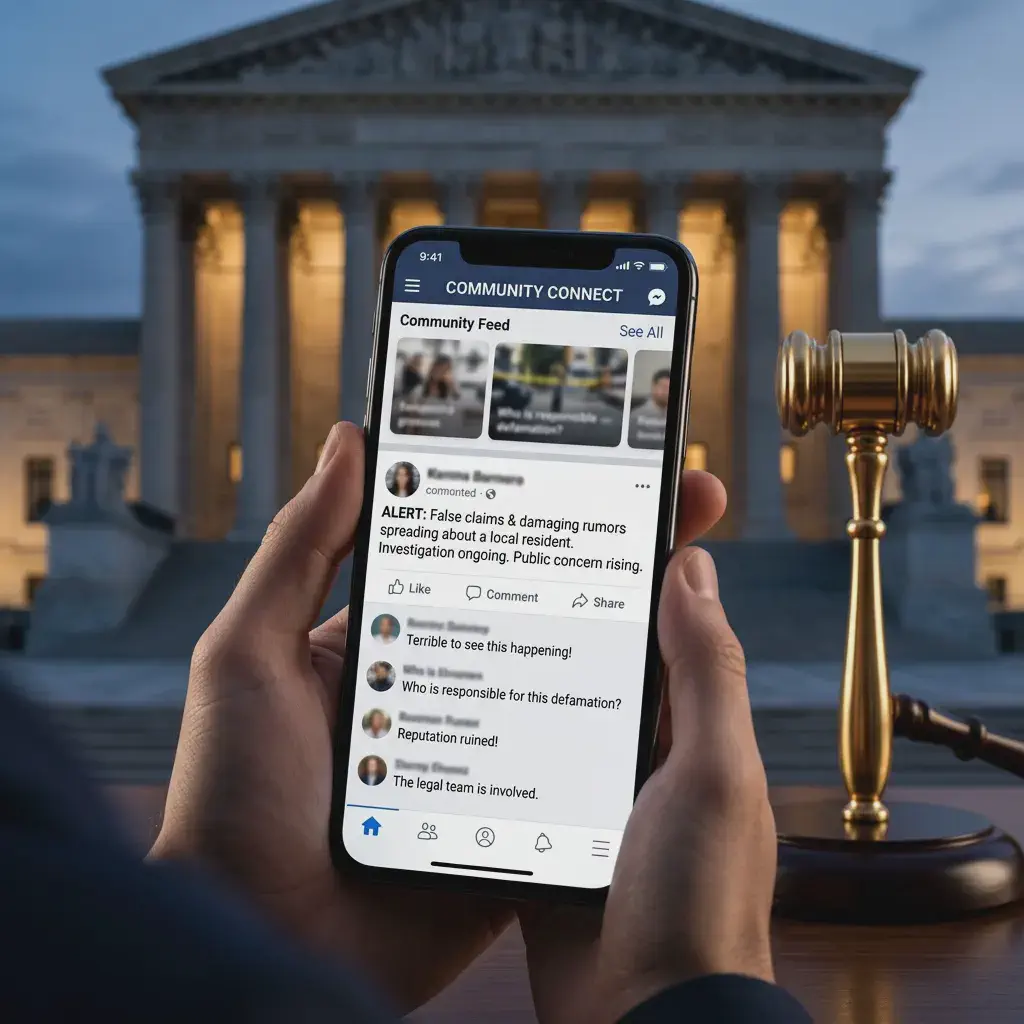
Andrew Bell: Just because you are promoting a good cause does not give you protection against defamation. If you publish a false statement of fact that damages someone’s reputation, you can be sued. A practical example: a community group opposing a cableway puts up a website saying the developer has a track record of environmental violations in other projects. If that is true and provable, they will be fine. If it is not true or they cannot substantiate it, and the developer has fewer than 10 employees, saying they have environmental violations could impact their ability to tender for future work and cause real harm. That is actionable.
Following Voller in 2021, it is not necessarily just the person who posted something — it is potentially also the administrators of the group. The ABC does not allow comments on its YouTube posts for exactly this reason: they are concerned about being treated as publisher of anything posted on their content. If you share another group’s defamatory post into your group, you can also be treated as having published it.
And importantly: parliamentary privilege protects members of parliament speaking in parliament. It does not protect anyone speaking elsewhere — not at a public meeting, not on Facebook, not in a community newsletter. It is a protection that exists only within the walls of parliament, full stop.
The Voller Decision: What It Means for Your Community Group
In Fairfax Media Publications Pty Ltd v Voller (2021) 275 CLR 91, the High Court held that a person or organisation that operates a Facebook page or public online forum is a publisher of third-party comments made on their page — not just of their own posts. This means community group page administrators can be sued for defamation in respect of comments they did not write and may not have read.
Practical steps for community group administrators:
- Monitor comments and promptly remove any that make unverified factual allegations about named individuals or companies
- Publish a moderation policy stating defamatory, misleading, or unverified claims will be removed
- Do not share posts from other groups without verifying the factual basis of any specific allegations contained in them
- Clearly distinguish between facts and opinions in your own posts: “We oppose this development” is opinion. “The developer has a history of environmental violations” is a statement of fact and must be verifiable and provable
- Parliamentary privilege does not protect you. It protects statements made by parliamentarians in parliament. It does not apply to community campaigners anywhere outside of parliament.
📎 For a full explanation of defamation law and the Voller decision, see Defamation Cases (Ep 6) .
Caller 5: Peter — Cancelled Overseas Tour, ACL Rights, and Fair Trading
Applying the Australian Consumer Law (Schedule 2, Competition and Consumer Act 2010 (Cth)), ss 18, 23–28, 60–62, 259(3).
📎 See also: What are my rights if a travel company cancels my tour? | QCAT & Disputes (Ep 7) | Debt Collection & Consumer Rights (Ep 12)

Peter: I booked a tour to Dubai and a Five Stans tour in Central Asia — over $10,000. Because of the Middle East situation they cancelled it. They gave me a credit less more than $1,000, saying they had supplier charges. They pointed me to their terms and conditions but when I asked for a breakdown they said they could not provide it. They have not replied to my email.
Andrew Bell: It would come down to what was in the contract or potentially the Australian Consumer Law. There is recent precedent over COVID where Qantas and Virgin were giving expiring credits and they eventually relented. But it often comes down to the actual conditions of the contract you signed. If they want to rely on a term or condition, they would have to explain exactly where it came from rather than giving you a generic figure. I would write to them saying you think they are unlawfully withholding your funds and ask for a breakdown of exactly where it comes from. This may be something to take to Fair Trading or QCAT.
Peter’s Situation: The ACL Position Is Stronger Than the Contract
This is an area where Andrew’s on-air advice pointed in the right direction but the law provides significantly stronger rights than the framing suggested. The contract alone does not determine the outcome — the Australian Consumer Law overrides contract terms that do not meet its standards.
What the ACL actually provides:
- Consumer guarantees (ss 60–62 ACL) apply to travel services automatically and cannot be excluded by contract. Where the supplier — not the consumer — cancels the service, this may constitute a major failure, entitling the consumer to a full refund under s 259(3) ACL. A credit is not the equivalent of a refund and the ACL does not require the consumer to accept it as full satisfaction.
- Unfair contract terms (ss 23–28 ACL): a standard form consumer contract term that permits the supplier to retain payment for “supplier charges” without specifying what those charges are, how they are calculated, or providing any mechanism to verify them, is a strong candidate for an unfair term. An unfair term is void. If the deduction clause is void, Peter may be entitled to recover the withheld amount as money had and received.
- Misleading conduct (s 18 ACL): a refusal to provide any breakdown of a deduction being relied upon to retain a customer’s money is consistent with misleading conduct. A written demand for the breakdown, sent by email with a deadline, creates a paper trail for Fair Trading.
Peter’s escalation pathway:
- Write formally demanding the breakdown in writing within 14 days, stating the company is in breach of the ACL consumer guarantees and that the deduction clause may be an unfair term
- Lodge with Queensland Fair Trading (13 74 68) — they can conduct an investigation and facilitate conciliation
- Apply to QCAT (1300 753 228) for amounts up to $25,000 in the minor civil disputes jurisdiction
- Credit card: Peter paid cash, so a chargeback is not available. Note for future: paying by credit card preserves the option of a chargeback for services not received, and many cards include built-in travel insurance.
Contact Bell & Senior Lawyers on (07) 5532 8777 if you are dealing with a disputed refund over $5,000 and the company is not responding.
Caller 6: Malcolm — Drink Driving on Private Property
Applying the Transport Operations (Road Use Management) Act 1995 (Qld) , ss 79, 80; and Jovanovic v Lucas [2009] QDC 138.
📎 See also: Can I be charged with drink driving on private property in Queensland?
Malcolm: Can you be charged with drink driving on private property?
Andrew Bell: It relates to operating a motor vehicle and can relate to road-adjacent areas. A driveway on a private residence or a public car park — I have had a client who had been to the pub, realised they were over the limit, decided to sleep in the car in a public car park, and they were charged. Your access to your keys and your ability to actually drive that vehicle is central to whether you are in control of it. If you are completely in a paddock not on a road, there may be some argument, but if you are potentially endangering the public, that would be within scope. And if police reasonably believe you have been recently driving, they can ask for a breath test.
Drink Driving on Private Property: Section 79 Contains No Location Restriction
Andrew’s on-air answer was correct in practical outcome. The legislation is stronger and more precise than the cautious radio framing suggested, and there is an important statutory defence that was not mentioned.
Section 79(11) removes any location limit from the offence entirely. The subsection expressly provides that all drink and drug driving offences under ss (1) to (2L) of the Transport Operations (Road Use Management) Act 1995 (Qld) apply to any person who:
- drives a motor vehicle on a road or elsewhere (s 79(11)(b))
- is in charge of a motor vehicle on a road or elsewhere (s 79(11)(a))
- attempts to put a motor vehicle in motion on a road or elsewhere (s 79(11)(c))
The words “or elsewhere” appear four times in s 79(11) and apply to the offence provisions themselves, not merely to the breath testing power. There is no location in Queensland where s 79 does not apply. The “road related area” concept, while relevant to other road use offences, plays no role in s 79.
There is one narrow statutory defence under s 79(6), applicable only to the “in charge of” limb, not to driving or attempting to start the vehicle. To succeed, the person must prove beyond reasonable doubt all four of the following:
- They manifested a clear intention to refrain from driving — either by occupying a compartment other than the driver’s seat, or by some action outside the vehicle
- They were not so intoxicated as to be incapable of forming that intention
- The vehicle was parked so as not to constitute a source of danger to other persons or traffic
- They had no conviction under s 79 within the preceding 12 months
The person who attempts to “sleep it off” while sitting in the driver’s seat with keys accessible will generally fail this defence because they have not manifested any intention to refrain from driving. Moving to the back seat and placing keys out of reach gives the defence its best chance.
Practical consequences:
- Location is irrelevant — the offence applies on any private driveway, in a paddock, in a car park, or anywhere else
- Andrew’s client who was charged after sleeping in a public car park was charged under s 79(11)(a), which is beyond doubt
- Being involved in any accident while over the limit will almost certainly void your vehicle insurance regardless of location
- The s 79(6) defence must be proved by the defendant on oath — it is not raised merely by assertion
Seek legal advice promptly if you have been charged. Time limits for traffic matters are strict.
Contact Bell & Senior Lawyers on (07) 5532 8777 for urgent advice on drink driving charges.
Related Episodes
- Ep 13: Administrative Law Part 1 — Merits Review, Judicial Review & the Springbrook Cableway — The full explanation of administrative law, standing, review pathways, and the Springbrook approval regimes. Start here if you have not heard Part 1.
- Ep 7: QCAT & Neighbourhood Disputes — Covers QCAT jurisdiction, procedures, tree and fence disputes, and self-representation.
- Ep 5: Wills and Defamation — First discussion of defamation principles.
- Ep 6: Defamation Cases — Detailed treatment of defamation, including the elements of the cause of action and the Voller decision.
- Ep 12: Loan Agreements, Debt Forgiveness & Debt Collector Rights — Covers the ACL, consumer remedies, and enforcement.
Disclaimer: This transcript provides general legal information only. It is not personal legal advice. Everyone’s situation is different, so please seek independent legal advice for your own circumstances. Call Bell & Senior Lawyers on 07 5532 8777.