
Before You Sign: A Contract Review Checklist for Queensland Businesses

Need legal help with this topic?
Get a confidential assessment of your matter today.

Most business contracts are signed without a lawyer - and most contract disputes were avoidable at the drafting stage. This checklist is what we work through when reviewing a Queensland commercial contract. Use it to triage before you sign, and bring us in for the documents that matter (leases, supply agreements, shareholder deals, anything with personal guarantees).
The 10 Clauses That Decide Who Wins
1. Parties and structure
Who exactly is contracting - the company, the trust’s trustee, or you personally? Signing “for” a $2 shelf company with no assets is very different from a solvent trading entity. Check ACNs, trustee identifications, and whether directors are giving personal guarantees (see clause 10).
2. Scope and specifications
Vague scope is the root of most payment disputes. Deliverables, quantities, timeframes, standards (AS standards? industry codes?), and an agreed variation process (who can order changes, at what price) should be explicit. “To be agreed” is a future lawsuit.
3. Price, payment and security
- When do invoices fall due? Is there a progress-payment regime (building contracts have their own under the Building Industry Fairness Act)?
- Interest on late payment? Suspension rights for non-payment?
- Security: retention, bank guarantees, PPSR registrations over supplied goods (retention of title clauses only work if registered on the PPSR - an unregistered ROT clause usually secures nothing on insolvency. 1).
4. Liability: caps, exclusions and the ACL
Look for: a liability cap (often expressed as “fees paid in the previous 12 months”), exclusions of indirect and consequential loss, and carve-outs. Two traps:
- A clause excluding liability for consumer guarantees is void under the ACL - but businesses routinely include them anyway. 2.
- A cap that excludes “consequential loss” may or may not cover lost profits depending on drafting - courts have gone both ways. Ambiguity here is worth real money.
5. Indemnities
An indemnity is a promise to pay the other side’s losses regardless of fault - it is not limited by negligence principles. Watch for one-way indemnities (“the customer indemnifies the supplier for everything”), indemnities for the other party’s own negligence, and “loss of profits” wording. Indemnities should be mutual, fault-based, and capped where possible.
6. Termination rights
Who can end the contract, when, and what happens after:
- Termination for cause - how long are cure periods for breaches?
- Termination for convenience - can they walk away with 30 days’ notice? What do you get paid?
- Consequences: payment for work in progress, vesting of IP, survival of clauses, and whether accrued rights survive.
7. Intellectual property
Default law says the creator owns IP - contracts routinely reverse that. If you are a customer commissioning software, design or content, an assignment (“assigns all IP”) or an exclusive broad licence matters enormously. If you are a supplier, watch for demands to assign your pre-existing tools and libraries.
8. Confidentiality and restraints
Confidentiality should be mutual and survive termination (2-5 years is common). Restraints of trade on a business seller or key person must be no wider than reasonably necessary to protect legitimate interests - Queensland courts will blue-pencil overreaching clauses, but only after expensive argument.
9. Dispute resolution and governing law
A tiered clause (negotiation → mediation → litigation) saves relationships and money. Check the governing law and jurisdiction: a Queensland business handed a contract governed by NSW or Victoria law may face different rules and longer travel to court - usually worth negotiating home.
10. Guarantees and “boilerplate” that isn’t
Personal guarantees from directors survive the company’s escape routes - never guarantee without understanding the exposure. Then the fine print that bites: entire agreement clauses (kill your pre-contract promises), no-assignment clauses, force majeure definitions, and unilateral variation rights (“supplier may update terms from time to time”).
Red Flags We See Weekly
- Orders of work placed “subject to our standard terms” that arrive after signing - a battle of forms waiting to happen
- Auto-renewal clauses with 90-day non-notice windows
- “Time is of the essence” imposed on you but not them
- Unlimited indemnities for data breaches in SaaS agreements
- Insurance clauses naming obligations you cannot actually obtain
- Unregistered retention-of-title in supply agreements
When a Lawyer Review Is Non-Negotiable
Bring us in before signing where there is: a personal guarantee, exclusivity, IP assignment, a liability exposure beyond the contract value, a restraint on how you trade, or anything you would not be comfortable litigating. A fixed-fee review costs a fraction of the dispute it prevents.
Bell & Senior Lawyers reviews and negotiates commercial contracts across the Gold Coast - fixed fees, fast turnarounds. Call (07) 5532 8777. General information only - not legal advice for your specific transaction.
Related Reading
- Commercial & Retail Leasing Lawyers Gold Coast
- Retail Leasing Guide for Queensland Small Business
- Are family loan agreements binding?
- PPSR registrations explained
The Five-Minute Triage - Before You Read Anything
Most contracts can be triaged before detailed review:
Who sent it? The party whose paper it is drafted on their assumptions. A customer receiving a supplier’s terms (or vice versa) should assume the drafting party’s interests are protected - because they are.
What is the value and duration? A 12-month $120,000 agreement justifies hours of scrutiny; a one-off $300 purchase does not. Scale the review to the exposure.
Is it standard-form? Standard-form contracts to small businesses now carry unfair-contract-terms penalty exposure - which changes leverage in negotiation. The small business receiving standard terms can often have unfair clauses removed simply by citing the regime.
The triage verdict: sign as-is (low value, low risk), negotiate specific clauses (the ones this checklist flags), or obtain legal review (high value, long duration, complex risk). Most business contracts land in the middle category - and the middle category is what this guide equips you for.
Clause One - Who Are You Actually Contracting With?
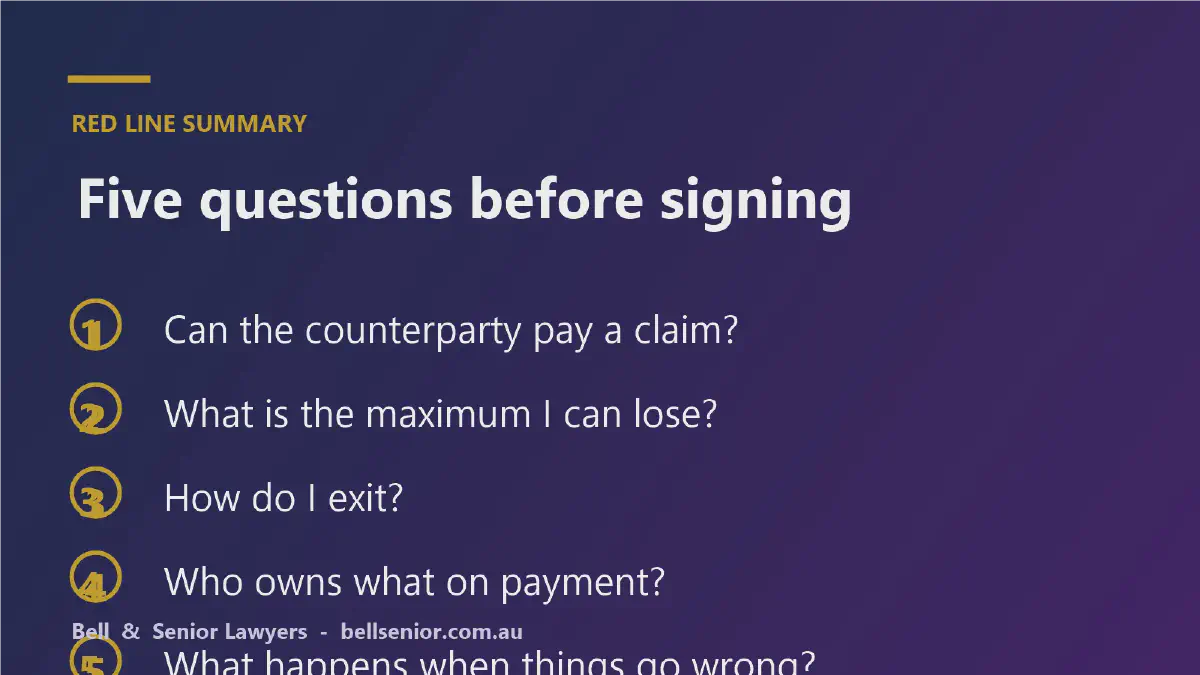
The counterparty identity decides whether any remedy is worth anything:
- Exact legal name: “XYZ Pty Ltd” not “XYZ” - check the ABN lookup for the registered name and ACN
- Solvency signals: company search (directors’ history, charges registered), years trading, reviews
- The guarantor question: for significant supply or service contracts with newly formed companies, a personal guarantee from the director converts an empty-shell risk into a collectible promise
- Related entities: who signs vs who performs vs who invoices - mismatches hide liability-shifting
The five minutes spent verifying the counterparty outrank every other clause check, because remedies against a vanished entity are theoretical exercises.
The Money Clauses - Price, Payment and Escalation
Read these with a calculator open:
The price itself: fixed or variable? What triggers variation? Is GST included (the contract should say - the GST-inclusive presumption applies where silent)?
Payment terms: when do invoices issue, when are they due, what interest runs on late payment (and is it a genuine estimate or an unenforceable penalty)? The customer’s review asks: can I pay early for discount? The supplier’s asks: what security exists for long payment cycles?
Escalation clauses: CPI-linked or unilateral price rises? The unilateral variety in standard-form small-business contracts is UCT-exposed; CPI-linkage with notice is the defensible version.
Deposits and progress payments: what do they secure, what happens on termination mid-performance? The progress-payment schedule should track deliverable milestones, not calendar dates alone.
Automatic renewals: the auto-renewal clause that requires 90 days’ notice to exit is the subscription-economy trap. Diarise every renewal window the moment the contract signs.
The Performance Clauses - Scope, Standards and Time
Scope definition: what exactly is being delivered? Deliverables enumerated, acceptance criteria stated. The scope clause is 80% of services disputes - vagueness here writes next year’s argument.
Time commitments: deadlines stated as obligations (“by 30 June”) or aspirations (“targeting Q2”)? Consequences of delay: extension rights, delay damages, termination triggers?
Quality standards: specifications referenced (which standard? whose test?), warranty periods, defect-notification windows (the customer’s obligation to notify defects promptly - check the length before signing).
Dependencies declared: what must you provide for performance (access, information, approvals)? The supplier delayed because the customer never supplied inputs needs the dependency clause as defence - customers should read it as their own deadline list.
The Risk Clauses - Liability, Indemnity and Insurance
The three clauses that allocate catastrophe:
Liability caps: what is the maximum either party can owe? Measured against contract value and your realistic worst-case loss. The cap expressed as “fees paid in the preceding 12 months” needs the arithmetic done against actual fees - the number surprises people.
Exclusions: consequential loss excluded - but defined how? The undefined “consequential loss” is a litigation lottery; demand the definition (lost profits? lost data? all indirect loss?).
Indemnities: who indemnifies whom for what? The one-way indemnity from you is a red flag; the indemnity outside the liability cap is a second unlimited promise. Check whether the indemnity covers the other party’s own negligence.
Insurance requirements: whose insurance covers the allocated risks, at what levels, with proof required when? An indemnity backed by no insurable interest is an unsecured promise.
The negotiation positions here are predictable (customers push caps up and carve-outs wide; suppliers defend narrow), which is why the clauses reward preparation: know your walk-away numbers before the call.
The Exit Clauses - Termination and Its Consequences
Termination rights both ways: for cause (which breaches qualify, cure periods of realistic length) and for convenience (who holds it, what payment accompanies it)?
The consequences schedule: final payment mechanics, refund of prepaid amounts, handover duties (data, source code, credentials), survival of confidentiality/indemnity clauses.
Suspension rights: can the supplier suspend services for late payment without terminating? The suspension clause is leverage; check notice requirements before it activates.
Renewal and wind-down: auto-renewal windows diarised; exit-assistance periods defined (the SaaS data-export right is the modern example).
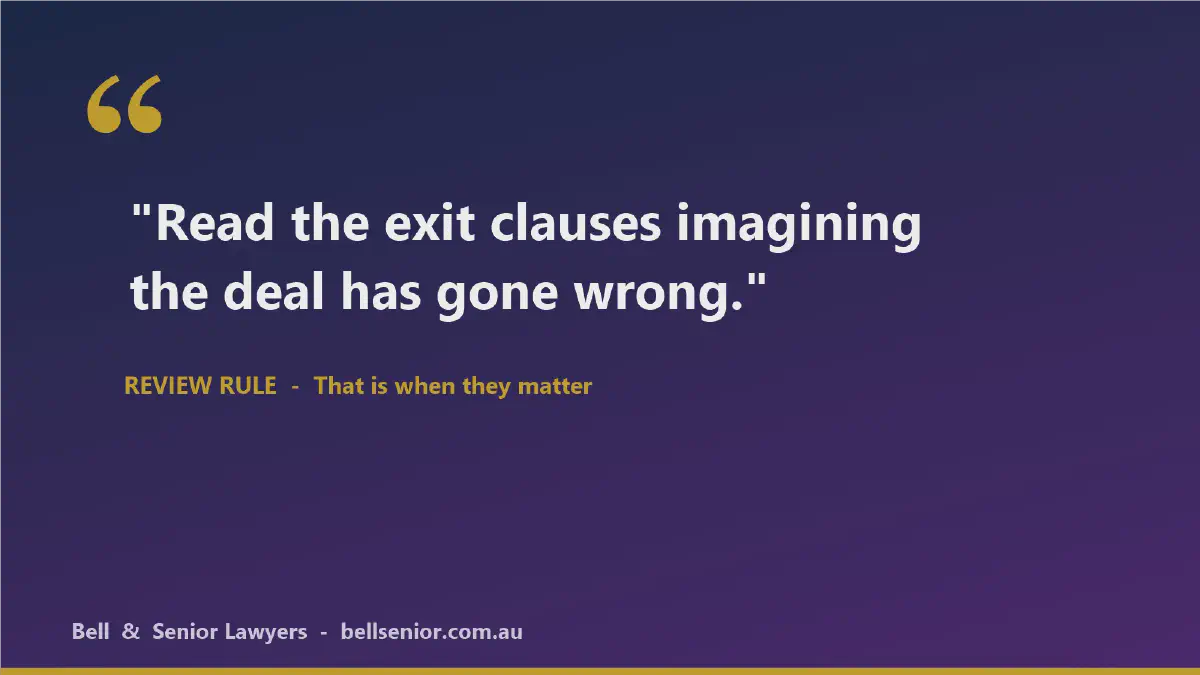
A contract with strong performance terms and weak exit terms is a gilded cage. Read the exit clauses imagining the deal has gone wrong - because that is when they matter.
The Fine Print That Bites
The boilerplate deserves its own pass:
- Entire agreement - kills every pre-contract promise. If a salesperson’s representation mattered, it goes in the document or it does not exist
- Variation - unilateral variation clauses (“we may update these terms”) are UCT-exposed for small business; demand consent-based variation
- Assignment - can the contract be transferred to a third party without your consent? The assignment-to-competitor scenario is why consent clauses exist
- Non-solicitation - whose staff can be poached, for how long? Mutual and time-limited is fair; one-sided and open-ended is not
- Notices - email valid? Address current? The clause decides whether your termination notice legally arrived
- Force majeure - enumerated events only? Exit right after defined duration? The COVID lessons apply
- Governing law/forum - interstate counterparty terms nominating their home forum add cost to every dispute
- Dispute ladder - negotiation/mediation tiers with time limits that actually bite, preserving urgent injunctive rights
The Consumer Overlay - When Extra Rules Apply
Where the contract involves consumer transactions (personal, domestic, household purposes) or small-business standard forms:
- Consumer guarantees cannot be excluded - “no refunds”, “as is”, warranty-waiver language is void, and misrepresenting consumers’ rights attracts penalties
- Unfair terms are void - and post-November 2023, proposing them carries civil penalties against the proposing business
- Door-to-door and phone sales carry cooling-off regimes with prescribed disclosure requirements
- Prescribed wording rules govern how businesses may limit consumer-guarantee remedies
The business-side lesson: the compliance cost of unfair drafting now exceeds its benefit. The consumer-side comfort: the worst-looking clause may already be legally dead.

IP and Confidentiality - Who Owns What
Commissioned work: the default law gives copyright to the creator - not the payer. The customer buying custom software, design or content should require express assignment on payment, including source code and moral-rights waivers. The developer must carve out pre-existing IP with a licence back.
Open-source disclosure: copyleft licences (GPL family) can contaminate proprietary code obligations - demand disclosure of open-source components in any software contract.
Licences vs assignments: a perpetual exclusive licence can achieve most commercial goals without transfer; know which you are negotiating.
Confidentiality: mutual? Surviving termination for how long? Standard exclusions present (public knowledge, independent development)? A confidentiality clause without practical remedy (liquidated amounts or indemnity) protects nothing real.
Data and Privacy Clauses - The Modern Mandatory
Any contract touching personal information needs:
- Roles defined: who is the “controller”/responsible party, who processes on whose instructions?
- Purpose limitation: data used only for the contracted purpose
- Security standards: at minimum reference to reasonable safeguards; specifics for sensitive data
- Breach notification: defined timelines (days, not months)
- Return/destruction on exit: the data-export right is the exit-clause cousin
- Sub-processors: consent or notice before third parties receive data
The Australian Privacy Act’s reform trajectory makes these clauses stricter over time; contracts drafted today should anticipate tomorrow’s standards rather than yesterday’s.
The Negotiation Email - Turning Review Into Terms
The review produces a list; the negotiation converts it. The email that works:
“We are ready to proceed subject to the following amendments: (1) clause X - liability cap increased to 12 months of fees; (2) clause Y - mutual indemnities limited to breach and negligence; (3) clause Z - termination for convenience on 60 days notice with payment for work performed. We can sign within 24 hours of receiving amended terms.”
The anatomy: numbered amendments, replacement wording proposed (not objections), a completion incentive (speed), no more than 3-5 asks (the rest is noise). The counterparty’s legal team processes this in one pass; the paragraph of grievances gets filed.
The trade discipline: concede governing law to win the liability cap; accept their mediation body to fix your indemnity. Every amendment is currency - spend deliberately.
Papering concessions: agreed changes are variations signed by both parties - not emails to be interpreted later. The contract register holds every executed version.
When to Walk Away
Some contracts should not be fixed:
- The counterparty refuses all amendments to standard terms with significant exposure clauses - the refusal itself is information
- The economics only work if nothing goes wrong - contracts are priced for what happens when something does
- You cannot verify the core promise (references, insurance certificates, financial capacity)
- The relationship began with misrepresentation - it does not improve under contract
- Your lawyer says the exit clauses are unusable and you need an exit
Walking away from a bad contract is a negotiation skill. The deal that costs you nothing to decline is the cheapest transaction you will ever review.
The Printable Checklist
Identity and capacity:
- Counterparty’s exact legal name and ACN verified (ABN lookup)
- Solvency/reputation checked; guarantee obtained where exposure warrants
- Signatory has authority to bind the entity
Money:
- Price fixed or variable - variation triggers identified
- GST treatment stated
- Payment terms, late-payment interest checked against penalty doctrine
- Deposit/progress payments tied to milestones
- Auto-renewal windows diarised from signing day
Performance:
- Deliverables enumerated with acceptance criteria
- Deadlines stated as obligations with consequences
- Quality standards referenced by specification
- Your own dependencies (inputs, access, approvals) listed as deadlines
Risk:
- Liability cap arithmetic done against realistic worst case
- “Consequential loss” defined or defined by you
- Indemnities mutual, capped, fault-based
- Insurance requirements verified as obtainable
Exit:
- Termination for cause with realistic cure periods
- Consequences scheduled (payment, refunds, handover, survival)
- Exit-assistance/data-export rights present where relevant
Fine print:
- Entire-agreement clause noted - verbal promises moved into writing
- Unilateral variation removed or converted to consent-based
- Assignment requires consent
- Notices clause workable (email valid, address current)
- Governing law/forum acceptable; dispute ladder time-limited
Consumer overlay (where applicable):
- No void exclusion of consumer guarantees relied on by either side
- Standard-form terms survive the UCT test
- Cooling-off rights preserved and diarised where they apply
Process:
- Every clause date diarised at signing
- Executed copies with all amendments kept in the contract register
- Legal review obtained for high-value or complex contracts
Case Studies - The Review That Paid
The cap arithmetic. A Gold Coast IT firm reviewed a managed-services agreement capping supplier liability at “fees paid in the preceding 3 months” ($9,000 against a $36,000 annual contract). The client’s realistic worst case - a failed backup restoration destroying financial data - exceeded $400,000 in recovery costs. The negotiation email proposed a 12-month fee cap with carve-outs for data loss; the supplier agreed to 6 months plus a $250,000 super-cap for data incidents. Review cost: two hours. The uninsured gap it closed: most of a business.
The auto-renewal that wasn’t. A marketing agency’s three-year office lease contained an option to renew exercisable “not less than six months before expiry” - buried in schedule four. The agency’s contract register flagged the date; the reminder fired; the renewal notice was served on time. The landlord, who had a higher-paying tenant waiting, contested the notice on technical grounds and lost. Without the register, the agency loses its location, its fit-out amortisation, and its negotiating position.
The UCT citation. A small business received a SaaS provider’s standard terms containing unilateral price variation and a no-refund clause on prepaid fees. Rather than negotiating clause-by-clause, the business replied citing the unfair-contract-terms regime: both clauses were candidates for void-and-penalty treatment for standard-form contracts to small businesses. The provider’s “standard” terms were amended within days. The lesson: knowing the regulatory framework is leverage that costs nothing to carry into a negotiation.
The Annual Contract Audit
Contracts age; businesses change. Once a year:
- List every recurring contractual relationship - suppliers, customers on standard terms, SaaS tools, leases, finance
- Re-run this checklist against each - your bargaining position may have changed
- Check renewal and notice windows for the next 18 months - diarise everything
- Update the counterparty file - solvency signals, insurance certificates, contacts
- Retire dead contracts formally - the auto-renewing agreement nobody uses still bills
The audit takes an afternoon annually. The alternative discovers the answers one dispute at a time.
FAQ Links and Further Reading
- Commercial law FAQs
- Contract breach remedies
- Are verbal contracts binding?
- Essential clauses guide
- Breach remedies guide
- Unfair contract terms guide
- Commercial law practice area
Signing Mechanics and the Contract Register
The review is complete; the signature approaches. The last discipline:
Verify signatory authority: the director signing for the counterparty (ASIC search confirms appointment); the delegated manager on your side acting within your authority policy. The unauthorised signature is the dispute that starts before the contract operates.
Execute properly: both parties sign the same version; every amendment schedule attached and initialled; dates complete. The “we’ll sort the paperwork later” instinct has ended more good deals than bad ones.
Build the register: one spreadsheet - contract, counterparty, value, start, expiry, renewal windows, notice periods, key obligations. The register is what makes the annual audit possible and what prevents the auto-renewal surprise entirely.
Store retrievably: executed originals in one dated folder per contract, scanned, backed up. The clause that wins the dispute is the clause you can produce.
The Closing Word
Contract review is not about distrusting counterparties - most businesses deal honestly most of the time. It is about ensuring that when assumptions fail, the document allocates the consequences deliberately rather than by default. Every clause in this checklist exists because someone, somewhere, discovered its absence in the worst possible way.
The habit stack is simple: triage before reading, verify before trusting, calculate before capping, diarise before filing. Run every significant contract through this checklist and the negotiation email writes itself - and the contracts you sign become assets rather than liabilities waiting to mature.
Signing something significant? Bell & Senior reviews and negotiates Queensland commercial contracts - fixed fees, 48-hour turnarounds available. Call (07) 5532 8777 or contact our Southport office . General information only - not legal advice.
Sector Quick Checks
SaaS and technology: data-export rights on exit; uptime commitments with service credits that actually compensate; source-code escrow where business continuity depends on the software; the super-cap for data breaches.
Supply and distribution: retention-of-title registered on the PPSR (unregistered ROT is the silent failure); delivery terms allocating risk in transit; minimum purchase obligations with realistic forecast mechanics.
Services and consulting: scope clause as the whole contract; variation process written and used; key-person clauses where specific individuals matter; intellectual property assignment on final payment.
Leases and licences: make-good obligations costed before signing; security (bank guarantee vs bond) return mechanics; assignment consent criteria objective; outgoings caps defined.
Finance documents: default notice periods; enforcement consequences; the personal guarantee read line-by-line (guarantees are where “standard terms” hide unlimited liability).
Each sector adds its own traps to the universal checklist - the universal list catches 80%; the sector check catches the rest.
Reading the Other Side’s Contract
When the counterparty’s paper arrives (the usual case), the review has an extra dimension: every clause was drafted to protect them. The reading order:
- Find their escape hatches first - liability caps, exclusions, termination rights they hold that you do not
- Find your obligations second - what you must do, by when, at whose cost; obligations you cannot control are risks to price
- Find your rights third - remedies, warranties, service levels - and check each is enforceable in practice (a remedy requiring litigation is worth less than one self-executing)
- The silence check last - what is missing? No exit clause? No data-export right? The absent term becomes the dispute
Then run the standard checklist. The asymmetry correction - converting their paper into a two-sided agreement - is precisely the negotiation email from earlier. Most counterparties accept reasonable amendments because most counterparties are reasonable; the ones who refuse have told you something valuable before you owe them anything.
The Cost-Benefit of Review
The arithmetic that justifies this entire guide:
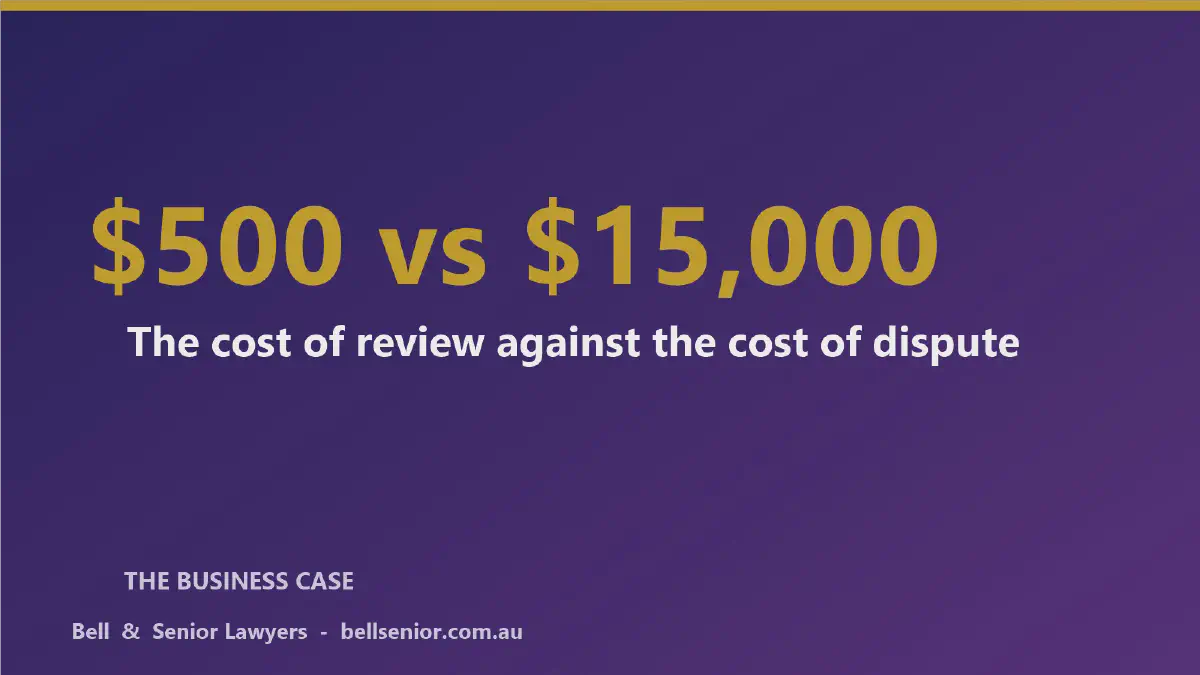
- Legal review of a commercial contract: typically $500-$2,500 fixed fee
- Litigating a badly reviewed contract: $15,000-$150,000 plus management time plus outcome uncertainty
- Probability adjustment: even a 10% chance of a material dispute makes the review the highest-return legal spend available to a business
The reviews that feel expensive are the ones skipped. Every case study in this guide - and most contract disputes generally - traces to a clause someone did not read carefully when reading it was cheap. Print the checklist, keep the register current, and treat the annual audit as non-negotiable. That is the whole discipline; everything else in this guide is commentary on it. And when a contract is too significant, too complex, or too one-sided to review alone - that is precisely what fixed-fee legal reviews are for. The review fee is always smaller than the exposure it prices - that inequality is the entire business case for this guide.
Speak With a Lawyer
Contact our Gold Coast team for a confidential discussion about your matter.
Enquiry Sent
Thank you for reaching out. A member of our legal team will contact you shortly.