
Essential Clauses for Queensland Business Contracts: What Each One Actually Does

Need legal help with this topic?
Get a confidential assessment of your matter today.

Every commercial contract has a skeleton - the standard clauses lawyers argue about line by line. This guide explains what each essential clause actually does in a Queensland contract, the negotiating positions on each side, and the drafting traps that turn boilerplate into litigation.
Governing law and jurisdiction
Decides which state/country’s law interprets the contract and where disputes are fought. A Queensland business handed a NSW-governed contract faces different precedent, different procedural rules and travel. Negotiate home unless there is a compelling reason otherwise - and note the difference between governing law (which rules) and jurisdiction (which court).
Dispute resolution tiers
The standard ladder: negotiation → mediation → litigation/arbitration, with defined timeframes at each step. Benefits: cooling-off, cost control, and mediation’s ~90% settlement rate. Traps: mandatory pre-action steps that the other party can weaponise with delay - draft time limits into each tier. 1
Indemnities: the faultless payment promise
An indemnity is a promise to make the other side whole for defined losses regardless of who was at fault - it steps outside the usual negligence apportionment. Watch for: one-way indemnities, cover for the indemnified party’s own negligence, uncapped “all losses” wording, and indemnities for third-party claims with no conduct requirement. Defensible drafting: fault-based, mutual where possible, capped, with exclusions for the indemnitee’s own acts.
Limitation of liability
The cap clause - typically “the greater of fees paid in the prior 12 months” or a fixed sum. Three drafting battlegrounds:
- What counts toward the cap (fees? insurance recoveries?)
- “Consequential loss” - Australian courts split on whether it includes lost profits; sophisticated parties now define it expressly
- Carve-outs - indemnities, confidentiality, IP infringement and consumer guarantee obligations often sit outside the cap (sometimes for both sides, sometimes just theirs)
Force majeure
Excuses performance for events beyond control. Post-2020, everyone reads it closely. Key drafting points: an enumerated list (pandemic, government order, supply failure) beats vague “acts of God”; a notice requirement (failure to notify forfeits the excuse); and an exit right if the event runs past X months - otherwise both parties are frozen in a contract neither can perform.
Termination
- For cause: defined breach categories, cure periods (7–14 days typical), and immediate termination for insolvency or serious/irremediable breaches
- For convenience: the powerful right to exit without fault - if you have it, negotiate payment for work done and sunk costs; if you don’t, understand the other side does
- Consequences: accrued rights survive, payment for WIP, IP licences that survive or die, and post-termination obligations (return of data, handover assistance)
Confidentiality
Mutual, survives termination (2–5 years typical), with standard exclusions (public knowledge, independently developed, legally compelled). The trap: carve-outs so broad the clause protects nothing.
Entire agreement
Kills reliance on pre-contract promises - everything said in the sales meeting vanishes unless written in. If you signed one, the written contract is the deal. If a promise matters, it goes in the document.
Boilerplate that bites
Assignment (can they sell the contract to your competitor?), unilateral variation (“supplier may update terms”), non-solicitation of staff, insurance obligations (can you actually obtain the named cover?), and notices clauses (email valid? address current?).
The meta-rule
Clauses are negotiable - the first draft is an opening position, not scripture. The cost of a one-hour clause negotiation is trivial against the cost of the dispute the clause decides.
- Before You Sign: the contract review checklist
- Commercial & retail leasing practice area
- Civil litigation practice area
Bell & Senior Lawyers drafts and negotiates Queensland commercial contracts - fixed fees. Call (07) 5532 8777. General information only - not legal advice.
Chapter: Governing Law and Jurisdiction - Drafted Properly
The boilerplate everyone skips is where forum shopping starts. A governing-law clause answers two different questions that contracts routinely blur:
Which law interprets the contract? For a Queensland business dealing with an interstate counterparty, the difference between Queensland and New South Wales law is rarely dramatic in commercial contract doctrine - but it is real in specific doctrines (retailer protections, property law overlays, statutory trust regimes), and the choice signals where disputes are expected to land.
Which court or tribunal hears the dispute? An exclusive jurisdiction clause names the forum; a non-exclusive clause preserves flexibility (useful where enforcement against assets in multiple places is foreseeable). The drafting trap: “the courts of [X] shall have jurisdiction” without more may be read as non-exclusive - if exclusivity matters, say “the parties submit to the exclusive jurisdiction of.”
The negotiation positions: the party with the weaker bargaining position wants home forum (no travel costs, home-law advantage); the stronger party wants its own. The common middle ground: defendant’s forum (disputes are heard where the party being sued resides) - which is genuinely mutual because each side risks being sued in the other’s home.
The arbitration overlay: for international counterparties, an arbitration clause (ACICA rules are the Australian default) buys enforceability under the New York Convention that foreign court judgments lack - the reason cross-border supply agreements arbitrate even when neither party loves it.
Drafting example
“This agreement is governed by the laws of Queensland, Australia. The parties submit to the exclusive jurisdiction of the courts of Queensland and the courts competent to hear appeals from those courts.”
Short, exclusive, and it names the appeal courts - the last part matters because a clause naming only first-instance courts generates argument about where appeals run.
Chapter: Dispute Resolution Tiers - With Time Limits That Bite
The standard escalation ladder (negotiation → mediation → litigation) is only as good as its time limits. Without them, the tier becomes a delay weapon: the breaching party “agrees to mediate” and then agrees to nothing, month after month, while your cash flow bleeds.
The drafting pattern that works:
- Good-faith negotiation - 10 business days from written notice of dispute, between named senior representatives
- Mediation - if unresolved, mediation administered by a named body (Resolution Institute or AMINZ), to commence within 20 business days and conclude within 2 months
- Court or arbitration - either party may commence after the mediation concludes or is terminated
Each tier needs its own trigger, its own deadline, and an express right to seek interim relief (injunctions, freezing orders) at any time - the ladder must never delay urgent protective action.
The mediation clause details that matter: who bears the mediator’s fees (split), who may attend (with authority to settle - a mediation without a decision-maker is theatre), and confidentiality of the process.
The without-prejudice overlay: Queensland’s Uniform Civil Procedure Rules chapter 9 gives formal offers to settle real costs consequences - reject an offer that beats the eventual judgment and the rejecting party pays the offeror’s costs from the offer date. The clause should preserve those statutory offers alongside contractual mediation.

Chapter: Indemnities - The Faultless Payment Promise
An indemnity is the most one-sided instrument in commercial drafting: a primary promise to make the other party whole for defined losses regardless of fault, foreseeability or mitigation. It sits outside the ordinary damages rules - which is exactly why every indemnity clause deserves line-by-line attention.
The taxonomy
| Type | What it does | Risk profile |
|---|---|---|
| Fault-based | Covers losses caused by the indemnifier’s breach or negligence | Defensible, insurable - the fair default |
| Absolute / bare | Covers defined losses “howsoever caused” | Extreme - survives even the indemnified party’s own negligence unless drafted out |
| Third-party claims | Covers claims brought by others | Standard for contractor engagements; scope is everything |
| Loss of profits | Covers indirect loss | The most dangerous variant - uncapped profit indemnities can dwarf the contract value |
The five drafting questions
- Who indemnifies whom for what? One-way indemnities from the customer are a red flag; mutuality tracks risk allocation
- Does it survive termination? Most indemnities should - say so expressly
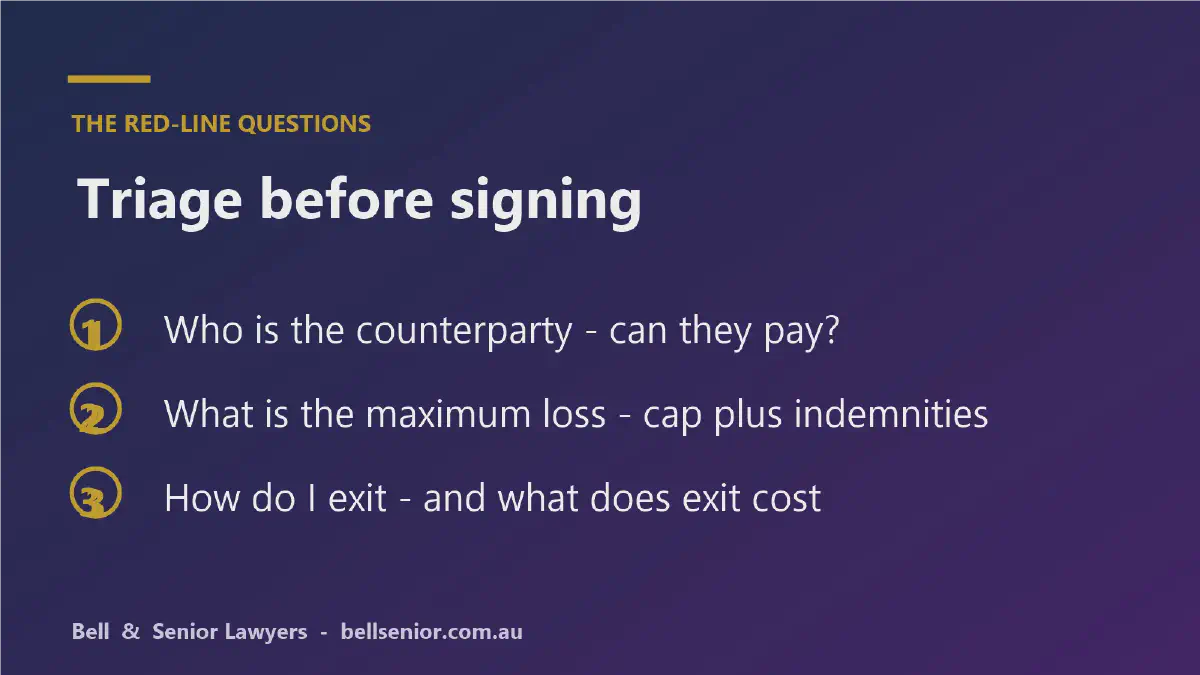
- Is it capped? An indemnity outside the liability cap is a second, unlimited promise - deliberate, sometimes, accidental often
- Does the indemnified party have a duty to mitigate? Silence favours the indemnified party; a mitigation duty favours the indemnifier
- Insurance: can the indemnifier actually obtain cover for the indemnified risk? An indemnity without insurable backing is a promise against the world
The insurance interplay
An indemnity is only as good as the indemnifier’s balance sheet or its insurance. The clause should require the indemnifier to hold specified cover and produce evidence on request - and customers should verify the certificate, not just the promise. Where the risk is severe, additional-insured status on the indemnifier’s policy converts a promise into a policy right.
The redraft example
Before: “The customer indemnifies the supplier against all losses arising from or connected to this agreement.”
After: “Each party indemnifies the other against losses to the extent caused by the indemnifying party’s breach of this agreement or its negligence, excluding losses to the extent caused by the indemnified party’s own negligence, and limited per clause [cap].”
Same length. Radically different exposure.
Chapter: Limitation of Liability - The Cap Architecture
The liability clause is where contract value and contract risk finally meet. Three architectural decisions define it:
1. The cap itself. Common structures: fees paid in the prior 12 months (the SaaS default), a fixed dollar sum, or an insurance-linked amount. The cap should track the counterparty’s realistic insurance and turnover - a $1M cap against a $80,000-a-year supplier is a promise of air.
2. What counts toward the cap. “All payments made under this agreement” versus “fees paid in the 12 months preceding the claim” produce very different numbers on long contracts. Aggregation rules (multiple claims, one cap or per-claim caps) decide the tail scenarios.
3. The carve-outs. What sits outside the cap: usually indemnity obligations, confidentiality breaches, IP infringement, wilful misconduct - and, critically, consumer guarantee liabilities, which the ACL will not allow to be excluded at all in consumer contexts.
The “consequential loss” problem
Australian courts have split on whether “consequential loss” includes lost profits (the debate turns on the second limb of Hadley v Baxendale). Modern drafting defines the exclusion expressly: “neither party is liable for loss of profits, loss of revenue, loss of data, or indirect or consequential loss, however arising” - followed by the carve-outs for the losses that matter to the deal. If the clause excludes consequential loss without defining it, the ambiguity itself is the dispute.
The ACL interaction
Terms excluding or limiting consumer guarantee remedies are void in consumer contexts - and the ACL also restricts the liability-limiting language businesses may use for consumer guarantees (the prescribed wording regime). For B2B contracts above the consumer thresholds, exclusion is lawful but must be reasonable under the unfair-contract-terms analysis where the contract is standard-form - the two regimes overlap here, and a cap that survives one test can fail the other.
The negotiation playbook
- Customers: push the cap up to 12-24 months of fees, carve out data-breach and IP indemnities, define consequential loss to preserve lost profits where that is the real risk
- Suppliers: accept a cap (it is a selling point), resist carve-out creep, and require the customer to carry its own insurance for its consequential exposure
- Both: say what happens to prepaid fees on termination - the refund mechanics are a cap clause in disguise
Chapter: Force Majeure and Hardship - Post-Pandemic Drafting
Force majeure clauses excuse performance when events beyond control prevent it. COVID turned this once-neglected clause into the most litigated standard term in commercial contracts - and the drafting lessons are now settled.
The enumerated list beats the general phrase. “Acts of God, war, government order, epidemic, pandemic, supply-chain failure, industrial action, natural disaster” - name the risks you actually face. A bare “events beyond the parties’ reasonable control” invites the court to decide what “beyond control” means, which is another way of saying it invites a dispute.
Notice and mitigation duties: the affected party must notify within a defined window (5-10 business days) and mitigate. Without a notice requirement, the excuse can be deployed retrospectively against a party who had no idea performance was excused - an unfairness the doctrine will not tolerate.
The exit right: if the force majeure event continues past a defined period (60-180 days), either party may terminate. Without it, both parties are frozen in a contract neither can perform - the COVID lesson in one sentence.
Hardship clauses (rare in Australian standard forms, common in long-term supply): a price or quantity review mechanism when circumstances change fundamentally but performance remains possible. For multi-year supply agreements, the hardship clause is cheaper than the relationship breakdown that follows its absence.
The Australian caveat: force majeure is purely contractual - there is no general doctrine excusing performance for changed circumstances. If the clause does not cover the event, the contract stands (subject to the very narrow doctrine of frustration). The clause is the only protection, so the enumeration is the negotiation.
Chapter: Termination - The Clause That Ends All Clauses
Termination rights are the enforcement mechanism for every other clause - and the source of the sharpest disputes when drafted loosely.
For cause
The structure: defined breach categories (material breach, insolvency events, IP breaches, confidentiality breaches), a cure period for curable breaches (7-14 business days is standard), and immediate termination for irremediable breaches. Two details decide most disputes: how the breach is notified (written, specifying the breach - a general grievance letter is not a termination notice), and whether the cure opportunity was genuine (a 48-hour cure window for a breach requiring a month to fix is not genuine).
For convenience
The right to exit without fault - the customer’s favourite, the supplier’s nightmare. The negotiation is the payment: termination for convenience should carry payment for work performed plus committed, non-cancellable costs (and nothing for lost future profit unless the supplier priced that risk in). Suppliers who cannot refuse the clause should price it into the rates.
The consequences clause
What happens on termination is where the money moves: payment for work performed to date, refund mechanics for prepaid undelivered services, handover obligations (data, source code, credentials), survival of confidentiality/indemnity/IP clauses, and the transition assistance regime (duration, rates).
The repudiation danger
Terminating without a right to terminate is itself a repudiation - it converts you from the innocent party into the breaching party, with the counterparty entitled to damages. The discipline: never terminate on a legal theory you have not verified in writing. The letter of advice before the termination notice is the cheapest insurance in commercial litigation.
Chapter: IP, Confidentiality and the Fine Print
Intellectual property
The default law gives copyright to the creator - which for commissioned software, design or content means the developer, not the customer. The contract reverses or preserves that default:
- Customers buying custom work should require assignment of all IP on payment, expressly including source code, documentation, and a waiver of moral rights - plus delivery of source in escrow or repository form
- Developers must carve out pre-existing IP (frameworks, libraries, tools) with a perpetual licence granted to the customer - otherwise the assignment clause accidentally sells the reusable asset base for one project’s fee
- Open-source components must be disclosed with their licences: copyleft obligations (GPL family) can require the customer’s own code to be released open-source - a real and litigated contamination risk
Confidentiality
Mutual, surviving termination for 2-5 years, with the standard exclusions (public knowledge, independent development, legally compelled disclosure). The trap: carve-outs so broad the clause protects nothing. The other trap: confidentiality clauses with no practical remedy (the loss from a leak is often unquantifiable - consider a liquidated amount or an indemnity for third-party claims).
The boilerplate that bites
- Entire agreement - kills every pre-contract promise. If a representation mattered, it goes in the document
- Unilateral variation - “the supplier may update these terms” with no consent right: the customer signs a contract with future strangers
- Assignment - can the contract be sold to your competitor? Consent-required assignment is the default protection
- Non-solicitation of staff - mutual, time-limited (12 months), and genuinely protective
- Notices - email valid? Address current? The clause decides whether your termination notice legally arrived
The Negotiation Playbook
The first draft is an opening position, not scripture - and the response is negotiation, not acceptance. The playbook:
- Triage the clauses against the seven chapters above; identify the three that matter most for this deal
- Prepare the redraft before the call - proposed wording beats objections
- Trade across clauses - accept their governing law to win the liability cap; concede the cap to fix the indemnity
- Paper every concession - the agreed variation is a contract amendment, signed
- Know the walk-away - the clause you cannot live without is the one that justifies losing the deal
- Before you sign: the contract review checklist
- Breach of contract: your remedies
- Unfair contract terms: the 2023 reforms
- Taking a business to QCAT
- Commercial law practice area
Bell & Senior drafts and negotiates Queensland commercial contracts - fixed fees, fast turnarounds. Call (07) 5532 8777 or contact our Southport office . General information only - not legal advice.
Chapter: Sector Variations - The Same Clause, Different Stakes
SaaS and technology supply. The liability cap conversation is dominated by data: a breach of the provider’s security can cost the customer multiples of the annual fee, so customers push a “super-cap” for data breaches (10x fees is a common landing). Data-export and exit-assistance clauses are the SaaS version of make-good. And the UCT regime applies directly to standard-form SaaS terms sold to small businesses - the auto-renewal and unilateral-variation clauses the industry standardised on are now void-and-penalised territory.
Supply and manufacturing. Retention-of-title clauses secure unpaid goods only if registered on the PPSR - the unregistered ROT clause is the most common silent failure in supply contracts. Delivery terms (Incoterms for international), inspection-and-rejection windows, and batch/warranty obligations carry the quality risk.
Services and consulting. The scope clause is the contract: deliverables, acceptance criteria, and the variation mechanism decide 80% of disputes. Professional indemnity insurance requirements should match the indemnity exposure - and the “personal services” caveat matters for the ABN contractor workforce.
Leases and licences. Not technically contracts of sale, but the same clause architecture applies with property-specific overlays: make-good (the end-of-term liability), security (bank guarantees vs bonds), and assignment consent rights. See the retail leasing guide for the full treatment.
The One-Page Red-Line Summary
Before signing any standard-form contract, the review reduces to five questions:
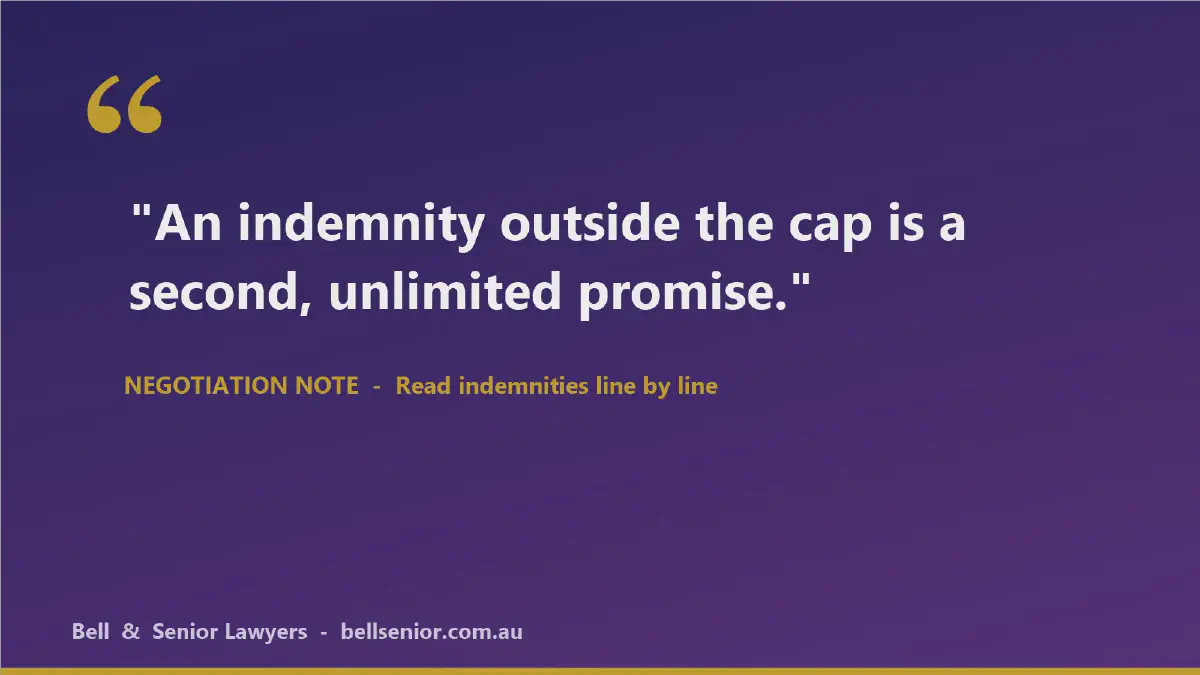
- Who is the counterparty - and can they pay a claim (or is there a guarantee)?
- What is the maximum I can lose under this contract, counting the cap, the indemnities and the exclusions together?
- How do I exit - for cause, for convenience, and what does exit cost?
- Who owns what - IP, data, materials - on payment and on termination?
- What happens when things go wrong - which forum, which law, whose costs?
If the answers to those five questions are acceptable, sign. If any answer is unknown, that clause is the negotiation.
- Before you sign: the contract review checklist
- Breach of contract: your remedies
- Unfair contract terms: the 2023 reforms
- Commercial law practice area
Bell & Senior drafts, reviews and negotiates Queensland commercial contracts - fixed fees, 48-hour turnarounds available. Call (07) 5532 8777 or contact our Southport office . General information only - not legal advice.
Related FAQs and Guides
- Can a SaaS agreement completely exclude liability?
- What business structure should my tech startup use?
- Before you sign: the contract review checklist
- Breach of contract: your remedies
- Unfair contract terms: the 2023 reforms
- Commercial law practice area
Chapter: Worked Example - Negotiating a SaaS Agreement
A Gold Coast marketing agency (12 staff) signs up for a project-management SaaS platform. The standard terms arrive: 24-month lock-in, unilateral price variation, liability capped at one month’s fees, no data export on exit, unilateral suspension for “any reason.”
The triage: the data (client campaign material) and the lock-in are the real exposures. The cap is inadequate against a data-loss claim. Suspension without notice threatens client deliverables.
The negotiation email (extract):
“We are ready to proceed subject to four amendments: (1) clause 14.3 - suspension only for amounts unpaid 14 days after written notice; (2) clause 14.4 - on termination we receive a full export of our data in standard format at no charge; (3) clause 8.1 - the liability cap increases to 12 months of fees, and does not apply to breaches of confidentiality or data protection; (4) clause 6.2 - price variations limited to CPI, maximum once per 12 months, with 60 days notice. We can sign within 24 hours of the amended terms.”
The outcome pattern: providers amend for customers who ask precisely - the four amendments cost the provider nothing in a normal year and close the deal. The customers who sign unamended standard terms are the ones whose disputes fill the case reports.
The lesson: the negotiation is clause-specific, proposes replacement wording, and trades speed for the amendments that matter. The five questions in the red-line summary identify which four amendments those are.
Chapter: The Annual Contract Audit
Standard-form contracts age. The annual audit for a Queensland business:
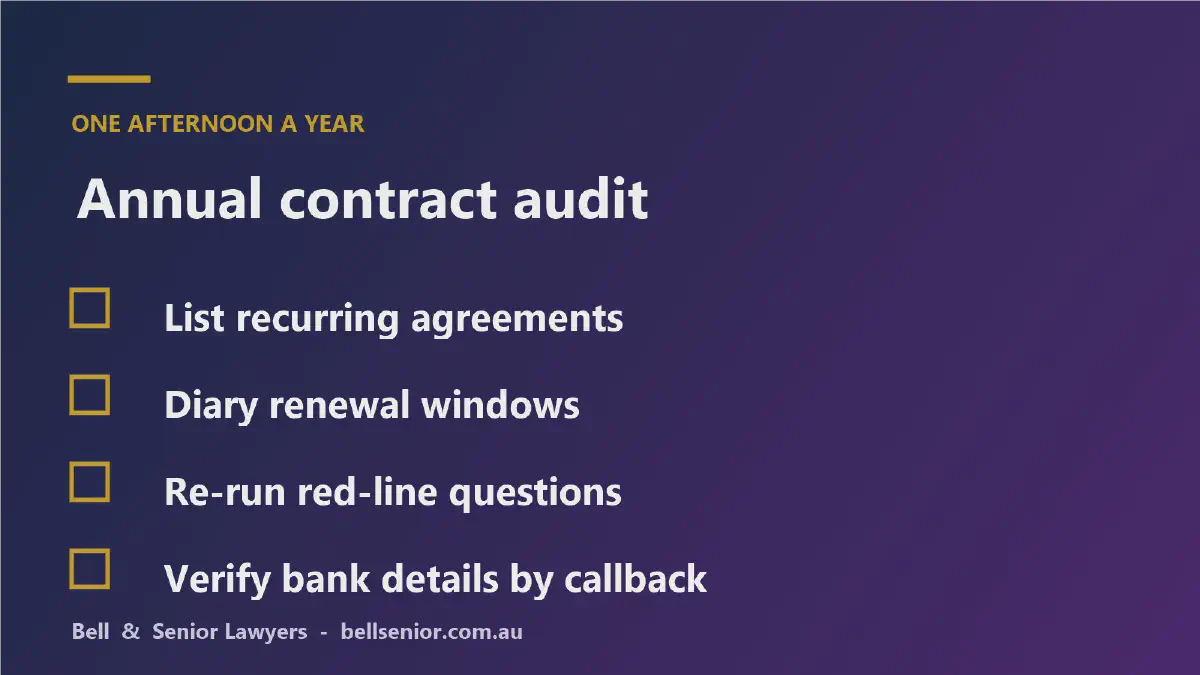
- List every recurring standard-form relationship - SaaS tools, suppliers, insurance, finance, leases, franchises
- Diary the renewal and variation windows - the 90-day non-notice auto-renewals are the classic leak
- Re-run the five red-line questions on each - the business changed this year; the answers may have too
- Check the UCT exposure - terms proposed to your small business customers after November 2023 carry penalty risk if unfair
- Update the supplier master file - bank details verified by callback (the BEC defence), contacts current, insurance certificates in date
The audit is an afternoon once a year. The alternative is discovering the answers during a dispute.
Chapter: Interstate Counterparties - A Practical Example
A Brisbane manufacturer signs a supply agreement with a Melbourne distributor. The distributor’s standard terms nominate Victorian law and exclusive Victorian jurisdiction. The manufacturer’s exposure: any dispute means litigating in Melbourne, under law that is substantively similar but procedurally different, at a cost premium for interstate counsel.
The realistic options: accept Victorian forum if the relationship is likely to be dispute-free (the cost of insisting may exceed the risk); counter with defendant’s forum (each party sues and is sued at home); or propose Queensland forum with a carve-out permitting enforcement proceedings anywhere the debtor’s assets sit. The third option is the sophisticated middle ground most businesses never think to ask for - it preserves home-court advantage for the main dispute while keeping collection practical.
The lesson generalises: every boilerplate choice has a price tag attached to a scenario. The drafting exercise is deciding which scenario you are pricing.
The final discipline: keep the signed copy where the business can find it. The clause that wins the dispute is the clause you can produce - the executed original, with every amendment attached, in the contract register the annual audit maintains.
A note on signing mechanics: the person who signs binds the entity only if they have authority. Verify signatories for counterparties (director search via ASIC, or the ABN lookup) - the unauthorised signature is the dispute that starts before the contract even operates. For your own side, a delegation-of-authority policy (who may sign what, at what value) prevents the well-meaning manager from committing the business to terms nobody reviewed.
Notes
Notes
Speak With a Lawyer
Contact our Gold Coast team for a confidential discussion about your matter.
Enquiry Sent
Thank you for reaching out. A member of our legal team will contact you shortly.
-
Property Law Act 2023 (Qld). ↩︎