

A Gold Coast property settlement follows a defined sequence of steps from separation to final formalisation, typically taking between six months and two years depending on complexity. Strict time limits apply: twelve months from divorce for married couples, and two years from separation for de facto couples. Miss those deadlines and you need the court’s permission to proceed. This guide walks through every step with indicative timeframes.

Separating from a partner on the Gold Coast brings with it a range of legal and financial tasks that need to be addressed thoughtfully and in the right order. Property settlement, the legal process of dividing assets, liabilities, and financial resources, is among the most significant. Done properly, it provides financial certainty, prevents future disputes, and allows both parties to move forward on a firm footing. Done poorly, missed entirely, or left too late, it can result in the loss of entitlements that would otherwise be protected by law.
This guide sets out the full property settlement process from the moment of separation through to final implementation, with indicative timeframes at each step.
In This Guide
What Is a Property Settlement?
Property settlement is the legal process of dividing the assets, liabilities, and financial resources of two people who have separated, whether from a marriage or a de facto relationship. It is governed by the Family Law Act 1975 (Cth), which applies throughout Australia including Queensland, and in practice encompasses everything from the family home and investment properties to bank accounts, businesses, vehicles, shares, trusts, and superannuation interests.1
A property settlement can be reached by agreement between the parties, the most common and generally the most cost-effective outcome, or determined by a judge following contested proceedings in the Federal Circuit and Family Court of Australia (FCFCOA). Either way, the substantive legal framework the parties and the court must apply is the same: the four-step process now codified by the Family Law Amendment Act 2024 (Cth) that took effect on 10 June 2025.2
A property settlement is separate from divorce. You do not need to be divorced to complete a property settlement, and in many cases it is better to address property before applying for divorce, because the twelve-month time limit for married couples begins running from the date the divorce order takes effect, not the date of separation.
Understanding the Time Limits
Time limits are the single most common source of preventable loss in family law property matters. They are strict, they are largely unforgiving, and they are set by statute.
Married Couples: 12 Months from Divorce
Under section 44(3) of the Family Law Act 1975 (Cth), a married person must commence court proceedings for property settlement (or obtain consent orders) within 12 months of the date the divorce order takes effect — that is, within 12 months of the divorce becoming final.3
There is an important sequencing point that many people miss: a divorce order cannot be applied for until the parties have been separated for at least 12 months.4 This means that in practice, the earliest a married couple can be divorced is 12 months after separation, and they then have a further 12 months from that divorce date to formalise property. In theory, a married person could have up to approximately 24 months from separation before the property settlement time limit actually bites, but this is not a reason to delay. Waiting for divorce before addressing property is generally poor strategy because it compresses your available time unnecessarily and may allow the other party to deal with assets in the interim.
De Facto Couples: 2 Years from Separation
Under section 44(5) of the Family Law Act 1975 (Cth), a person in a de facto relationship must commence proceedings for property orders within 2 years of the date of breakdown of the de facto relationship — effectively, the date of separation.5 De facto relationships are recognised under the Family Law Act in Queensland where the parties have lived together on a genuine domestic basis, and also in certain shorter relationships where there is a child of the relationship or one party has made substantial contributions to the other’s property.6
What Happens if You Miss the Deadline?
Outside these time limits, the FCFCOA will not hear your property application unless you first obtain leave of the court to proceed out of time. Leave is not automatically granted. The court must be satisfied that failure to grant leave would cause hardship to the applicant or to a child of the relationship.7 Simply being unaware of the time limit, or having delayed for reasons of convenience, will generally not satisfy the hardship threshold. Once the limitation period has expired, the other party is free to deal with, sell, encumber, or dispose of their property without any legal obligation to account to you for it.
Once the Deadline Passes, Your Rights Are Permanently Extinguished Missing the 12-month (marriage) or 2-year (de facto) deadline means you are legally locked out of your former partner’s property. Even if you were entitled to hundreds of thousands of dollars, the court will only grant a late application in cases of extreme hardship. Do not wait for ’the right time’ to bring it up — the law doesn’t wait for you.
Contact our property settlement team immediately if your deadline is approaching. Call (07) 5532 8777.
The Legal Framework: The Four-Step Process
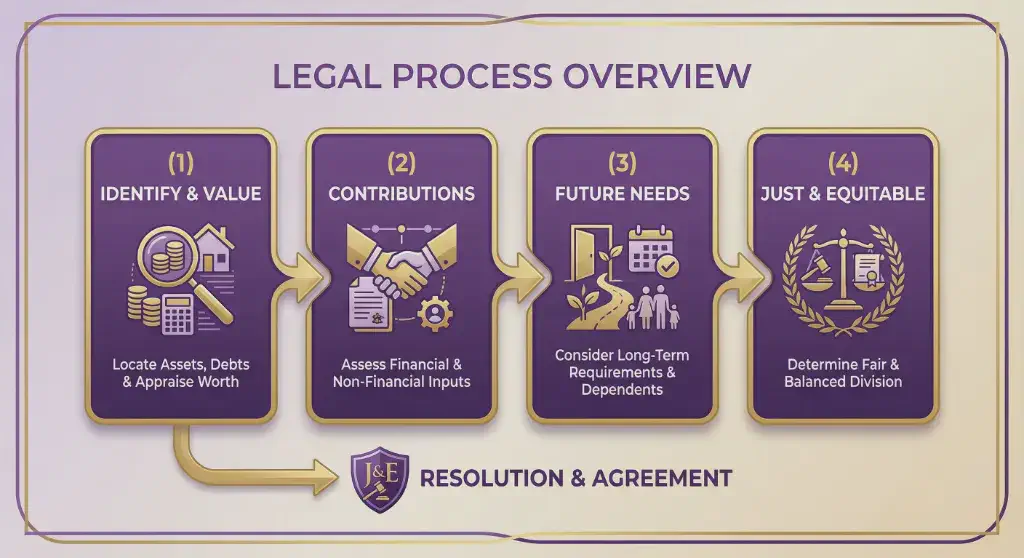
Before walking through the practical timeline, it is important to understand the legal framework that governs every property settlement, whether negotiated privately or determined by a court. Since 10 June 2025, the Family Law Amendment Act 2024 (Cth) has codified this process as a statutory framework that courts, lawyers, and parties must follow.8
Step A, Identify and Value All Property and Liabilities
The first step is to identify all assets, liabilities, and financial resources of both parties, regardless of whose name they are held in or when they were acquired. The property pool is comprehensive and includes:
- The family home and any investment or holiday properties (including Gold Coast properties held anywhere)
- All bank, savings, and offset accounts
- Superannuation interests of both parties (treated as property under Part VIIIB of the Family Law Act)9
- Vehicles, boats, caravans
- Shares, managed funds, and investment portfolios
- Business interests, including sole trader goodwill, company shares, and partnership interests
- Trusts, where a party exercises effective control over a trust, trust assets may be treated as property of that party10
- Inheritances and gifts received, included in the pool, but their origin is relevant to the contributions assessment
- All debts and liabilities, including mortgages, personal loans, HECS/HELP debts, credit cards, and tax liabilities
The pool is valued at the time of the settlement or hearing, not at the date of separation. This distinction matters significantly on the Gold Coast where property values fluctuate.
Step B, Assess the Contributions of Each Party
The second step is to assess what each party contributed to the property pool, expressed as a proportionate assessment of the overall pool. Contributions are not limited to direct financial contributions and include:
- Financial contributions: income earned, capital brought into the relationship (including pre-relationship assets), inheritances, gifts, and proceeds from the sale of pre-relationship property
- Non-financial contributions: unpaid labour improving the family home, managing investment properties, supporting a partner’s business, or building a business without drawing a market salary
- Contributions to the welfare of the family: the primary care of children and performance of domestic labour, which are recognised as contributions to the asset pool of equal value to financial contributions11
Since 10 June 2025, the court must now expressly consider the economic effect of any family violence on each party’s contributions and capacity to contribute.12 Where one party’s earning capacity was suppressed, their career interrupted, or their financial position damaged by family violence, that effect is directly factored into the contributions assessment.
Step C, Assess Each Party’s Future Needs
Once contributions are assessed, the court adjusts the outcome to account for the future needs of each party under section 75(2) of the Family Law Act 1975 (Cth).13 The relevant factors include:
- The age and state of health of each party
- The income, property, and financial resources of each party
- Each party’s capacity to earn income, taking into account their vocational skills, qualifications, employment history, and the care responsibilities they will carry
- Whether either party will have the care of children and the financial demands that creates
- The standard of living established during the relationship
- The duration of the relationship and its effect on each party’s earning capacity
- Any child support payable by either party
These factors can result in a significant adjustment to the contribution-based split, particularly in long relationships, where one party has significantly lower earning capacity, or where one party carries the primary care of children post-separation.
Step D, The Just and Equitable Requirement
Finally, the court (or the parties, in a negotiated settlement) must ensure that any proposed outcome is just and equitable in all the circumstances.14 This is an overarching requirement under section 79(2) — a court will not make a property order simply because it has been agreed by the parties if it considers the outcome unjust or inequitable. In the context of consent orders, the FCFCOA reviews the proposed terms to confirm they meet this threshold before approving the application.
The Practical Timeline: Step by Step
With the legal framework in mind, the practical steps of a Gold Coast property settlement from separation to implementation are set out below with indicative timeframes.
Step 1 — Separation: Secure Your Position
Timeframe: Immediately on separation
The period immediately following separation is the most important for protecting your financial position, and it is the period when people most commonly make costly errors by acting impulsively or by doing nothing.
Practical actions at separation:
- Document the property pool: Gather account statements, superannuation statements, property valuations, mortgage statements, and loan documents. Photograph personal property, artworks, jewellery, and vehicles. Take screenshots of online accounts and investment portfolios.
- Protect joint accounts: Consider whether funds in joint accounts are at risk of being unilaterally depleted. If so, seek urgent legal advice, the court has power under section 114 of the Family Law Act to make injunctions preventing the disposal of property pending settlement.15
- Notify your superannuation funds: You can request information about your former partner’s superannuation balance under the superannuation information-sharing provisions of the Family Law Act — this information can only be requested through the court once proceedings are commenced, so acting early on your own fund information is valuable.
- Seek legal advice: Obtaining advice at this stage, before positions harden and before either party takes steps that may be difficult to reverse, is the most effective use of legal fees in the entire property settlement process.
Step 2 — Obtain Current Valuations
Timeframe: Weeks 2–8
Before any meaningful negotiation can occur, both parties need to know what they are actually dealing with. The property pool must be valued at current market values, which for Gold Coast properties may be substantially different from purchase prices or the value at separation.
Key valuations typically required:
- Real property: A current market appraisal from a licensed valuer. Where the parties cannot agree on a valuation, the usual approach is to either agree on a single jointly instructed valuer, or for each party to obtain their own valuation, with the gap then to be negotiated. Courts generally prefer a single jointly appointed valuer for disputed real property.
- Business interests: Where one or both parties operate a business, a formal business valuation by an accredited valuer is required. Business valuations are complex, can take four to eight weeks, and are often a significant source of dispute.
- Superannuation: Self-managed superannuation funds (SMSFs) require formal valuation of their underlying assets. For industry and retail super funds, the fund itself provides a current benefit statement.
- Personal property: Vehicles, jewellery, artworks, and similar items can generally be valued by agreed online reference (RedBook for vehicles) or, for significant items, by a specialised lawyer valuer.
Step 3 — Financial Disclosure
Timeframe: Weeks 4–12
Full and frank financial disclosure is a legal obligation, not a courtesy. Both parties are required to disclose all assets, liabilities, income, financial interests, and financial resources to each other before any binding agreement is reached or consent orders are filed.16 The FCFCOA will not approve consent orders without confirmation that disclosure has been provided.
In practice, disclosure is exchanged through:
- Financial statements (Form 13 / Initiating Financial Questionnaire): The standard FCFCOA forms requiring disclosure of all assets, liabilities, income, and expenses
- Supporting documentation: Bank statements (typically three years), tax returns (three years), payslips, business financial statements, trust deeds, and any other documentation relevant to the disclosed items
- Superannuation information: Superannuation fund benefit statements or current balance confirmations
A party who fails to provide full financial disclosure risks serious consequences. The court has the power to set aside consent orders or make adverse findings where it is later established that material information was concealed, even after orders have been made.17 A party who receives consent orders knowing the other party’s disclosure was incomplete can find themselves with orders that are inadequate and no effective remedy if the limitation period has passed.
Hiding Assets Is the Fastest Way to Have Your Orders Overturned The duty of ‘full and frank disclosure’ is not a suggestion. If you hide a bank account, a business interest, or a trust, the Court can set aside your final property orders years later and order you to pay the other party’s legal costs for the fraud. Total transparency is the only way to ensure your settlement is final.
Speak to us if you suspect your partner is hiding assets . We use subpoenas and forensic accounting to uncover the truth. Call (07) 5532 8777.
Step 4 — Negotiate
Timeframe: Weeks 6–20 (negotiated settlement)
With valuations agreed or substantially settled and financial disclosure exchanged, the parties, typically through their lawyers, are in a position to negotiate the terms of a property settlement…
Most Gold Coast property settlements resolve at this stage. The parties who invest the time and modest cost required for properly documented negotiation avoid the very substantial cost and delay of contested court proceedings.
Step 5 — Superannuation Splitting (If Applicable)

Where superannuation is to be split as part of the settlement, which is the case in many Gold Coast property matters, particularly those involving long relationships, additional procedural steps are required that add time to the overall process.
The superannuation splitting process:
-
Identify each party’s superannuation interests. Obtain current member benefit statements from all relevant funds. Where information is not readily available, the court’s superannuation information-gathering power can be used once proceedings are on foot.
-
Draft the proposed splitting order. The draft order specifying the split must be prepared in precise terms that comply with the fund’s requirements and the Family Law (Superannuation) Regulations 2001 (Cth).
-
Give the fund procedural fairness. The draft order must be served on the relevant superannuation fund trustee, who has up to 28 days to respond with any objection or requirement for amendment.18 This step is mandatory, a superannuation fund cannot be legally bound to effect a split unless it was given procedural fairness.
-
Formalise the orders. Once the fund has approved the draft (or the 28-day period has elapsed without objection), the consent orders are filed with the FCFCOA.
-
Serve the sealed orders and Regulation 144 Notice on the fund. After the court seals the orders, a certified copy must be served on the fund along with a Regulation 144 Notice containing the non-member spouse’s details and instructions for the split. The fund then has a further 28 days to process and effect the split.19
For self-managed superannuation funds (SMSFs), additional complexity arises from the need to comply with the Superannuation Industry (Supervision) Act 1993 (Cth) and to update the fund’s trust deed and investment strategy. Legal and accounting advice specific to the SMSF is strongly recommended.
Step 6 — Formalise the Agreement
Timeframe: Adds 4–8 weeks after terms are agreed (consent orders)
Reaching an agreement is not the same as having a legally binding and enforceable settlement. An informal understanding, a verbal agreement, or an unsigned document provides no legal protection. There are two methods of formalising a property settlement agreement:
Consent Orders
Consent orders are filed with the FCFCOA using the Application for Consent Orders (Form 11) along with the Terms of Settlement setting out the proposed orders in detail. The court reviews the application on the papers, there is no hearing, and approves it if satisfied the proposed outcome is just and equitable.20 The filing fee is $205 from 1 July 2025.21
Once sealed, consent orders carry the full force and enforceability of court orders made after contested proceedings. They can be enforced through the court’s contempt and enforcement powers if a party fails to comply. For most Gold Coast property settlements, consent orders are the preferred formalisation method.
Processing time by the FCFCOA for consent order applications varies but typically runs four to eight weeks from filing.
Binding Financial Agreement
A binding financial agreement (BFA) is a private contract between the parties under Part VIIIA (married couples) or Part VIIIAB (de facto couples) of the Family Law Act 1975 (Cth).22 It does not require court filing or approval, the parties sign it, and it becomes binding when both have received independent legal advice (evidenced by a solicitor’s certificate on each party’s copy).
A BFA can be used to deal with property not available through consent orders (for example, arrangements about property owned outside Australia), and it can be entered into before, during, or after a relationship. However, unlike consent orders, a BFA is subject to being set aside by the court on grounds including:
- Fraud or non-disclosure of a material matter
- Unconscionable conduct in obtaining the agreement
- Circumstances have arisen that make it impractical to carry out the agreement
- A material change in circumstances relating to the care, welfare, or development of a child
The risk of a BFA being challenged means that consent orders are generally preferred for post-separation property settlement where both parties are willing to cooperate.
Step 7 — Implementation
Timeframe: 4–12 weeks after orders are made
Making the orders is not the end of the process, the orders must be implemented. Implementation involves the practical transfer of assets, discharge of liabilities, and fulfilment of each obligation specified in the orders. Key implementation tasks typically include:
- Transfer of real property: The title transfer is effected through the Queensland Land Registry. Stamp duty (transfer duty) is not payable on property transferred pursuant to a family law order or financial agreement under section 246 of the Duties Act 2001 (Qld) — a significant saving.23
- Refinancing: Where one party takes over the family home, the existing joint mortgage must be refinanced into their sole name. This requires lender approval and is separate from the legal order to transfer, a lender is not bound by a family law order to accept a single borrower. Refinancing timing should be considered when drafting the settlement terms.
Don’t Stay on a Mortgage for a House You No Longer Live In A court order to transfer property does not automatically release you from the mortgage. If your former partner defaults on the loan while your name is still on it, the bank will come after you for the full debt, and your credit rating will be destroyed. Ensure your settlement includes a strict deadline for refinancing.
Contact Bell & Senior Lawyers to ensure your settlement terms protect you from future debt liability. Call (07) 5532 8777.
- Share and investment account transfers: Conducted through the relevant broker or platform, typically requiring a certified copy of the sealed court orders.
- Superannuation split: As described in Step 5 above, effected by service of the sealed orders and Regulation 144 Notice on the fund.
- Discharge of joint debts: Joint accounts, credit cards, and personal loans should be addressed, joint liabilities remain the legal responsibility of both parties until the lending institution agrees to release one party, regardless of what the family law orders say.
The Full Timeline at a Glance
| Stage | Activity | Indicative Timeframe |
|---|---|---|
| Separation | Secure documents, get initial advice | Week 1 |
| Valuations | Real property, business, super | Weeks 2–8 |
| Financial disclosure | Exchange Form 13 and supporting documents | Weeks 4–12 |
| Negotiation / FDR | Without-prejudice exchange, mediation | Weeks 6–20 |
| Superannuation procedural fairness | Serve draft on fund; 28-day response | Add 4–8 weeks |
| Consent orders filed | FCFCOA processes application on papers | Add 4–8 weeks |
| Implementation | Transfers, refinance, discharge debts | Add 4–12 weeks |
| Total, cooperative, moderate complexity | 6–12 months | |
| Total, complex or contested | 12–24+ months |
What Happened on 10 June 2025: The New Legal Framework
On 10 June 2025, significant amendments to the property settlement provisions of the Family Law Act 1975 (Cth) took effect under the Family Law Amendment Act 2024 (Cth).24 These amendments affect all property settlements, whether resolved by agreement or by a court, that were not finalised before that date.
The key changes are:
1. Codification of the four-step framework. The courts’ longstanding four-step approach to property settlement, previously developed through case law, has now been expressly written into the statute. This provides greater clarity and consistency.
2. Economic effect of family violence. The court is now expressly required to consider the economic effects of any family violence on the parties when assessing contributions and future needs.25 This includes the suppression of a victim’s earning capacity, interruption to their employment or career, and financial harm caused by the perpetrator’s conduct during the relationship.
3. Restructured contributions framework. The statute now more explicitly addresses the range of contributions recognised, including contributions as primary carer and homemaker, which are given equal standing to financial contributions.
4. Hardship for children. Future needs considerations have been refined to place greater emphasis on the housing and care needs of children of the relationship.
These changes apply to all negotiations and proceedings commenced or continuing from 10 June 2025. If you received legal advice about your property settlement before that date, it is worth revisiting whether the new framework affects the outcome you were previously advised to expect.
When Agreement Cannot Be Reached: Court Proceedings
Where good-faith negotiation and FDR have been genuinely attempted but the parties cannot reach agreement, court proceedings in the FCFCOA become necessary. From the date of filing an initiating application for financial orders, the typical court timeline to a final hearing is 12 to 24 months, and the costs for a contested property final hearing are substantial, averaging approximately $30,000 per party for a typical matter, with complex cases regularly exceeding $100,000 per party.26 *The FCFCOA does not maintain a dedicated registry on the Gold Coast. All family law matters for Gold Coast residents are filed and heard in the Brisbane Registry, located at the Harry Gibbs Commonwealth Law Courts, 119 North Quay, Brisbane.27 Matters are filed electronically through the Commonwealth Courts Portal. While most procedural steps occur via the Brisbane registry, complex or lengthy trials are always heard at this location.
The court filing fee for an initiating application for financial orders (property settlement) is $435 from 1 July 2025, or $710 if combined with a parenting application. For matters proceeding to a hearing of more than one day, daily hearing fees of $695 to $945 per day (depending on Division) apply after the first hearing day.28
For a detailed comparison of the court and mediation pathways including timelines and full cost data, see our related guide: Mediation vs Court: Which is Faster for Family Law Matters in Queensland?
Protecting Yourself During the Process
The period between separation and final settlement can be months or years. During that period, both parties remain legally capable of dealing with assets held in their own name. There are several protective mechanisms available where there is genuine risk:
- Caveat on real property: Where you have a proprietary interest in real property held in the other party’s name, lodging a caveat at the Queensland Land Registry prevents the title from being transferred or mortgaged without notice…
- Section 114 injunction: The FCFCOA can make injunctive orders under section 114 of the Family Law Act preventing the disposal, encumbrance, or diminution of specified assets pending the resolution of property proceedings.29
- Bankruptcy considerations: If either party is experiencing financial difficulty, the interaction between family law property claims and the Bankruptcy Act 1966 (Cth) is complex…
Why Formal Advice Matters at Every Step
Property settlement on the Gold Coast is not a process that rewards informal arrangements. Agreements not properly documented provide no enforceable protection. Agreements reached without full financial disclosure can be set aside. Consent orders filed with incorrect superannuation splitting provisions create implementation problems that are expensive to unwind. And time limits, once missed, create obstacles that can only be overcome by demonstrating hardship to a court.
Bell & Senior Lawyers acts for Gold Coast and South East Queensland clients across all stages of the property settlement process, from initial advice at separation through to implementation of final orders…
Related Topics
- Family Lawyer Gold Coast, Divorce & Property Settlements
- Property & Conveyancing Lawyers Gold Coast
- Mediation vs Court: Which is Faster in QLD?
- Domestic and Family Violence in Queensland: The Complete Legal Guide
Speak to a trusted Gold Coast property settlement lawyer. Bell & Senior Lawyers advises Gold Coast and South East Queensland families on all aspects of property settlement from our Southport office. Call (07) 5532 8777 or make an enquiry online .
Need Legal Advice?
Contact us today to discuss your matter. We'll respond within 24 hours.
Enquiry Sent
Thank you for reaching out. A member of our legal team will contact you shortly.
-
Family Law Act 1975 (Cth) s 4 (definition of ‘property’); Part VIII (property settlement for married couples); Part VIIIAB (property and financial matters for de facto couples). ↩︎
-
Family Law Amendment Act 2024 (Cth), amending the Family Law Act 1975 (Cth) with effect from 10 June 2025; Attorney-General’s Department, ‘Family law (property) changes from 10 June 2025 — Fact Sheet’ (January 2025) https://www.ag.gov.au . ↩︎
-
Family Law Act 1975 (Cth) s 44(3) (Limitation period for property settlement, married couples — 12 months after divorce order takes effect). ↩︎
-
Family Law Act 1975 (Cth) s 48(1) (ground for divorce is irretrievable breakdown evidenced by 12 months separation); s 55(4) (divorce order takes effect one month after it is made). ↩︎
-
Family Law Act 1975 (Cth) s 44(5) (Limitation period for property settlement, de facto couples — 2 years after relationship breakdown). ↩︎
-
Family Law Act 1975 (Cth) s 4AA (meaning of ‘de facto relationship’); s 90SB (geographical nexus and threshold requirements for de facto property claims in Queensland). ↩︎
-
Family Law Act 1975 (Cth) s 44(6) (Leave required to proceed outside limitation period, court must be satisfied that hardship would be caused if leave refused). ↩︎
-
Family Law Amendment Act 2024 (Cth); Attorney-General’s Department (n 2). ↩︎
-
Family Law Act 1975 (Cth) Part VIIIB (superannuation interests); s 90MC (superannuation interest is ‘property’ for purposes of Part VIIIB). ↩︎
-
See Kennon v Spry (2008) 238 CLR 366 (High Court of Australia) (trust assets treated as property of the party who exercises effective control of the trust in appropriate circumstances). ↩︎
-
Family Law Act 1975 (Cth) s 79(4)(c) (contributions as homemaker or parent are contributions to the welfare of the family and are assessed as contributions to the property pool). ↩︎
-
Family Law Amendment Act 2024 (Cth); Attorney-General’s Department, ‘Family law (property) changes from 10 June 2025’ (n 2) (courts must consider economic effect of family violence in assessing contributions and circumstances). ↩︎
-
Family Law Act 1975 (Cth) s 75(2) (matters to be taken into account in assessing future needs, applicable to married couples by s 79(4)(e) and to de facto couples by s 90SF(3)). ↩︎
-
Family Law Act 1975 (Cth) s 79(2) (court may make such order as it considers appropriate for the alteration of property interests, but must not make an order unless satisfied that it is just and equitable to do so). ↩︎
-
Family Law Act 1975 (Cth) s 114(1)(e) (court may grant injunction for the purposes of or in connection with proceedings for alteration of property interests). ↩︎
-
Federal Circuit and Family Court of Australia (Family Law) Rules 2021 (Cth) r 6.06 (duty of disclosure in financial proceedings, parties must give full and frank disclosure of all financial matters). ↩︎
-
Family Law Act 1975 (Cth) s 79A (court may set aside property orders on grounds including that an order was made in circumstances of fraud, including non-disclosure of a material matter). ↩︎
-
Family Law (Superannuation) Regulations 2001 (Cth) reg 44 (requirement to provide procedural fairness to superannuation fund trustee before making superannuation splitting orders; fund has 28 days to respond). ↩︎
-
Family Law (Superannuation) Regulations 2001 (Cth) reg 144 (Regulation 144 Notice, details of non-member spouse required by fund to effect a superannuation split; fund has 28 days to process). ↩︎
-
Federal Circuit and Family Court of Australia (Family Law) Rules 2021 (Cth) r 10.15 (consent order applications, court considers whether orders are just and equitable on the papers without a hearing). ↩︎
-
Federal Circuit and Family Court of Australia, ‘Family law fees, Application for Consent Orders’ (from 1 July 2025) https://www.fcfcoa.gov.au/resources/fees . ↩︎
-
Family Law Act 1975 (Cth) Part VIIIA (financial agreements for married couples); Part VIIIAB (financial agreements for de facto couples in participating jurisdictions including Queensland). ↩︎
-
Duties Act 2001 (Qld) s 246 (exemption from transfer duty for dutiable transactions arising from or reasonably attributable to a breakdown of a relationship if the transaction is given effect under a court order or a financial agreement under the Family Law Act). ↩︎
-
Family Law Amendment Act 2024 (Cth), operational from 10 June 2025; Attorney-General’s Department (n 2). ↩︎
-
Attorney-General’s Department, ‘Family law (property) changes from 10 June 2025’ (n 2) (economic effects of family violence expressly required to be considered from 10 June 2025). ↩︎
-
Mediations Australia, ‘How Much Does a Family Lawyer Cost in Australia?’ (December 2025) https://mediationsaustralia.com.au ; Federal Circuit and Family Court of Australia reporting. ↩︎
-
Federal Circuit and Family Court of Australia, ‘QLD, Court Locations’ https://www.fcfcoa.gov.au/court-locations/QLD ; Brisbane Registry located at 119 North Quay, Brisbane QLD 4000. ↩︎
-
Federal Circuit and Family Court of Australia, ‘Family law fees’ (from 1 July 2025) https://www.fcfcoa.gov.au/resources/fees . ↩︎
-
Family Law Act 1975 (Cth) s 114(1)(e) (injunctions in relation to property in connection with financial proceedings). ↩︎