
Mediation vs Court: Which is Faster for Family Law Matters in Queensland?

For most Queensland families, mediation resolves parenting and property disputes in three to six months, compared to twelve to twenty-four months in the Federal Circuit and Family Court. For parenting matters, a genuine attempt at family dispute resolution is compulsory by law before filing. This guide covers compulsory requirements, exemptions, what cooperation means in practice, the real costs of both pathways, whether you can self-represent, and how to lock in any agreement you reach.

When a relationship ends and there are children to care for or property to divide, the first question most Gold Coast families ask is not which legal arguments they have, it is how quickly this can be resolved, and what it is going to cost. This guide answers both questions directly, sets out the law on when mediation is compulsory and when it is not, explains what happens when one party refuses to cooperate, and gives you the factual foundation to make an informed decision about how to proceed.
In This Guide
Two Pathways, One Goal

When a relationship ends in Queensland, parties have two broad legal pathways available to resolve disputes about children and property: Family Dispute Resolution (FDR) — commonly called mediation, and court proceedings in the Federal Circuit and Family Court of Australia (FCFCOA). Both operate under the Family Law Act 1975 (Cth), which applies uniformly across all Australian states and territories regardless of where you live.1
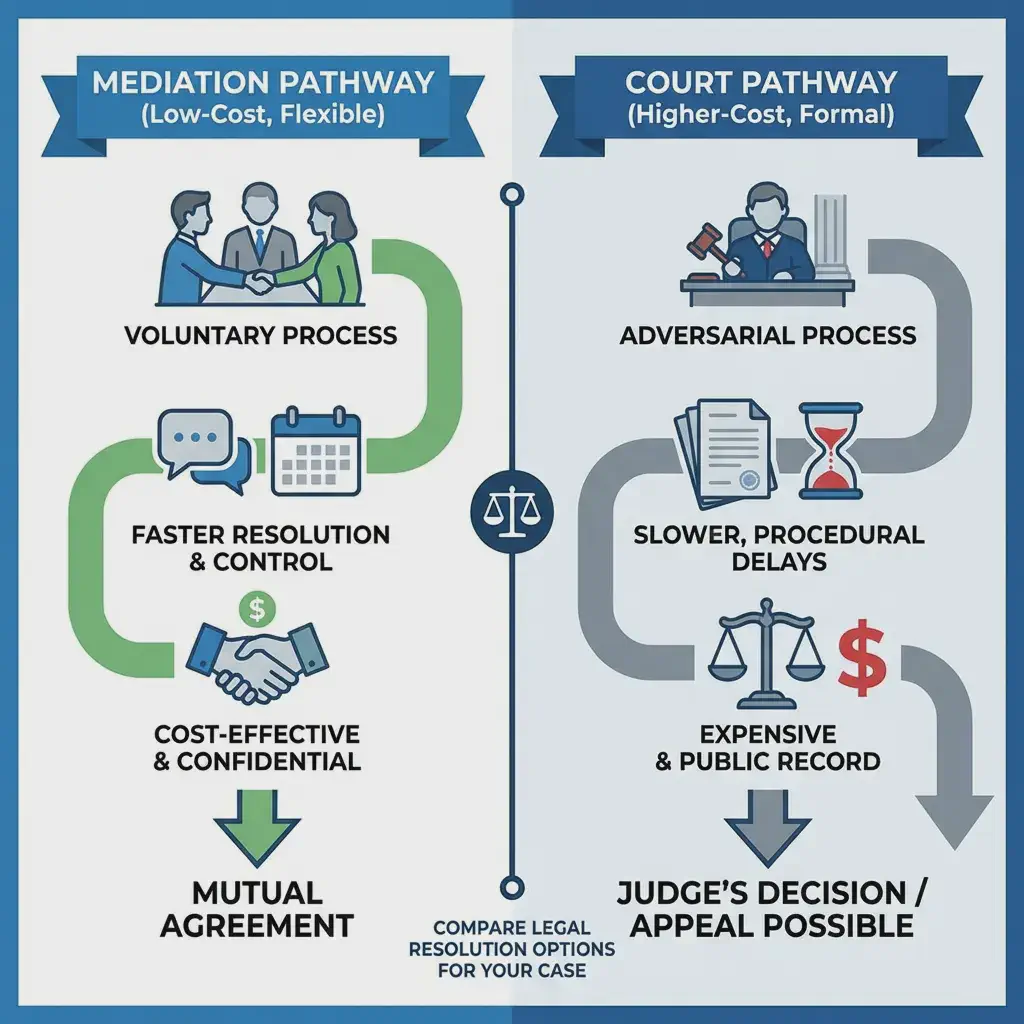
The core difference is who controls the outcome. Mediation is a structured, facilitated negotiation guided by an impartial accredited practitioner. The parties make their own decisions and reach their own agreement. Court proceedings transfer that decision-making power to a judge, who hears evidence from both parties and imposes binding orders regardless of whether either party agrees with them. Courts have coercive authority that no mediator can exercise, but that authority comes at a substantial price in time, money, and emotional toll.
Is Mediation Compulsory Before Court?
Parenting Matters: Yes, as a General Rule
For disputes about children, the Family Law Act 1975 (Cth) imposes a compulsory pre-filing requirement. Section 60I(7) provides that a court must not hear an application for a parenting order unless the applicant files a certificate issued by an accredited family dispute resolution practitioner (FDRP) under section 60I(8), or satisfies the court that one of the specific exemptions in section 60I(9) applies.2 This means that in most parenting disputes, you cannot walk into the FCFCOA and commence proceedings without first attempting FDR, the gate is closed until you have that certificate in hand or can point to a recognised exemption.
The policy rationale is well established. The Family Law Act 1975 (Cth) prioritises the best interests of the child as the paramount consideration under section 60CA, and extensive research supports the finding that negotiated parenting arrangements, ones the parties themselves design, tend to be more durable, more flexible, and less harmful to children than arrangements imposed by a court following adversarial litigation.3 Compulsory FDR reflects that evidence base.
Property Matters: Not Compulsory, but Strongly Encouraged
For financial and property disputes, including property settlement, superannuation splitting, and spousal maintenance, there is currently no equivalent statutory compulsion to attempt FDR before filing in the FCFCOA.4 A party may file an initiating application for financial orders without first attending mediation. However, the FCFCOA’s Central Practice Direction, Family Law Case Management makes clear that the court expects parties to have genuinely explored resolution before commencing proceedings, and once a matter is on foot the court routinely orders the parties to attend dispute resolution as part of its own case management process.5 Filing in court to resolve a property dispute that was never put to mediation is a legitimate choice, it is simply not the fastest one.
What Is an Accredited FDRP?
Not every mediator or counsellor is authorised to issue a section 60I certificate. Only a person who holds accreditation as a Family Dispute Resolution Practitioner (FDRP) under the Family Law (Family Dispute Resolution Practitioners) Regulations 2008 (Cth) can conduct the FDR process and issue the required certificate.6 Accreditation requires meeting prescribed training, competency, and continuing education standards, and practitioners must be registered with an approved accreditation body.
Accredited FDRPs practice across a range of settings in Queensland, including:
- Private FDR practitioners: Engaged directly by the parties, offering greater scheduling flexibility at a cost. Many law firms can refer you to suitable practitioners.
- Family Relationship Centres (FRCs): Government-funded centres offering subisidised FDR services, operating in most major Queensland centres.
- Relationships Australia Queensland: A significant provider of subisidised FDR services across South East Queensland, including the Gold Coast.
- Legal Aid Queensland: Provides FDR referrals and services to eligible clients.
The Compulsory Exemptions: When You Do Not Have to Mediate
Section 60I(9) of the Family Law Act 1975 (Cth) provides six specific circumstances in which the compulsory FDR requirement does not apply. Understanding these exemptions is important both for parties who need to move quickly to court and for parties who believe an exemption applies to their situation but are uncertain.
Exemption A: Family Violence
The compulsory requirement does not apply where there are reasonable grounds to believe that a party or child has been subjected to, or is at risk of, family violence within the meaning of the Family Law Act 1975 (Cth).7 The definition of family violence in the Family Law Act is broad, encompassing physically violent behaviour, coercive control, emotional abuse, economic abuse, and any behaviour that causes a family member to fear for their safety.8
Two critical points about this exemption. First, it requires reasonable grounds — a bare allegation without supporting circumstance will not automatically satisfy the requirement. Evidence supporting the exemption may include police records, domestic violence orders, medical records, or other contemporaneous documentation. Second, even where this exemption is established, the court will typically require written confirmation under section 60J of the Family Law Act that the applicant has received information from a counsellor or FDRP about the services available in circumstances of family violence.9
Exemption B: Child Abuse
Where there are reasonable grounds to believe that a child who would be subject to the proposed parenting order has been subjected to, or is at risk of, abuse, FDR is not compulsory.10 Abuse for this purpose includes any act or omission that causes harm to a child, including physical, sexual, psychological, and emotional harm, and neglect. This exemption often overlaps with the family violence exemption in practice, as child abuse frequently occurs in the context of domestic violence.
Exemption C: Urgency
The exemption for urgency applies where the application is made in circumstances that are genuinely urgent such that it would not be appropriate to require FDR before filing.11 The clearest examples are:
- A real and immediate risk that a child will be removed from Australia by the other parent
- An immediate safety risk to a child requiring urgent protective orders
- A situation where interim orders are needed on very short notice to prevent harm
Courts interpret urgency as requiring genuine imminence of harm or removal, not merely a desire to move proceedings forward quickly. The FCFCOA has the power to make orders on an urgent basis without notice to the other party under rule 4.09 of the Federal Circuit and Family Court of Australia (Family Law) Rules 2021 (Cth) where the circumstances justify it.12
Exemption D: Inability to Effectively Participate
This exemption applies where a party is unable to participate effectively in FDR due to an incapacity such as a physical or mental health condition, a location that makes participation impractical, or other circumstances rendering effective participation impossible.13 Geographic remoteness can ground this exemption in appropriate cases, though the increasing availability of video-conferenced FDR has reduced the circumstances in which location alone will suffice.
Exemption E: Consent Orders
Where both parties have already reached agreement and are seeking consent orders to formalise that agreement, no FDR is required, there is no dispute to be resolved.14 This exemption is commonly used where parties have negotiated informally or through their lawyers and simply need the court to give their agreement the force of a court order.
Exemption F: Contravention Proceedings
Where one party is applying for orders relating to a serious contravention of existing parenting orders — meaning a contravention that is not merely technical or minor, and that caused or threatened harm to the child or seriously affected the other party’s parenting time, FDR is not required.15 This recognises that in circumstances of deliberate and serious breach, requiring the aggrieved party to attempt further negotiation before accessing the court’s enforcement powers would be procedurally unjust.
Reasons Not to Pursue Mediation
Setting aside the formal exemptions above, there are practical circumstances in which proceeding to FDR is unlikely to produce a useful outcome even where it may technically be required:
1. A significant power imbalance exists between the parties. Mediation is a facilitated negotiation, not an adjudication. Where one party has substantially more resources, legal knowledge, emotional resilience, or social power than the other, the mediation environment may produce an agreement that reflects that imbalance rather than a fair outcome. A court, by contrast, applies the law neutrally without regard to the relative bargaining power of the parties.
2. One party is demonstrably unwilling to disclose assets. In property matters, mediation requires that both parties voluntarily provide honest financial disclosure. The FDRP has no subpoena power, cannot compel document production, and cannot sanction dishonesty. Where one party is concealing assets, has complex business structures, or is refusing to provide meaningful financial information, the court’s discovery and subpoena mechanisms are the only tools capable of producing an accurate picture of the asset pool.
3. The matter involves a serious and recent criminal offence. Where criminal proceedings arising from the same circumstances as the family law dispute are on foot or anticipated, legal advice is essential before attending FDR. Statements made in FDR are generally confidential under section 10H of the Family Law Act 1975 (Cth),16 but the interaction between FDR confidentiality and criminal proceedings is complex and can create risk.
4. One party intends to use the FDR process as a delay tactic. In circumstances where one party is consistently dragging out proceedings to obtain a tactical advantage, for example, depleting the asset pool, reducing superannuation, or continuing to occupy the family home without contributing to mortgage payments, the court’s interim order powers offer relief that FDR cannot.
5. There is a genuine and reasonable fear of attending the same session. Even where shuttle mediation (where the parties are in separate rooms) is available, some circumstances make the mediation environment genuinely unsafe or retraumatising for one party. In those circumstances, pursuing the section 60I(9)(a) exemption and proceeding directly to court with appropriate protective orders in place may be the correct approach.
What Does a ‘Genuine Attempt’ at FDR Mean?
The compulsory FDR requirement under section 60I does not merely require attendance, it requires a genuine attempt. This distinction matters because an FDRP can issue a section 60I(8) certificate noting that a party attended but did not make a genuine attempt, which has significant consequences in subsequent court proceedings.17
What constitutes a genuine attempt is assessed by the FDRP conducting the session, having regard to all the circumstances. In practice, a genuine attempt requires:
- Active participation: Engaging with the process, listening to the other party’s position, and communicating your own position clearly
- Good faith engagement: Approaching the session with a genuine intention to explore resolution, not merely to obtain the certificate as quickly as possible
- Reasonable proposals: Making proposals that bear a reasonable connection to the actual issues in dispute and are capable of forming the basis of an agreement
- Continuation through the process: Not walking out after a brief period without legitimate justification, and not refusing to address core issues
Failing to ‘Play Fair’ Can Cost You Thousands in Court Fees Mediation is not just a ’tick-box’ exercise. If the mediator certifies that you attended but did not make a ‘genuine attempt’, a Judge can order you to pay the other party’s legal costs for the entire court case. You cannot afford to be seen as the person who frustrated the process.
Contact our family law team for advice on how to effectively participate in mediation. Call (07) 5532 8777.
A party who attends but refuses to engage, presents only extreme or unreasonable positions without movement, or behaves in a way designed to frustrate the process, risks the FDRP certifying their non-genuine participation. That certificate is then filed in court proceedings, where it is directly relevant to the court’s exercise of its discretion on costs.
Cost Consequences of Failing to Make a Genuine Attempt
Under section 117 of the Family Law Act 1975 (Cth), the general rule is that each party bears their own costs in family law proceedings.18 However, the court has a broad discretion to depart from that rule where the conduct of a party warrants it. A section 60I(8) certificate noting that a party failed to make a genuine attempt at FDR is precisely the kind of conduct the court considers in that discretion. Parties who deliberately frustrate the mediation process and force a matter to contested court proceedings may find themselves ordered to pay a portion of the other party’s costs, even if they ultimately succeed on the substantive issues.
How Long Does Mediation Take?
Private Accredited FDRPs
Private accredited practitioners can typically move faster than government-subisidised services and offer more scheduling flexibility, including evening and weekend sessions by arrangement. The indicative timeline for private FDR in Queensland is:
| Stage | Typical Timeframe |
|---|---|
| Initial intake with practitioner | 1–2 weeks from first contact |
| Separate pre-mediation sessions | 1–2 weeks after intake |
| Mediation session(s) | Scheduled within 2–4 weeks of intake |
| Section 60I certificate issued | Within days of session conclusion |
| Consent orders filed and approved | 4–8 weeks after agreement |
| Total (private, matter resolves) | 3–6 months from separation |
Government-Subsidised Services
Relationships Australia Queensland and Family Relationship Centres provide subisidised FDR for eligible Queensland families. The trade-off for reduced cost is availability. Wait times for initial intake at subisidised services typically range from four to twelve weeks, and the time from intake to a scheduled mediation session adds further delay.19 For parties who need to move quickly, particularly where a section 60I certificate is needed before filing court proceedings, private FDR is generally the more time-efficient choice.
How Long Does Family Court Take?
The FCFCOA was created on 1 September 2021 by the merger of the former Family Court of Australia and the Federal Circuit Court of Australia under the Federal Circuit and Family Court of Australia Act 2021 (Cth).20 The merger aimed to address the prolonged waiting times that had characterised both predecessor courts: before the merger, median time to trial in the Federal Circuit Court was 21 months and up to 26 months in the Family Court. The FCFCOA’s stated objective is to finalise 90 per cent of family law cases within 12 months of filing, with a median time to trial of approximately 10 months.21
In practice, contested matters regularly take 12 to 24 months from the date of filing, and complex cases involving multiple issues, high-value assets, business interests, or disputed international arrangements can take considerably longer. The indicative FCFCOA case management pathway from filing to final order is:
| Stage | Typical Timeframe from Filing |
|---|---|
| First Court Event (FCE) | 1–2 months |
| Interim Hearing (if required) | 2–6 months |
| Court-Ordered Dispute Resolution | 3–5 months |
| Compliance and Readiness Hearing | ~6 months |
| Final Hearing listed | 9–12 months (FCFCOA target) |
| Judgement delivered | Within 3 months of final hearing |
| Total (contested, typical) | 12–18 months from filing |
| Total (contested, complex) | 18–24+ months from filing |
One important contextual point: “12 months from filing” does not mean 12 months from separation. In most parenting matters, several months have already elapsed while FDR is attempted and the section 60I certificate is obtained before any court application is filed. Adding the pre-filing FDR period to the court timeline, the realistic total elapsed time from separation to a final contested court order in a disputed parenting matter is commonly two to three years.
The Real Costs: What People Actually Spend

Understanding the cost of each pathway is essential to making an informed decision. The figures below are drawn from publicly available data including the FCFCOA’s own reporting, practitioner schedules, and independent research.
The Cost of Mediation
Mediation costs in Queensland are primarily made up of the FDRP’s fees, which are typically shared equally between the parties, and any legal advice obtained in preparation for and during the session.
| Service | Indicative Cost (per party, QLD) |
|---|---|
| Intake and assessment | $200 – $300 |
| Half-day mediation session (3 hours) | $700 – $1,400 |
| Full-day mediation session (6 hours) | $1,000 – $2,800 |
| Section 60I certificate issue | $300 – $400 |
| Parenting plan or property agreement preparation | $220 – $500 |
| Lawyer preparation and attendance (if engaged) | $600 – $2,500 |
| Typical total (uncontested, resolves at mediation) | $1,500 – $5,000 per party |
Subisidised FDR through Relationships Australia Queensland and Family Relationship Centres is available at substantially reduced cost or at no cost for eligible participants, based on a means assessment. If you reach agreement at mediation and subsequently file for consent orders without contested proceedings, the FCFCOA filing fee for a consent order application is $205 from 1 July 2025.22
The Cost of Court Proceedings
The FCFCOA reports that the average cost of a family law matter that proceeds to a final hearing is approximately $30,000 per party.23 This figure encompasses legal fees and court filing costs for a contested matter of typical complexity. Complex cases, those involving high-value assets, business interests, trusts, superannuation strategies, or bitterly contested parenting arrangements requiring experienced evidence, regularly exceed $100,000 per party, and the most protracted family law litigation can reach $200,000 to $300,000 or more.24
FCFCOA filing fees applicable from 1 July 2025 include:
| Application Type | Filing Fee |
|---|---|
| Divorce Application | $1,125 (reduced fee $375) |
| Consent Orders (property or parenting) | $205 |
| Initiating Application (Parenting OR Financial, Final) | $435 |
| Initiating Application (Parenting AND Financial, Final) | $710 |
| Initiating Application + Interim Orders | $585 – $860 |
| Response to Initiating Application | $435 |
| Conciliation Conference | $490 |
| Daily Hearing Fee, Division 2 (after first day) | $695 per day |
| Daily Hearing Fee, Division 1 (after first day) | $945 per day |
These filing fees are payable to the court and are separate from legal fees. Family lawyers in Australia charge between $300 and $750 per hour depending on experience, location, and case complexity.25 For a four-day contested final hearing, not uncommon in property matters, hearing fees alone (after the first day) can add $2,085 to $2,835 to the court’s charges, before a single hour of legal preparation is counted.
Trials Are for Those Who Can Afford to Lose $100,000 Once you file in the Federal Circuit and Family Court, you are on a conveyor belt toward a final hearing that typically costs $30,000 to $100,000+ per party. Before you commit to the litigation pathway, you must have a hard-headed assessment of whether the assets in dispute are worth the legal spend.
Speak to us for a trial-readiness assessment before you file your application. Call (07) 5532 8777.
What Mediation Actually Saves
Even accounting for preparation time and the cost of obtaining legal advice before the FDR session, which Bell & Senior strongly recommends, the median outlay for a matter resolved at mediation and formalised as consent orders is a fraction of the cost of contested court proceedings:
- Mediation + consent orders: Approximately $3,000 – $8,000 total per party (inclusive of legal advice and consent order preparation)
- Contested final hearing: $30,000 average per party, with $100,000+ common in complex matters
The financial argument for attempting mediation before committing to court proceedings is compelling in most family law matters.
Can I Represent Myself in Family Court?
There is no legal requirement to be represented by a lawyer in the FCFCOA. A person who appears in court without legal representation is referred to as a litigant in person (or self-represented litigant, abbreviated SRL). Litigants in person appear in the FCFCOA regularly, the 2019–20 FCFCOA Annual Report recorded that 22 per cent of litigants were involved in matters where one or both parties lacked legal representation at some point in their proceedings, and 39 per cent of litigants at trial were self-represented.26 A significant proportion of self-represented litigants proceed without representation not by preference but because they cannot afford a lawyer and are not eligible for legal aid.
Potential Advantages of Self-Representation
Self-representation is not inherently unworkable and in limited circumstances can be a reasonable approach:
- Cost reduction: The most obvious advantage. Eliminating legal fees reduces the financial burden of proceedings, which is particularly significant in low-value property disputes where the cost of legal representation may approach or exceed the value of the assets in dispute.
- Direct control: A self-represented party speaks for themselves in proceedings, which some parties prefer where the dispute is straightforward and their position is clear.
- Consent orders on agreement: Where both parties have reached agreement and are simply filing consent orders, self-representation is most viable. The FCFCOA provides standard forms and detailed filing guides, and the process for straightforward consent order applications does not require sophisticated legal skill.
Significant Risks of Self-Representation
The advantages above must be weighed carefully against substantial and well-documented risks:
Procedural complexity: The FCFCOA operates under the Federal Circuit and Family Court of Australia (Family Law) Rules 2021 (Cth), a detailed set of procedural rules governing filing, service, disclosure, evidence, and conduct at hearings. Self-represented parties who do not understand these rules routinely make procedural errors that cause delays, result in applications being struck out, or disadvantage their position before a judge has considered the merits of their case.
Affidavit evidence: In family law proceedings, evidence is almost always given by affidavit, a written sworn statement prepared in advance. An affidavit that is poorly structured, contains inadmissible material, or fails to address the legal criteria the court must apply is less persuasive and may be struck out in part. Preparing affidavit evidence that complies with the rules and advances your case effectively requires both procedural knowledge and an understanding of the legal tests being applied.
Cross-examination: At a contested hearing, a self-represented party must cross-examine the other party and any witnesses, including, potentially, independent children’s lawyers or family report writers. Effective cross-examination is a technical skill. A poorly conducted cross-examination can actively damage your case by eliciting evidence that supports the other party’s position.
Emotional difficulty: Family law proceedings are inherently emotionally charged, and self-represented parties frequently find it difficult to maintain the detachment necessary to present their case effectively. Research consistently shows that self-represented litigants struggle to separate their emotional investment in the outcome from their obligations as advocates for their own position.27
Research outcomes: A 2003 study of self-represented litigants in Australian family law proceedings found that 77 per cent of participants — including court staff and the litigants themselves, considered that the proceedings would have been assisted if one or both parties had been represented.28 This does not mean self-represented parties never achieve good outcomes; it means that on average, the absence of legal representation is associated with worse outcomes and more procedurally burdensome proceedings for everyone involved.
Imbalance where the other side is represented: Where one party has a lawyer and the other does not, the represented party’s lawyer must still comply with their professional obligations and cannot take unfair advantage of the self-represented party. However, the practical imbalance in legal knowledge, procedural skill, and ability to manage a contested hearing is real and significant.
When Self-Representation May Be Viable
Self-representation may be a reasonable choice in the following limited circumstances:
- Consent order applications: Both parties are in agreement, the terms are clear, and the matter is not legally complex
- Straightforward divorce applications: Where there are no disputed property or parenting issues, a divorce application is a relatively mechanical process
- Modest-value financial matters: Where the assets in dispute are of sufficiently low value that engaging legal representation is not economically rational
- Procedural or short appearances: Where a legally represented party cannot attend a routine mention and a trusted person attends as a stand-in with leave
Alternatives to Full Legal Representation
Parties who wish to manage their own proceedings but want professional support at critical points have access to a model known as limited scope representation or unbundled legal services. Under this arrangement, a lawyer is engaged for specific tasks, reviewing documents, advising on strategy, preparing an affidavit, or attending a particular hearing, rather than representing the party throughout the entire proceeding. This can substantially reduce cost while ensuring that the most technically demanding aspects of the case receive qualified attention.
The Procedural Disadvantage of Self-Representation Appearing unrepresented against a lawyer is like playing a professional sport without knowing the rules. If you miss a disclosure deadline or file an inadmissible affidavit, the Judge cannot help you or ‘fix’ your mistakes. You are held to the same standard as a solicitor.
Contact Bell & Senior Lawyers for limited-scope assistance with your court documents. Call (07) 5532 8777.
Mediation vs Court: A Direct Comparison
| Factor | Mediation (FDR) | Court Proceedings |
|---|---|---|
| Compulsory for parenting matters? | Yes, s60I Family Law Act 1975 (Cth) | Only after FDR is attempted (or exemption established) |
| Compulsory for property matters? | No, but strongly encouraged | No prerequisite (but court often orders it anyway) |
| Typical time to resolution | 3–6 months (private); 6–12 months (subisidised) | 12–24+ months from filing |
| Total elapsed time from separation | 3–9 months | Often 2–3 years |
| Typical cost per party | $1,500 – $8,000 (incl. legal advice) | $30,000+ average; $100,000+ common in complex matters |
| Who decides the outcome | The parties, with facilitation | A judge, after hearing evidence |
| Confidentiality | Protected under s10H Family Law Act 1975 (Cth) | No, filings and orders are on the public record |
| Flexibility of outcomes | High, parties design their own arrangement | Constrained by the legal framework |
| Enforceability | Only if formalised as consent orders | Yes, court orders are directly enforceable |
| Asset disclosure | Voluntary, no subpoena power | Compulsory, court can compel production |
| Emotional impact | Generally lower | Generally higher, adversarial and public |
Formalising a Mediated Agreement: Making it Stick
Reaching agreement at FDR is a significant achievement, but an agreement made in mediation has no legal force unless it is properly formalised. Parties who leave FDR with a verbal understanding or an informal written note, and fail to take any further step, have no enforceable protection if the other party changes their position, breaches the arrangement, or disputes what was agreed.
There are two methods of formalising a family law agreement:
Parenting Plan
A parenting plan is a written agreement, signed by both parties, setting out the parenting arrangements going forward. It is recognised under Part VII of the Family Law Act 1975 (Cth).29 A parenting plan is not a court order — it cannot be enforced by the court through the contravention mechanism, and it does not carry any immediate legal sanction if one party fails to comply. However, a parenting plan is relevant in any subsequent court proceedings: a court must consider the terms of any parenting plan in place when determining what order to make, and parties who unilaterally depart from a parenting plan without justification may find that the court weighs that departure against them.
Consent Orders
Consent orders are filed with the FCFCOA and made by the court in the terms agreed between the parties. The court considers whether the proposed parenting orders are in the best interests of the child (the paramount consideration under section 60CA) and whether proposed financial orders are just and equitable (the requirement under section 79(2) for property matters) before approving them.30 If satisfied, the court makes the orders, which then carry the full force and enforceability of a court order made after contested proceedings. There is no requirement to attend a hearing, consent orders can be approved on the papers.
For most families, particularly where children or significant property are involved, formalising the mediated outcome as consent orders is the strongly recommended approach. It combines the speed and flexibility of a negotiated outcome with the certainty and enforceability of a court order, the best of both pathways.
When Court Proceedings Are the Right Choice
Despite the clear advantages of mediation for most families, there are circumstances in which court proceedings are not merely unavoidable but the correct, and sometimes urgent, response to the specific situation:
- Immediate risk to a child: Where a child faces an immediate safety risk or a parent is planning to relocate internationally without the other parent’s consent, urgent applications, including applications made on a without-notice basis, may be necessary.31
- Asset concealment or dissipation: Where one party is hiding or disposing of assets, the court’s injunctive powers under section 114 of the Family Law Act 1975 (Cth) can freeze assets and prevent disposal pending determination of property proceedings. No mediator has equivalent power.32
- Entrenched non-cooperation: Where one party categorically refuses to engage with FDR, the section 60I certificate noting refusal enables filing immediately. Court is then the only available pathway.
- Enforcement of existing orders: Where final parenting or property orders are already in place and a party is in serious, repeated, or flagrant breach, a contravention application under Division 13A of Part VII of the Family Law Act 1975 (Cth) is the appropriate enforcement tool.
- International abduction risk: Where there is a real and immediate risk that a child will be removed from Australia in breach of parenting arrangements, the FCFCOA can issue return orders under the Family Law (Child Abduction Convention) Regulations 1986 (Cth), and urgent applications to the court are essential.
Related Topics
- Gold Coast Property Settlement: A Step-by-Step Timeline — The comprehensive guide to financial division after separation.
- Family Lawyer Gold Coast, Divorce & Property Settlements
- Domestic and Family Violence in Queensland: The Complete Legal Guide
- Property & Conveyancing Lawyers Gold Coast
- Commercial Law FAQ
Speak to a trusted Gold Coast family lawyer. Bell & Senior Lawyers acts for Gold Coast and South East Queensland families across all family law matters from our Southport office. Call (07) 5532 8777 or make an enquiry online .
Need Legal Advice?
Contact us today to discuss your matter. We'll respond within 24 hours.
Enquiry Sent
Thank you for reaching out. A member of our legal team will contact you shortly.
-
Family Law Act 1975 (Cth); this Act applies in all Australian states and territories by virtue of the Commonwealth’s constitutional head of power over marriage and matrimonial causes under s 51(xxi) and (xxii) of the Constitution. ↩︎
-
Family Law Act 1975 (Cth) s 60I(7) (Court must not hear application unless FDRP certificate filed or an exemption applies under s 60I(9)). ↩︎
-
See generally Australian Institute of Family Studies, Evaluation of the 2012 Family Violence Amendments to the Family Law Act (AIFS, 2015); R Chisholm, ‘Family Courts and the FDR Requirement’ (2009) 23 Australian Journal of Family Law 1. ↩︎
-
Compulsory FDR is not currently required for purely financial applications under Part VIII or Part VIIIAB of the Family Law Act 1975 (Cth); however, the Central Practice Direction, Family Law Case Management (FCFCOA, 2021) requires parties to certify compliance with pre-action procedures including FDR and genuine negotiation before filing. ↩︎
-
Federal Circuit and Family Court of Australia, Central Practice Direction, Family Law Case Management (effective 1 September 2021), [4.1]–[4.3]. ↩︎
-
Family Law (Family Dispute Resolution Practitioners) Regulations 2008 (Cth) reg 4 (Meaning of family dispute resolution practitioner); only accredited FDRPs may issue certificates under s 60I(8) of the Family Law Act 1975 (Cth). ↩︎
-
Family Law Act 1975 (Cth) s 60I(9)(a) (Family violence exemption). ↩︎
-
Family Law Act 1975 (Cth) s 4AB (Definition of family violence, including assault, coercive control, emotional abuse, and psychological harm). ↩︎
-
Family Law Act 1975 (Cth) s 60J(1) (Court must not hear application in circumstances of family violence or child abuse exemption unless applicant has confirmed receipt of information about available services). ↩︎
-
Family Law Act 1975 (Cth) s 60I(9)(b) (Child abuse exemption). ↩︎
-
Family Law Act 1975 (Cth) s 60I(9)(c) (Urgency exemption). ↩︎
-
Federal Circuit and Family Court of Australia (Family Law) Rules 2021 (Cth) r 4.09 (Without-notice applications and urgent applications). ↩︎
-
Family Law Act 1975 (Cth) s 60I(9)(d) (Inability to participate effectively exemption). ↩︎
-
Family Law Act 1975 (Cth) s 60I(9)(e) (Consent orders exemption, parties have already agreed). ↩︎
-
Family Law Act 1975 (Cth) s 60I(9)(f) (Contravention proceedings exemption, serious contravention of existing orders). ↩︎
-
Family Law Act 1975 (Cth) s 10H (Admissibility of communications made in the course of family dispute resolution); s 10J (Admissibility of certificate issued under s 60I(8)). ↩︎
-
Family Law Act 1975 (Cth) s 60I(8)(aa) (FDRP may certify that a party attended but did not make a genuine attempt at FDR). ↩︎
-
Family Law Act 1975 (Cth) s 117(1) (General rule: each party bears their own costs); s 117(2) (Court’s discretion to depart from the general rule, having regard to the circumstances including the parties’ conduct). ↩︎
-
Relationships Australia Queensland, ‘Family Dispute Resolution (FDR)’ https://raq.org.au/services/separation/family-dispute-resolution-fdr/ . ↩︎
-
Federal Circuit and Family Court of Australia Act 2021 (Cth); the FCFCOA commenced operations on 1 September 2021 under the leadership of Chief Justice William Alstergren. ↩︎
-
Queensland Law Society, Proctor, ‘Senator: FCFCOA changes reducing wait times’ (27 March 2022); Federal Circuit and Family Court of Australia, Central Practice Direction, Family Law Case Management (2021), [2.4]. ↩︎
-
Federal Circuit and Family Court of Australia, ‘Family law fees, Application for Consent Orders’ (from 1 July 2025) https://www.fcfcoa.gov.au/resources/fees . ↩︎
-
Federal Circuit and Family Court of Australia, cited in Mediations Australia, ‘How Much Does a Family Lawyer Cost in Australia?’ (December 2025) https://mediationsaustralia.com.au/how-much-does-a-family-lawyer-cost-in-australia/ . ↩︎
-
Mediations Australia (n 23); Family Law (familylaw.com.au), ‘Family Lawyer Legal Fees and Costs in Australia’ (July 2025). ↩︎
-
Mediations Australia (n 23) (‘Family lawyers in Australia charge between $300 and $750 per hour (plus GST), depending on experience, location, and case complexity’). ↩︎
-
Federal Circuit and Family Court of Australia, Annual Report 2019–20, 34 (reporting that 22 per cent of litigants were involved in matters where one or both parties were unrepresented at some stage, and 39 per cent were self-represented at trial); cited in SBS News, ‘One in five family court cases in Australia proceed without a lawyer’ (11 August 2022) https://www.sbs.com.au . ↩︎
-
T Forell and L Gray, No Straight Lines: The Experience of Unrepresented Litigants in Australian Courts and Tribunals (University of Technology Sydney, 2022), discussed in SBS News (n 26). ↩︎
-
Australian Parliament, Senate Legal and Constitutional Affairs Committee, Legal Aid and Access to Justice (2004) ch 10, citing a 2003 research study on self-represented litigants in Australian family law proceedings finding that 77% of respondents considered proceedings would have been assisted by representation https://www.aph.gov.au . ↩︎
-
Family Law Act 1975 (Cth) ss 63C–63E (Parenting plans, requirements, effect, and relationship to parenting orders). ↩︎
-
Family Law Act 1975 (Cth) s 60CA (best interests of the child as paramount consideration); s 79(2) (property settlement, just and equitable requirement); Federal Circuit and Family Court of Australia (Family Law) Rules 2021 (Cth) r 10.15 (Consent order applications). ↩︎
-
Family Law Act 1975 (Cth) s 60I(9)(c) (urgency exemption); s 67K (Recovery orders); Federal Circuit and Family Court of Australia (Family Law) Rules 2021 (Cth) r 4.09 (Without-notice applications). ↩︎
-
Family Law Act 1975 (Cth) s 114(1)(e) (injunctions for the purpose of, or in connection with, financial proceedings). ↩︎