
Legal Matters: Off-the-Plan Risks, Sunset Clauses & Executor Powers After Death
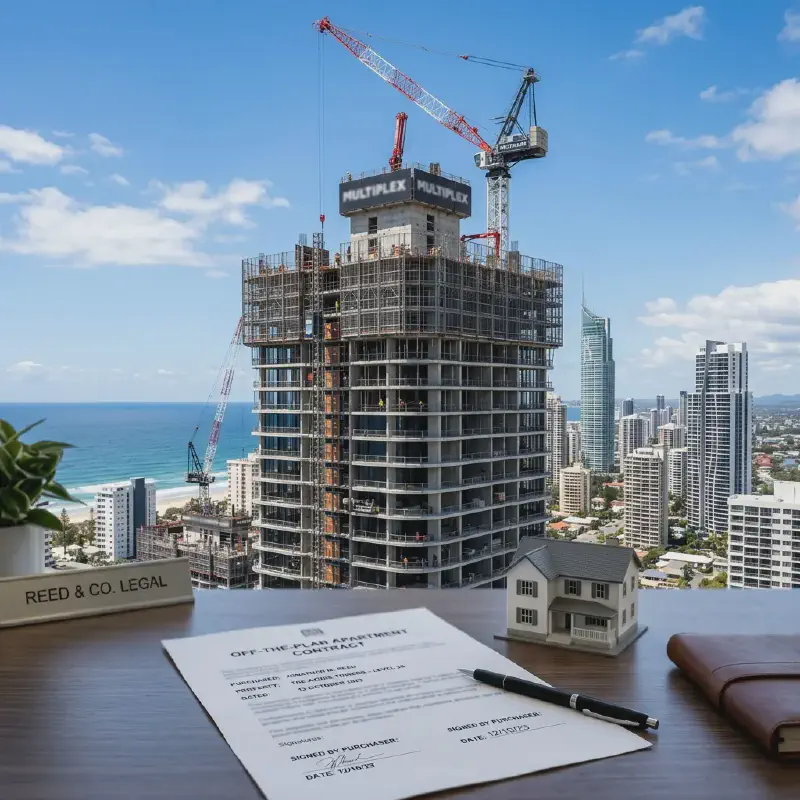
In this episode of Legal Matters on 4CRB, Andrew Bell and Colin Balewski continue their property law series with a deep dive into the legal risks of buying off the plan on the Gold Coast, one of Australia’s most active off-the-plan markets. They also address a listener email about a vague QCAT disclosure on a property going to auction, and take a live call from Cheryl about how to ensure her Will gives her Executor the power to act immediately after her death.
Key Topics
- Form 2 Recap: A summary of last week’s disclosure rules and the risks of defective Form 2 statements
- QCAT Disclosures: What to do when a Form 2 flags an unresolved QCAT matter relating to fences or trees
- Off-the-Plan Purchasing: Why the Gold Coast is Australia’s hottest off-the-plan market, and the major legal traps to understand before signing
- Sunset Clauses: How developers have exploited them, and what Queensland’s 2023 reforms actually protect, and don’t
- Valuation Gaps: Why your bank’s settlement valuation could leave you personally funding a six-figure shortfall
- Executor Powers & Probate: What your Will must say to let your Executor act immediately, and when probate is actually required in Queensland
Listener FAQ Highlighted In This Episode
- What is a Form 2 Seller Disclosure in Queensland?
- What is a sunset clause in an off-the-plan contract?
- Can a developer cancel my off-the-plan contract in Queensland?
- What is the valuation gap in an off-the-plan purchase?
- Does my Enduring Power of Attorney end when I die?
- What powers should I give my Executor in my Will?
- When is a Grant of Probate required in Queensland?
Listen to the full discussion above.
[!WARNING] Don’t Sign an Off-the-Plan Contract Blind Off-the-plan contracts are heavily weighted in favour of the developer and can run for hundreds of pages. If you fail to understand sunset clauses or don’t plan for valuation gaps, you could lose your entire deposit.
Contact our Gold Coast property lawyers today for a contract review before you sign anything.
Key Takeaways
- Form 2 Must Be Perfect: A defective Form 2 gives buyers the right to walk away penalty-free, right up to settlement day. Sellers must engage a lawyer before marketing their property.
- QCAT Risk Is Physical: When a Form 2 discloses a QCAT matter, your maximum exposure is usually a fence, tree, or retaining wall repair. A thorough building and pest inspection will quantify it.
- Off-the-Plan Contracts Are Not Standard: Developer contracts can run to 800 pages and are bespoke to each development. Never sign without a solicitor reviewing it.
- Sunset Clause Protection Has Gaps: Land contracts now have strong buyer protection in QLD. But if you are buying a strata title apartment, you may still be vulnerable to developer-initiated termination.
- Plan for the Valuation Gap: Lock in your finance before you commit to an off-the-plan contract. If the market softens, you could owe the difference between what you contracted to pay and what the bank will lend.
- Your EPA Ends at Death: Your Executor needs express powers in the Will to act immediately, paying the funeral, maintaining the property, and managing investments, before the estate is distributed.
Annotated Transcript
Form 2 Recap & QCAT Disclosures
A summary of last week’s disclosure rules and what to do when a Form 2 flags an unresolved QCAT matter.
📎 See also: Form 2 Seller Disclosures
Colin Balewski: Good morning, Andrew. Last week we discussed the massive changes with Form 2 seller disclosures. A listener emailed asking what it means if a Form 2 flags an unresolved QCAT matter relating to fences or trees.
Andrew Bell: Good morning, Colin. That’s a great question. When a Form 2 discloses an active QCAT matter, it’s typically a neighbourhood dispute, most commonly over a dividing fence, an encroaching tree, or a retaining wall repair. While it sounds scary to see “tribunal matter” on a disclosure, your maximum exposure is usually just the cost of that repair. I strongly recommend getting a thorough building and pest inspection, and perhaps a quote from a fencer or arborist, to quantify exactly what that risk might cost you before you proceed.
The Risks of Off-the-Plan Purchasing & Sunset Clauses
Applying the Property Law Act 2023 regarding sunset clauses.
📎 See also: Sunset Clauses
Colin: Let’s move on to off-the-plan purchasing. The Gold Coast is booming, and there’s a lot of cranes in the sky. What are the major traps?
Andrew: The Gold Coast is undoubtedly Australia’s hottest off-the-plan market right now. The biggest trap buyers fall into is thinking off-the-plan contracts are standard. They aren’t. A developer’s contract is bespoke to each development and can run up to 800 pages. Never sign one without a solicitor reviewing it first.
One of the most exploited mechanisms in recent years has been the “sunset clause.” A sunset clause allows either party to terminate the contract if the development isn’t completed by a specified date. What we saw in the rising market were unscrupulous developers deliberately delaying construction to trigger the sunset clause, cancel the contracts, and resell those same apartments at much higher prices.
Colin: Did the government fix that?
Andrew: Partly. Under the changes that came into effect in November 2023, developers selling land contracts can now only terminate under a sunset clause if they get the buyer’s written consent, or if the Supreme Court orders it. However, and this is a massive “however”—if you are buying a strata title apartment, which is what most off-the-plan stock is on the Coast, you do not yet have that same protection. The government is considering extending it, but right now, apartment buyers remain vulnerable.
The Valuation Gap Trap
📎 See also: Valuation Gaps
Colin: What happens if the market drops between signing and finishing the build?
Andrew: That leads to the “valuation gap.” When you sign an off-the-plan contract, you agree to a price today. But your bank won’t officially value the property until settlement, which might be two or three years away. They value it based on the market conditions at that time. If the market has softened and the bank values the property lower than your contract price, there is a shortfall. The bank won’t lend you the full amount you need. You are legally obligated to fund that gap personally, or you risk losing your entire deposit and being sued for breach of contract. Always ensure your finance is rock solid before committing.
Caller 1 — Cheryl | Executor Powers & Probate in QLD
📎 See also: Executor Powers
Cheryl (Caller): Hi Andrew. I have an Enduring Power of Attorney set up for my daughter to manage things, but I want to make sure she has immediate power to pay for my funeral and look after my house the moment I pass away. Does the EPA cover that?
Andrew: Hi Cheryl. That’s a very common misconception. Your Enduring Power of Attorney automatically ends the exact moment you die. From that point forward, it is completely invalid. Only your Executor, who you appoint in your Will, has the authority to manage your estate.
However, your Executor needs express powers written into your Will to act immediately. Your Will must explicitly authorise them to maintain your properties, pay urgent expenses like funeral costs, service debts, and manage your investments before the estate is formally distributed. Without those specific clauses, your Executor can face serious delays and frozen accounts.
Colin: And when is probate actually required in Queensland?
Andrew: Probate is the Supreme Court’s official recognition that the Will is legally valid. There is no single statutory monetary threshold in Queensland, it entirely depends on who holds the assets.
If you own real estate solely or as tenants-in-common, probate is always required to transfer the title. For bank accounts, each institution has its own threshold, typically between $50,000 and $100,000 for the major banks. Aged care Refundable Accommodation Deposits (RADs) almost always require probate due to their size. Share registries usually require it for holdings above $15,000 to $25,000. Superannuation with a binding death benefit nomination usually bypasses probate, but without one, the trustee might require it.
Disclaimer: This transcription provides general legal information only; it is not personal legal advice. Everyone’s situation is different, so please seek independent legal advice for your own circumstances.