
Can social media posts and text messages be defamatory in Queensland?
Social Media & Online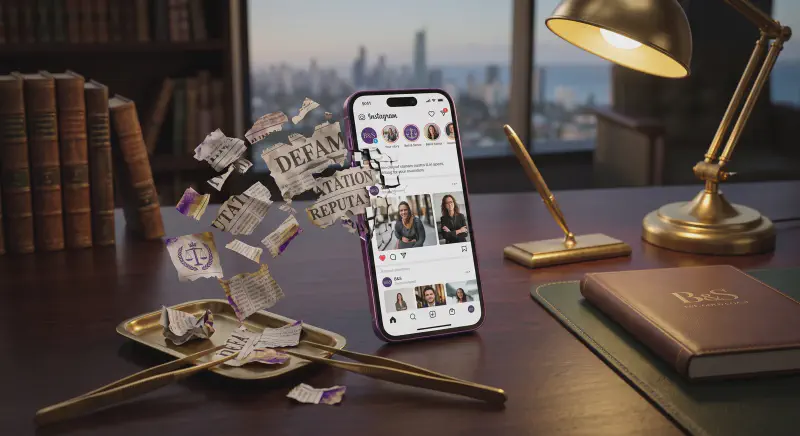
Many people assume that social media, private groups, or text messages fall outside defamation law, because they’re “not a newspaper.” This assumption is wrong and can be costly.
Online Platforms as “Publications”
Under the Defamation Act 2005 (Qld), a publication means any communication of defamatory matter to a person other than the subject.1 This includes:
| Platform | Is it a Publication? |
|---|---|
| Facebook public post | ✅ Yes |
| Facebook private group post | ✅ Yes, courts have found these are publications |
| Instagram or Twitter/X post | ✅ Yes |
| Google Review | ✅ Yes |
| Text message (to someone other than the subject) | ✅ Yes |
| Email forwarded to colleagues | ✅ Yes |
| Comment on a news article | ✅ Yes |
Private Facebook Groups, A Common Misconception
Several Australian court decisions have confirmed that posts in closed or private Facebook groups can constitute defamatory publications. The fact that only “members” can see the post does not make it private in a legal sense, depending on group size and membership, publication to even a small number of people can satisfy the publication element.
“The internet has changed the paradigm. We used to say to a group at a coffee shop ’this tradie is really bad’ — you’ve defamed them to three or four people. But when the internet is involved, you’re potentially defaming them to the entire world.” — Andrew Bell, Legal Matters, 4CRB, 17 March 2026
Text Messages
A text message sent directly to the subject is unlikely to be a publication for defamation purposes (since no third party sees it). However:
- A text sent to a third party (e.g., the subject’s employer, a mutual friend, a community group) that contains false and harmful allegations can be defamatory.
- Example: Texting someone’s boss falsely claiming they are an alcoholic could constitute a publication causing defamation, even if only one person receives the message.
The Permanent Record Problem
Unlike a verbal conversation in a pub (which fades from memory), online content:
- Creates a permanent and searchable record
- Can be screenshotted and redistributed even after deletion
- May appear in search engine results for years
You Are Not Anonymous Online
A common misconception is that a pseudonym or anonymous account protects you. In practice:
- Courts can issue Norwich Pharmacal orders requiring social media platforms or internet service providers to disclose the identity of a user.2
- This means a post made using a fake name or anonymous account can still result in a defamation claim being served on you personally — sometimes months after the post was made.
What If I’ve Already Posted Something?
If you are concerned about something you have posted:
- Do not delete it immediately — this could be seen as destruction of evidence if a claim is already in progress.
- Take a screenshot of the original post and any responses.
- Seek legal advice promptly — the defences available to you (truth, honest opinion, public interest) depend heavily on what was said and the circumstances.
If you have received a concerns notice or legal letter about a post, time limits apply.
Related Topics
- The Complete Guide to Defamation Law in Queensland
- What is defamation in Queensland?
- What happens if I receive a defamation letter?
- Queensland Court Hierarchy
Received a Defamation Notice?
Defamation proceedings in Queensland are subject to strict preliminary steps (concerns notices) and time limits. Don’t delay.
📞 Phone: (07) 5532 8777 | 🌐 bellsenior.com.au | Contact us
Need Specific Legal Advice?
The answers above are general. For advice tailored to your specific situation, contact our Southport solicitors today.
Enquiry Sent
Thank you. Our team will contact you shortly.