
Dividing fences: who pays for what in Queensland?
Fences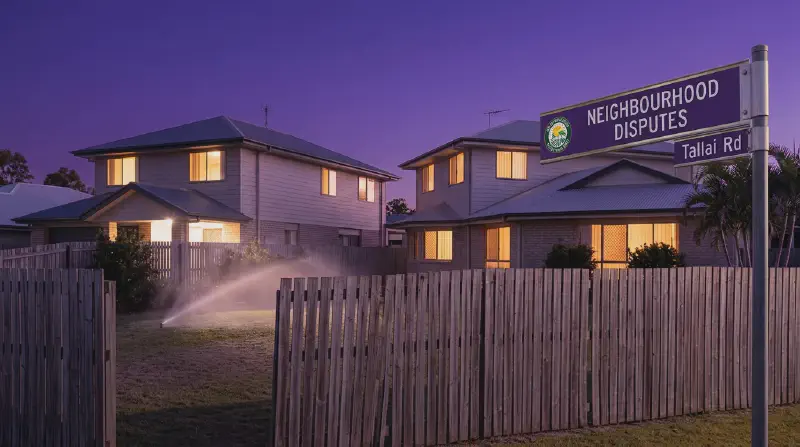
Under Queensland’s Neighbourhood Disputes Resolution Act 2011,1 adjoining owners are normally expected to share equally the reasonable cost of a sufficient dividing fence. The arguments start when one side wants rendered brick where timber palings would do - or when a storm flattens the old fence overnight and nobody agrees on who calls the contractor first2.
What counts as a sufficient dividing fence
The Act asks whether the fence is sufficient for both properties, judged against what is usual for the area and what each household reasonably needs - privacy, keeping children and pets safely contained, and basic security. Key points:
- The standard is adequacy, not aspiration. A standard timber or colorbond fence is usually enough; a designer wall is not automatically shared.
- Written quotes from fencers define the scope and price being shared.
- Where a boundary fence also forms part of a pool barrier, it must meet pool safety requirements as well - that obligation sits on top of the fencing rules.
If the two of you genuinely want something above standard, that is fine - the cost allocation just changes.
What sits behind the fence matters too. Gates, drainage that a new fence interrupts, and clearing along the boundary are all project-cost conversations - agree who handles them before quotes are signed, because fencers price these items separately and surprises here restart negotiations from zero.
The default: equal shares
Absent agreement otherwise, each adjoining owner contributes half of the cost of a sufficient fence. The premium for an upgrade belongs to whoever wants the upgrade. A common example: quotes come in at $3,200 for a standard fence and $7,500 for the rendered feature wall one neighbour loves. The neighbour pushing for the upgrade typically wears the difference, while the base sufficient-fence cost stays shared.
You can always agree to different shares - uneven blocks, one side benefiting from a gate, or one household clearly getting more from the design. Whatever you arrange, put it in writing with the quote attached.
Corner blocks and irregular boundaries deserve special care. Confirm exactly where the boundary runs before anyone posts anything - a fence built a metre over the line creates a far more expensive problem than the one it solved. A surveyor costs money; moving a fence costs more.
Repairs, damage and emergencies
Cost sharing bends depending on why the work is needed:
- Deliberate or careless damage - a car reverses through it, a renovation crew knocks it down - is on the person who caused it. They carry the repair bill, not half of it.
- Gradual decay or storm damage falls back on the normal sharing rules, because neither owner is at fault.
- Emergency repairs to make a boundary safe - loose panels near a pool, a fence leaning onto a footpath - can proceed urgently, with reasonable costs recovered later. Photograph everything before the repair.
Who pays when nobody is at fault deserves a plain answer too: normal wear, storm damage and fallen branches fall back on the shared model, because fencing is treated as a mutual burden between owners. Keep the temptation to invoice your neighbour for their half of a gum branch out of the correspondence - tree disputes follow their own pathway, and blending the two muddies both claims.
The right way to start the process
Most fence wars are avoidable with five boring steps:
- Talk to your neighbour before contacting anyone else, and agree on the rough standard.
- Get two written quotes for the work.
- Serve a written notice setting out the boundary, the proposed work, the quote, what you want them to contribute and how to respond.
- Give them a fair window to respond rather than demanding an answer on the spot.
- Record whatever you agree in writing, including who pays the fencer and when.
Owners who follow this sequence win QCAT arguments. Owners who build first and invoice later often discover they volunteered for the whole cost.
When agreement fails
If talks stall, mediation is cheaper than court. Beyond that, a fencing dispute is a minor civil dispute in QCAT, which handles claims up to $25,000. The tribunal can decide the type of fence required and who pays what, and its orders are binding. Bring the quotes, the notice you served, photographs of the old fence and any messages - tribunal members lean heavily on who followed the process.
The tribunal itself is built for self-represented neighbours: application forms are manageable, hearing fees are modest against fencing costs, and hearings are informal rather than courtroom theatre. Expect orders pegged to sufficiency rather than aspiration - which is exactly why the quotes you serve should honestly price a sufficient fence instead of your dream upgrade.
Traps that catch neighbours out
- Retaining walls are not dividing fences. They have their own rules under the same legislation and their own engineering costs, so never bundle them silently into a fencing quote.
- Trees along the boundary are covered separately again - overhanging branches and damaging roots follow a different pathway.
- Community titles schemes: if the boundary involves common property, the body corporate is in the picture under the Body Corporate and Community Management Act 1997, and committee approval comes before any fencing contract.
- Renting: tenants and owners hold different responsibilities here, so check the lease and speak with the landlord before committing either pocket.
- Payment mechanics: decide upfront whether one party pays the contractor and is reimbursed, or each pays their share directly - reimbursement promises made verbally have a way of evaporating.
One last practical note: never take unilateral action while talks continue. Removing the old fence, building anyway and presenting the invoice afterwards shifts you from claimant to aggressor in everyone’s eyes, including a tribunal member’s. Patience plus paperwork wins these disputes; shovels lose them.
Related reading:
Unsure where you stand? Contact Bell & Senior Lawyers for a free initial chat.
Notes
Need Specific Legal Advice?
The answers above are general. For advice tailored to your specific situation, contact our Southport solicitors today.
Enquiry Sent
Thank you. Our team will contact you shortly.