
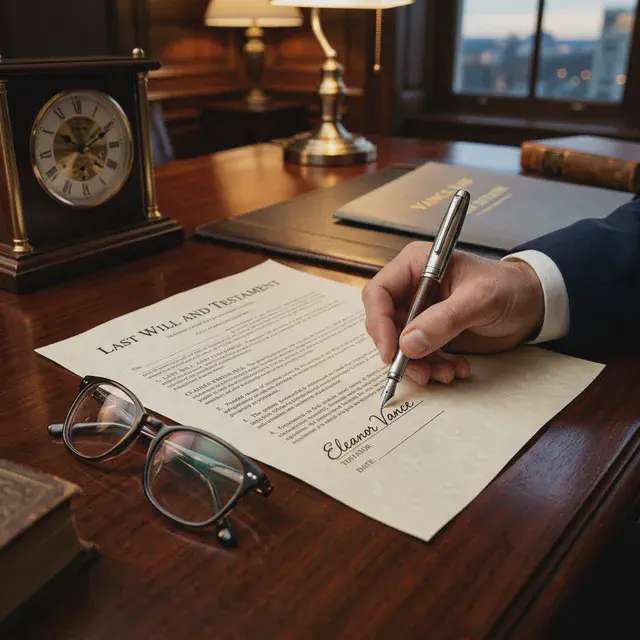
Andrew Bell joins Colin Balewski and Robyn Hyland on 4CRB to discuss the intricacies of Wills and Estates, focusing on five big reasons to get your Will in order.
Key Topics
- The Problem with the Succession Act: Exploring the default rules that apply if you die without a Will, which can force your spouse to “buy out” your children’s percentage of the estate.
- The Supreme Court Scramble: The time, cost, and stress placed on families trying to obtain “Letters of Administration” when there is no appointed executor in a Will.
- De Facto Relationships: The risk to unmarried couples living together. Without a Will, proving the relationship meets the legal parameters to inherit becomes significantly harder.
- Who Inherits in Blended Families: How default rules generally favour biological children, potentially leaving out step-children running contrary to a deceased parent’s wishes.
- Estate Challenges: As property prices soar, more estates find themselves challenged by family members expecting a portion. What courts look for to uphold your wishes over a challenger.
Listener FAQ Highlighted In This Episode
Who can challenge my Will?
Anyone who has a genuine expectation to inherit under your Will can formally challenge it via a Family Provision claim, such as estranged children, step-children, or de-facto partners who feel they were inadequately provided for. A well-documented Will helps protect your genuine intentions from these claims. Learn more about who can challenge a will in QLD
.
Is my old Will still valid if I move from another state to Queensland?
In Australia, Wills are recognised nationally. However, there are slight legal differences regarding how each state interprets them. While your basic wishes will be respected regardless of the state, it’s a good practice to refresh your Will so that it reflects standard localised wording if you’ve permanently relocated or if your Will is quite old.
What is ‘Tenants in Common’ vs ‘Joint Tenants’?
If you own property as Joint Tenants, when one owner dies, their share automatically passes via the ‘Right of Survivorship’ to the surviving owner: regardless of what the Will says. If you own property as Tenants in Common, your share forms a part of your estate when you die and is distributed according to the directions laid out in your Will. For further details, read our FAQ on Tenants in Common vs Joint Tenants
.
Relevant Resources
- Estate Planning 101 : Our comprehensive guide to protecting your legacy.
- Probate Timeframe in Queensland : How long does it actually take?
- Dying Without a Will : A guide to Queensland’s intestacy rules.
[!WARNING] Dying Without a Will Leaves Your Family Unprotected Under Queensland’s intestacy rules, dying without a Will means the state dictates how your assets are divided, potentially forcing the sale of the family home to pay out adult children. You also risk exposing your estate to the costly “Supreme Court scramble” for Letters of Administration.
Contact our Wills and Estates lawyers today to document your wishes and protect your legacy from unnecessary litigation.
Transcript
[Colin] Welcome back to Legal Matters. We’re talking about Wills and Estates this morning. I’ve put together five reasons why you might consider having a Will. In Queensland, they think that more than half of adults don’t have a Will. It protects your interests in lots of different ways.
[Andrew] The first reason that you might want to have a Will is people think that everything will not automatically go to their spouse. In Queensland, we have something called the Succession Act. If you have a spouse and kids, then the default rules are the spouse will get $150,000 and the household contents. And then everything else: there’s rules depending on how many kids you have about how it gets split. So we’ve seen people come into the law firm where they’ve actually had to sell houses and things to buy out the children’s estate, which isn’t what people thought.
[Colin] It is your wishes. If you don’t get that on the page, you may come down to exactly what the legislation dictates.
[Andrew] A Will is how you want to give things away. People have very strong beliefs around the things that are important to them. It might be a watch or a memento, it might be funds or how the grandkids want to be set up. Reflecting your wishes in a way that you want them to be delivered is the best tool that you can do. It also takes a lot of stress off the rest of the family. They don’t need to wonder what Granddad was looking to give or who he wanted to give it to. You’re helping them in a stressful time.
[Colin] To have that decision taken away and left in the hands of the courts can just add so much more stress to an already stressful situation.
[Andrew] This feeds into one of the other points I was going to mention: the Supreme Court scramble. If you have a Will and there’s an executor and things are clearly laid out, you can go with a death certificate to a bank, you can start making arrangements quickly. You may or may not need to go through probate. But if you don’t have a Will, then you have to apply to the court: well, you don’t apply, your executor or your family, the person that you didn’t appoint in the Will: someone has to go to court and then apply for what’s called Letters of Administration. That typically involves lawyers; it’s not something we’d recommend that you DIY. Meanwhile, bills might be piling up. So, the time is a big thing as well that you can save for everybody else involved.
[Robyn] Are the rules of intestacy different in Queensland to New South Wales?
[Andrew] Indeed they are. They differ subtly. There’s different legislation, there’s a different Supreme Court. However, in Australia, Wills are recognised nationally. If you did have a Queensland Will and you were to die interstate, your wishes would generally be respected, but there’s slight differences between how they apply in each state. Typically, it’s where the Will was written. And you should only have one Will. If you had a Will from 1985 and then you’ve come in and you want a refresh, typically you’d recommend that the previous one gets destroyed so there’s no confusion around which one was the current wishes.
[Robyn] Is that when you should be updating Wills? Every time there’s a significant change? And I also note that blended families is very common occurrence these days.
[Andrew] If you’ve changed partners recently, if you’ve adopted someone, if you have someone living with someone, the rules in Queensland, the default rules typically go to your biological children. So you might be excluding people that you actually would have expected that might have inherited. You may have a son or daughter that’s lived with you for 20 years, but you’re not their biological parent and without a Will, they don’t go anywhere. As you said, those life’s important moments are a good time to reflect. But the best time is probably now because you never really know what’s coming around the corner. It doesn’t have to be complicated. Who are the important people in your life? How do you want them to receive? Who do you trust to look after?
[Colin] Next point?
[Andrew] De facto partners. In Queensland, de facto has a legal definition of living with you for at least two years. People may have been together for a long time, they may have been married and then divorced and then they’re sort of back together. If you intend for your partner to inherit and you’re not married, then a Will will secure that they can inherit. Otherwise, they may not actually receive anything if you don’t have a Will.
[Andrew] With housing prices increasing across Queensland, one of the largest growing areas in the law that we’re seeing is challenges to people’s estates. Where people may have only had one house, it may have just been where everyone would have intended to live. Now with houses, the median house price being over a million dollars, there’s significant interest for lots of people to challenge.
[Robyn] Who can challenge a Will?
[Andrew] Typically, people would expect that maybe it’s only children, but it’s anyone who has a genuine expectation to inherit under a Will. So we’re seeing people trying to write people out of Wills, people saying that they’ve been forgotten out of Wills and launching expensive protracted legal claims to try to get some of the money. A clear Will that has your intentions is easier for the court to understand what were your intentions and make sure that they’re more likely to be followed.
[Robyn] Is having a well-documented Will likely to reduce the risk of a family provision claim?
[Andrew] Anyone can bring a claim whether there is a Will or not. However, the courts need to look into what were the intentions of the person whose estate it is. So a well-documented Will with witnesses, which clearly sets down their thinking at the time, goes a long way to say whether these people were validly excluded or included.
Caller Patricia (repeating audio from previous week): I’m just wondering if I have an Enduring Power of Attorney made up in New South Wales and signed in Queensland, is it legal?
[Andrew] There’s definitely signing rules that a lawyer must have actually signed it and been in presence with you, and then the people that you’ve appointed as your attorneys need to sign their acceptance. I would need to look into that further.
Caller Patricia: My Will and my husband’s Will, when we depart it all goes to him or it all goes to me. Now, we don’t own the house; we are Tenants in Common. So there wouldn’t be any trouble over that, would there?
[Andrew] Well, it depends on the provisions in your Will. If you were Joint Tenants, which is the typical way that married couples own properties, there’s what’s called a Right of Survivorship. So if one party dies, the other one automatically receives it, regardless of what’s in a Will. If you’re Tenants in Common but you have gifted your 50% ownership to your husband, then that’s a valid gift under a Will and that would transfer to him. And he would then have undivided title.
[Colin] We move now to Frederick.
Caller Frederick: It’s a kind of age discrimination, the change of hard copy and communication into internet. My strata situation is they are really changing everything from hard copy now into internet. They even have meetings now, I call them “phantom meetings,” without people. I’m pissed on the convenient old-fashioned hard copy information. What can I do?
[Andrew] Legally, most of these things say you have to include people, you have to notify people, and online increasingly is being either added to Acts or being considered as sufficient notice for these sorts of things. Queensland does have a Discrimination Commissioner, and I urge you to give them a call and speak to them because this is something that they will deal with on a frequent basis. However, I don’t think legally that you would have much chances of success.
[Colin] We move now to Chris.
Caller Chris: Andrew, mine’s a bit of an awkward situation. I’ve been in a de facto relationship for about 22 years. Subsequently, through illness I had to give up work. But in that period, I have been a contributor to the property that my partner owned when I first moved in. And we’ve shared all of the expenses. Now, I’m a number of years older than her and if I was to pass, I’ve asked her what she would leave my family because I have two grandchildren and a son. She agreed she would be leaving some to them, but I don’t believe she’s going to be leaving sufficient funds that I’ve actually contributed to our relationship. Would my son and my grandchildren be entitled to question the Will with her passing if she was only to leave me a small amount of funds?
[Andrew] If you die, you can really only pass on things that you own or have a direct control in. Some may argue there’s a “Constructive Trust” set up that you may own part of the property. However, that would require litigation. If she were to then pass and hadn’t passed on what you expected later, then your children may have a “Family Provision Claim” against her on the basis that they had the right to expect what their father had contributed to the property was going to be delivered equitably. However, that is going to be very messy and there will be different opinions as to how valid that claim would be if it was disputed.
[Andrew] Blended families and ensuring that your wishes are upheld whether one or the other passes before the other is a very interesting topic and might be the topic of a future episode.
[Colin] We move now to Jeffrey.
Caller Jeffrey: My son’s got married overseas and probably going to live permanently overseas. And I’m looking at redoing my Will because I understand foreigners can’t maintain assets in Australia. If he inherits shares in a company, can he keep that in Australia as distinct from perhaps inheriting a property?
[Andrew] Australian citizens can continue to hold property in Australia and even foreign citizens can too. Occasionally under the Foreign Investment Review Board, they may require people to be able to sell assets or pay extra tax based on some of the recent changes they’ve made for foreign residents. However, if he’s an Australian citizen, he has every right to inherit. But even if he isn’t, he can still inherit your property under a Will. He just may have to deal with it differently later. There are capital gains issues that properties need to be dealt with within two years or there’s tax implications. But from an estate point of view, you can still Will it to a person without having to be the funds transferred overseas basically.
[Colin] We move now to Elsie.
Caller Elsie: I’ve got a brother died on the 5th of December and the solicitor keeps putting off my niece and nephew saying that they can’t find the original Will. So everything’s tied up.
[Andrew] Without an original Will, then you’ve got the position that we were talking about earlier about Letters of Administration. Has a copy of a Will been found? Unfortunately, this is one of the few things left where, unlike we were talking about earlier about digital things, where actual physical signatures and physical copies of Wills are the only thing that is taken by the courts. They occasionally can consider if someone can attest to a copy being valid. However, without the original Will, there’s really not a lot that can be done. And if it never surfaces, then it would have to be treated like he died without a Will. This is why we recommend that people have certified copies at home and the original in the lawyer’s office and people know where they are.
Disclaimer: This is an edited transcript of the live radio broadcast. To hear the full unedited version, or to listen to callers’ questions, please listen to the audio file provided at the top of the page.