
Separation Checklist QLD: Property, Children and Money - The Complete Guide

Need legal help with this topic?
Get a confidential assessment of your matter today.

Separation is one of life’s hardest transitions - and one of the few where the legal system hands you a genuine advantage for being organised. This checklist is the roadmap we give clients in their first appointment: work through it in order, and you will avoid the mistakes that cost people years and tens of thousands of dollars.
Week 1: Establish the Foundations
1. Date-stamp the separation. A short written message to your partner: “I consider our relationship ended as of today.” This date drives the divorce clock (12 months), the de facto property deadline (2 years), and evidentiary questions from contributions to add-backs.
2. Money: protect without punishing.
- Dated screenshots of all joint account balances
- Secure your own income access; notify banks of the separation in writing
- Negotiate an interim split of joint funds in writing - courts punish reckless dissipation (draining accounts) far more than they punish careful protection
3. Children: stability first.
- Children stay in their usual routine while arrangements are worked out
- Put a short-term arrangement in writing (even by text) - it shows good faith and becomes evidence
- Never use children as leverage; early unilateral moves shape interim court views
4. The house.
- Neither party can lock the other out without a court order
- Family violence changes this entirely: protection orders can include exclusive occupation (ouster), and police can act in emergencies
- Keep paying (or formally document why not) - mortgage arrears damage both credit files
Weeks 2-4: The Full Financial Picture
5. Build the disclosure folder (documents you legitimately hold):
- Property valuations, mortgage statements, rates notices
- Bank, credit card, loan statements (all accounts)
- Superannuation statements (both - you can request your former partner’s interest later)
- Tax returns, payslips, business records
- Share portfolios, crypto, digital assets
6. Identify the deadlines now running:
- De facto couples: property proceedings generally within 2 years of separation
- Married couples: within 12 months of divorce finalisation
- Superannuation splitting: available once proceedings are on foot - but information requests take time
- Family provision / DVO cross-matters: their own clocks
7. Consider interim protection:
- Spousal maintenance where one party cannot meet reasonable needs
- Injunctions where assets are at risk of being sold, transferred or hidden
- Exclusive occupation orders where living together is unworkable or unsafe
Months 1-3: The Property Settlement Path
Queensland family property settlements follow a recognised structure:
- Identify the asset pool - assets, liabilities, superannuation, including interests in trusts and companies
- Assess contributions - financial and non-financial (homemaking, parenting), direct and indirect, past and future
- Assess future needs - age, health, income capacity, care of children
- The just and equitable outcome - a percentage adjustment, then how the pool is divided in kind. 1
The two resolution routes:
- Consent orders - agreed terms approved by the court without attending; enforceable, tax-effective (super splitting), binding
- Binding financial agreement - no court approval but strict legal requirements (independent advice for both parties); used where court filing is undesirable
Without either, the court process runs: disclosure → negotiation → mediation → hearing. Most matters resolve at or before mediation.
Children’s Arrangements: The Parallel Track
- Parenting plans (written, signed, not enforceable) vs consent orders (enforceable)
- Long-term decisions = equal shared parental responsibility in most cases
- Best interests of the child is the only criterion - safety now front and centre after 2024 reforms
- Before court: family dispute resolution and a section 60I certificate (with limited exceptions - urgency, family violence). 2
Money Traps That Cost Thousands
- Superannuation forgotten - often a third of the pool; splitting orders are available and routinely missed by DIY settlements. 3
- Verbal deals - “you keep the car, I keep the super” with nothing in writing is unenforceable and unadvisable
- New partner purchases before settlement - complicates disclosure and can be clawed back
- Waiting for “the right time” - evidence decays, values move, and the limitation deadline does not negotiate
- DIY consent orders - orders rejected by the court for defective drafting provide no protection; the drafting is the protection
Where Domestic Violence Fits
If there is violence, coercive control, or fear: safety planning comes before every item above. Protection orders can be applied for on short notice, can remove a violent partner from the home, and family law courts now treat safety as the paramount consideration in children’s matters. Support services exist (see our DV resources) - use them.
- First steps after separation
- Separating with a mortgage
- Property settlement process basics
- Mediation vs court
- Family law practice area
Bell & Senior Lawyers’ Gold Coast family team offers fixed-fee initial consultations - (07) 5532 8777. General information only - not legal advice for your specific matter.
Chapter: The First Fortnight - Stabilise Before You Strategise
The first two weeks after separation are about stability, not settlement:
Money: open your own transaction account if you do not have one; redirect your salary; keep paying the mortgage and essentials from joint funds where possible (unilateral raids create credibility problems later). List every account, balance and access card - a dated snapshot of finances at separation is evidence gold.
Housing: who stays is often decided by practicality (children’s school zone, whose income services the mortgage). The person who leaves does not abandon property rights - but document the date and reason for leaving.
Children: interim arrangements need to exist even before formal ones - school runs, routines, communication channels. The parent who unilaterally relocates children or blocks contact creates the family-report narrative they will spend years correcting.
Safety first: where there is violence, fear or coercive control, the sequence changes entirely - safety planning, police involvement where appropriate, protection order applications under the Domestic and Family Violence Protection Act 2012, and legal advice before any confrontation. The checklist below assumes a safe separation; it is not a substitute for safety planning.
What not to do: change locks without advice, drain accounts, disparage on social media, or involve children in adult disputes. Each is remembered by judges longer than anything either party says in their own favour.
Chapter: The Document File - What to Gather Now
Property settlements run on documents. Start collecting:
- Property records: title searches, mortgage statements (all properties), rates notices, valuations
- Financial statements: superannuation balances for both parties (you can request yours; valuations come later), bank statements 12 months back
- Income records: payslips, tax returns, business financials where relevant
- Liabilities: credit cards, loans, HECS/HELP balances, tax debts
- Insurance policies: life, income protection, health
- Business interests: structure charts, accountant-prepared summaries
- Inheritances, gifts, compensation receipts - the “fourth factor” contributions that can adjust outcomes
The file serves double duty: it powers the disclosure obligation (financial disclosure is compulsory in family law proceedings) and it prevents the information asymmetry that makes negotiations dishonest.
Chapter: Children - The Parenting Framework
Parenting arrangements run on one principle: the best interests of the child, with safety as the paramount consideration (Family Law Act 1975 s 60CA).
Equal shared parental responsibility vs equal time: the law presumes parents make major long-term decisions jointly (schooling, health, religion) - but that is about decision-making, not time. Equal time is considered where reasonably practicable; it is not a starting entitlement, and the presumption of equal shared responsibility does not apply where there are reasonable grounds to believe family violence or abuse occurred.
What works in practice: arrangements matching children’s ages and routines (the fortnight-with-each model suits teenagers differently than toddlers), written down, specific enough to prevent disputes (changeover times, holidays split into halves, phone contact schedules). The parenting plan (written, signed, no court involvement) or consent orders (court-approved, enforceable) both work; verbal agreements decay.
The mediation requirement: before filing parenting proceedings, most parties must attempt family dispute resolution (the s 60I certificate regime), with exemptions for violence and urgency. The mediation is genuinely useful - it settles the large majority of matters.
Relocation and passports: unilateral relocation with children is the fastest route to urgent recovery orders. Any move affecting the other parent’s relationship with children needs agreement or orders first.
Chapter: Property - The Four-Step Process
Australian property settlement follows a structured assessment:
- Identify and value the asset pool - everything, jointly or singly owned, including superannuation (which splits like other property)
- Assess contributions - financial (income, inheritances, initial capital), non-financial (renovations, business labour), homemaker and parental contributions over the whole relationship
- Assess future needs - age, health, earning capacity, care of children, the income disparity the relationship’s structure created
- Justice and equity check - would the proposed division actually be fair for these people?
The percentages emerge from the analysis rather than a formula: a 20-year marriage with young children and a primary earner looks nothing like a two-year defacto with no children. Time limits matter: married parties have 12 months from divorce to file; de facto couples 2 years from separation - out-of-time applications need leave.
Chapter: Formalising the Settlement - Consent Orders vs Binding Financial Agreements
A handshake settlement is not a settlement. Two instruments make it binding:
Consent orders - the agreed terms filed with the Federal Circuit and Family Court for approval without a hearing. Cheap (no court appearance), enforceable, and the registrar checks the terms are just and equitable before sealing. The standard instrument for most settlements: property transfers, super splits, mortgage releases, spousal maintenance terms.
Binding financial agreements (BFAs) - contract-based, no court approval required, but each party needs independent legal advice and a certificate saying so. BFAs work where consent orders do not (pre-relationship planning, some de facto structures) but carry set-aside risks if drafting or process is flawed.
The stamp duty and CGT rollover: properly structured family-law property transfers attract duty exemptions and capital gains tax rollover relief (Income Tax Assessment Act 1936 pt IV div 30) - but only when done through the right instrument at the right time. The DIY transfer before orders exists is how parties accidentally trigger duty and CGT on their own settlement. The accountant belongs in this conversation too; the tax consequences of who keeps what can exceed the legal fees of doing it properly.
Chapter: Divorce vs Everything Else
Divorce (the end of marriage’s legal status) is administratively separate from parenting, property and maintenance:
- The application: sole or joint, filed online; separation demonstrated by 12 months apart (which can occur under one roof with corroborating evidence)
- Children under 18: the court must be satisfied proper arrangements exist - not that they are perfect
- The divorce order takes effect one month and one day after grant - which starts the 12-month property filing clock
De facto couples never divorce; their separation date starts the two-year property clock immediately. The clock discipline from earlier chapters applies: diarise the limitation dates at separation, not years later.
Chapter: Spousal Maintenance
Beyond property division, a party may claim spousal maintenance where unable to support themselves adequately and the other party has capacity. The assessment weighs needs against capacity to pay - short-lived and modest in most cases, significant where young children or disability create genuine need. Urgent cases have expedited procedures; the interim-maintenance order while property settles is the common real-world use.
Chapter: Domestic Violence Orders - The Parallel Track
Protection orders run alongside (not instead of) family law proceedings:
- The application: police-initiated (the common route) or private application to the Magistrates Court
- Temporary protection can issue the same day; final orders after mention or trial
- Conditions are customisable: exclusion from the home (ouster), no-contact provisions, protecting children directly named on the order
- Breaches are criminal offences - the enforcement mechanism is real
The interplay with parenting matters: a protection order’s conditions must be consistent with any parenting orders (or the court varies them); and reasonable grounds of violence change the presumptions in property and parenting assessments. Where violence exists, disclose it to every lawyer in every proceeding - it is not background noise, it is legally material.
Coercive control, criminalised separately in Queensland from 2024-25 (Criminal Code s 334C), recognises that abuse is often a pattern - not a single incident. The pattern evidence (financial control, isolation, monitoring) belongs before both the magistrate and the family court.

Chapter: The Mediation Path - Why It Works Here
Family dispute resolution suits separation better than most litigation suits anything:
- The decisions are personal - school zones, pets, photo albums; a stranger in robes decides these worse than parents do
- The ongoing relationship continues - co-parents attend graduations together for decades; the litigation scorched-earth approach taxes everyone for years
- Cost and speed - mediation resolves in weeks what litigation takes years to reach
- The legal-framework overlay: lawyers advise between sessions, so agreements land inside just-and-equitable territory
The preparation makes the difference: disclosure exchanged beforehand, proposals costed (the accountant’s numbers), and realistic ranges known. The unprepared mediation becomes an expensive cup of tea.
Chapter: When Litigation Is Necessary
Some matters need court: genuine safety concerns, non-disclosure, unilateral relocation, intractable conflict over children, complex business structures resisting valuation. Even then, litigation narrows issues progressively - interim hearings stabilise arrangements while final determinations wait behind disclosure, valuations and family reports. The litigant who keeps negotiating through the process usually settles before trial; the one who stops communicating donates costs to the system.
Chapter: Superannuation - The Forgotten Asset
Superannuation is property in family law - splittable by order or agreement - and it is routinely the second-largest asset after the home. The process:
- Information first: each party can request the other’s super details via the approved form (or consent); balances, not valuations, for accumulation accounts
- Valuation: defined-benefit and self-managed funds need actuarial or accountant valuation
- The split: base-amount splits (accumulation) or percentage splits; the receiving party rolls it into their fund or holds it in the existing one
- Timing: the split follows the settlement orders - it is not automatic
The common error: trading super for the house without modelling outcomes. The 45-year-old who takes the house and no super may own a home they cannot afford to keep while their ex compounds a retirement balance tax-effectively. The financial planner belongs beside the lawyer here.
Chapter: The Checklist Itself
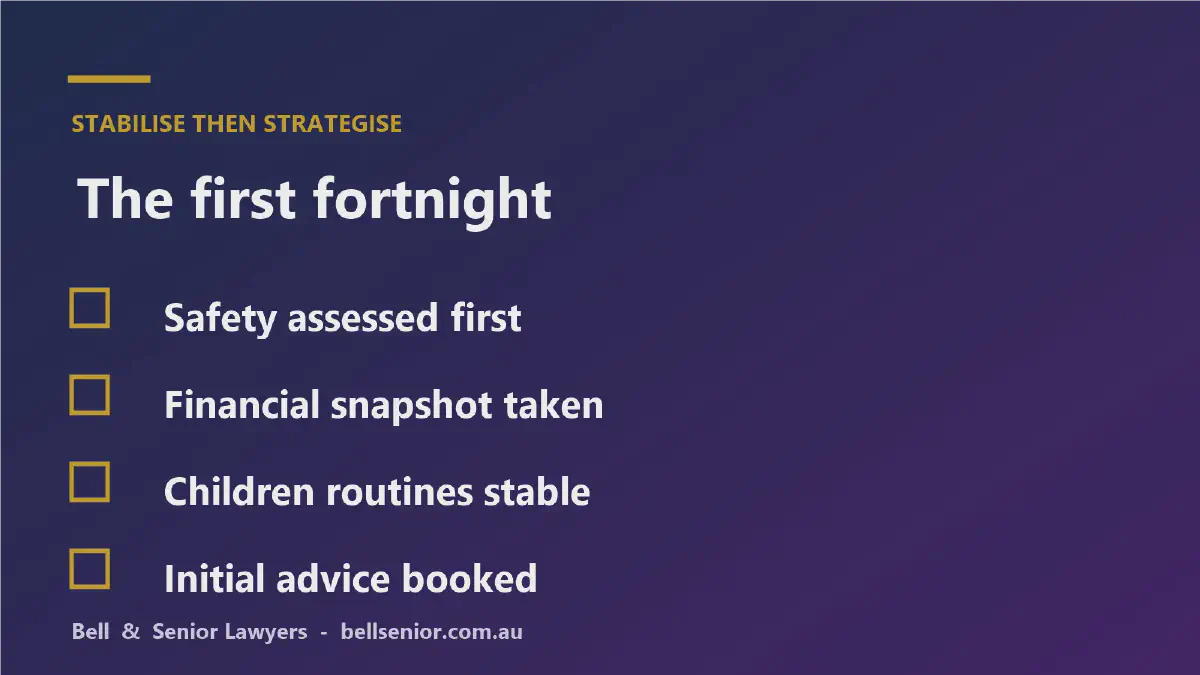
Week 1:
- Safety assessed (act immediately if not safe)
- Separation date recorded
- Own bank account opened; salary redirected
- Financial snapshot taken (accounts, balances, debts - dated)
- Interim children’s arrangements agreed and running
- Initial legal advice booked
Month 1:
- Document file gathered (property, financials, super, insurance)
- Disclosure obligations understood
- Mediation pathway chosen (FDR practitioner identified)
- Limitation dates diarised (12 months married / 2 years de facto)
- Will, powers of attorney, super beneficiary nominations updated
Months 2-6:
- Full disclosure exchanged
- Valuations obtained where needed
- Settlement negotiated through lawyers/mediation
- Consent orders drafted and filed
- Transfers, refinance or sale executed per orders
After settlement:
- Orders sealed and copies kept permanently
- Titles, mortgages, super splits completed per orders
- Estate planning refreshed on the new structure
Chapter: Case Studies
The mediated fortnight. A Robina couple, two primary-school children, separated after twelve years. Both worked; the dispute was genuinely about time arrangements and the house. Full disclosure exchanged within three weeks, one mediation session with lawyers present, consent orders filed a month later: week-about care matching the school calendar, house sold with proceeds split after the mortgage, super equalised by base-amount split. Total cost: under $9,000 combined. The litigation alternative: eighteen months, five figures each, same destination.
The non-disclosure that cost more than the asset. A business owner disclosed his company at last year’s accountant-prepared value; the spouse’s solicitor noticed the recent purchase of equipment inconsistent with decline. Subpoenas to the bank and supplier produced the real picture - a healthy business understated by roughly $400,000. The court adjusted the division upward against the discloser and ordered costs personally. Non-disclosure is the family-law sin that judges punish visibly; honesty is cheaper.
Chapter: Costs and the Value of Early Advice
Family law costs scale with conflict, not complexity. The same settlement can cost $4,000 (consent orders after direct negotiation) or $60,000 each (fully litigated) - the legal machinery is identical; the usage differs.
Where money buys most value:
- The early strategy session - knowing your range before negotiating prevents both overreach and underselling
- The document assembly - a complete disclosure file shortens everything downstream
- Mediation done prepared - one good session beats four bad directions hearings
- The consent orders drafted properly - the sealed order is only as good as its drafting
Legal aid and fixed fees: eligibility exists (means-tested) for parenting matters especially; some firms (including ours where suitable) offer fixed-fee stages. Ask at the first appointment.

Chapter: Emotional Infrastructure
The practical guide ends where the human one continues: separation involves grief performed under legal deadlines. The supports that make the process work:
- A counsellor or psychologist (Medicare-rebated via mental health care plan)
- One trusted friend who is not a litigation strategy committee
- Children told age-appropriately, together where safe, never recruited
- Relationships Australia and Lifeline (13 11 14) for the hard weeks
- The lawyer kept as lawyer - emotional support delivered by professionals trained for it costs less per hour
The parties who manage their wellbeing negotiate better settlements than those who litigate their pain. That is not soft advice; it is economics.
Chapter: FAQ Links and Further Reading
- Family law FAQs
- Property settlement process basics
- De facto relationships in Queensland
- Economic abuse in family law
- Family law practice area
- Does divorce revoke your will?
- Renting rights when separating
Chapter: De Facto Separations - Same Machinery, Different Triggers
Queensland de facto couples (including same-sex couples) access the same family law property and maintenance machinery as married couples - with different threshold questions:
When did the relationship start? The two-year minimum applies to jurisdiction (or a child of the relationship, or substantial contributions with injustice if not covered, or registration under state law). The start date is contested more often than either party expects - the evidence is cohabitation patterns, finances, public representation.
Registration option: couples can register relationships under Queensland’s Relationships Act 2011, which settles the jurisdiction question in advance.
The separation date matters more: no divorce application intervenes; the two-year limitation clock starts at separation immediately. The couple who separates amicably and “gets around to the paperwork later” discovers the clock ran anyway.
Chapter: Grandparents and Other Carers
The Family Law Act expressly recognises grandparents’ significance to children. Grandparents may apply for parenting orders (time or communication) without being parties to the parents’ relationship. In practice:
- Agreement first: many families resolve contact through conversation or mediation
- Court applications succeed where grandparent relationships were significant and denial harms children
- Kinship carers raising grandchildren have additional support pathways (Centrelink allowances, Queensland kinship care programs)
Third-party carers (step-parents, aunts, uncles) similarly have standing where they have been involved in children’s care - the law recognises the people who actually raise children, not just biological categories.
Chapter: Business Owners and Complex Structures
Where one or both parties own businesses, the settlement gains a specialist layer:
Valuation first: the business worth $800,000 on the accountant’s tax-minimising books may be worth double at market. Family-law-appropriate valuations (business valuers who understand the jurisdiction) prevent both overpayment and underselling.
The liquidity problem: the business owner often holds wealth in an illiquid form - the spouse entitled to 50% of a $2M business does not want half a business. Solutions: the owner keeps the business against other assets and an equalisation payment; staged payments secured properly; or sale where neither option works.
Structure hygiene: trusts, companies and partnerships complicate but do not hide value - courts look through structures to control and benefit. The pre-separation restructuring (“moving assets to mum’s trust”) is set aside as a device to defeat claims, with costs consequences. The time to plan structures is before relationships form; after separation, transparency is the only workable strategy.

Chapter: The Other Documents to Update Now
Separation changes estate planning immediately - and most people forget:
- Your will: separation does not revoke wills (divorce revives gifts to ex-spouses differently); update now
- Enduring powers of attorney: your estranged spouse may still hold financial and personal power - revoke and reappoint
- Superannuation binding death nominations: the fund pays per nomination, not per will - check it
- Life insurance beneficiaries: same logic
- Joint bank account mandates and credit cards: liability continues until changed
The five updates take an afternoon and prevent the scenario every separated person fears: their estranged spouse making decisions for them in a crisis.
Chapter: Case Study Three - The Restraining Structure
A Gold Coast builder separated after fifteen years. The asset pool included the family home ($1.4M), his building company, and a discretionary trust holding investment properties - structures his accountant had built over years. The spouse’s solicitors applied the control-and-benefit analysis: distributions history showed the trust funded family lifestyle; the builder was appointor and sole director of the trustee. The court treated trust assets as property available for adjustment.
The settlement: home to the spouse (children’s primary base), business and trading entities to the builder with an equalisation structure, trust assets split by value against the pool. The lesson is not that structures fail - it is that honest valuation of everything produces settlements both sides can live with, while defensive restructuring produces hearings neither side enjoys.
Chapter: A Closing Word
Separation is simultaneously a legal event, a financial restructure and one of life’s larger griefs. This checklist treats all three seriously because they interlock: the person who stabilises finances early negotiates from strength; the parent who keeps children out of conflict preserves the relationship the orders will formalise; the party who discloses fully settles faster.
The law’s machinery - parenting frameworks, the four-step property process, consent orders, protection orders where needed - works predictably when engaged deliberately. Start with the first-fortnight checklist, build the document file, take advice before major decisions, and use mediation where safety allows. The families who follow that sequence reach the other side faster, cheaper, and with relationships intact enough to attend the same school concerts. That outcome - not the courtroom victory - is what good family law practice aims at. Print the checklist, start with week one, and take independent advice before the decisions that cannot be undone later. The rest of this guide exists to make that advice fast. The rest follows. And on the days the process feels heavier than expected - it will, sometimes - the checklist is also permission to do only the next item on it.
Notes
Separating? Bell & Senior guides Gold Coast families through parenting, property and protection matters - fixed fees where possible. Call (07) 5532 8777 or contact our Southport office . General information only - not legal advice.
Notes
Speak With a Lawyer
Contact our Gold Coast team for a confidential discussion about your matter.
Enquiry Sent
Thank you for reaching out. A member of our legal team will contact you shortly.