
Legal Matters: Police Roadside Stops Part 2, Settlement Extensions and Family Provision Claims

Whether police can look through your car at a roadside stop turns almost entirely on one thing: whether you agreed to it. In Episode 32 of Legal Matters, Andrew Bell finishes the Queensland police roadside stop series that callers flooded last week, walking host Colin Balewski through vehicle searches, lawful directions, self-defence items, phones and recording police. Andrew’s eldest daughter also sat in the studio for the school holidays, although she wisely declined to answer any questions on air.
Three callers widened the conversation. Ron asked why an agent told him either party can push settlement back five days, George asked whether a daughter adopted out at birth could contest his will, and Sue asked how to structure her will and superannuation around an estranged daughter.
Key Topics
- Recap of Part 1: pulling over, “I don’t know, could you please tell me?”, and the three things you must provide
- Why an RBT or roadside drug test is one of the few reasons police can stop you without suspicion, and why they cannot hold you longer than needed
- Getting out of the car, arrest, and the value of asking “Is that a lawful direction?”
- When police can search your car, the plain view problem, and what happens to evidence from an unlawful search
- Why carrying a bat, bar, torch or knife “for protection” can itself be an offence in Queensland
- The speed round: informal questioning, “If you’re innocent…”, phone access and recording the interaction
- REIQ contracts and the one-off 5 business day settlement extension
- Whether a child adopted out at birth can bring a family provision claim
- Superannuation BDBNs, estranged adult children and testamentary trusts
Listener FAQ Highlighted in This Episode
- Can police search my car if I say no?
- What does “Is that a lawful direction?” actually achieve?
- Can I keep something in the car for self-defence?
- Can police look through my phone, and can I film them?
- Why can either party extend a Queensland property settlement by five days?
- Can a child adopted out at birth contest my will?
- Can I leave my super to two of my three children and give the third a smaller gift?
Key Takeaways
- Always pull over safely when signalled, and answer “Do you know why I pulled you over?” with “I don’t know, could you please tell me?” so you do not volunteer offences the officer never saw.
- Give your name, address and licence when asked. Refusing, or giving false details, can be an offence in itself.
- Random breath and drug testing is compulsory and needs no suspicion, but police should not detain you longer than reasonably needed for that purpose.
- You do not have to answer exploratory questions such as “Where have you been tonight?” Every answer narrows the explanations you can rely on later.
- If you are uncomfortable with a request, ask “Is that a lawful direction?” If the answer is yes, comply, including getting out of the car or submitting to arrest. Resisting can be a separate offence even if the arrest proves unlawful.
- Without consent or a warrant, police generally need a reasonable suspicion of a prescribed circumstance to search your car. Looking through the windows is not a search, and anything in plain view can supply that suspicion.
- Evidence from an unlawful search is not automatically excluded in Queensland. The court has a discretion, which is another reason to make your lack of consent clear at the time.
- In Queensland, self-defence is not a reasonable excuse for carrying a knife in public, and carrying everyday objects as weapons can lead to charges. Carry items for their ordinary purpose only.
- Decline phone access unless police have a warrant or order, and consider recording the interaction once safely stopped.
- Under standard REIQ contracts, either party can extend settlement once by up to 5 business days without reasons, but time remains of the essence and missing the extended date can cost a buyer the deposit.
- A Queensland adoption order generally ends the legal parent and child relationship with the birth parent, which makes a family provision claim by a child adopted out at birth very difficult.
- A valid BDBN can direct super outside the estate. An estranged adult child still has standing to bring a family provision claim, but documented reasons and financial independence weigh heavily against success.
Annotated Transcript
Segment 1: Recap of Part 1 and the “Why did I pull you over?” trap
⚖️ Topic: Pulling over, answering the opening question, and roadside fines Relevant law: Police Powers and Responsibilities Act 2000 (Qld)
Colin: This topic we started tackling last week, the callers flooded in and we didn’t get to finish, so we thought we’d finish the conversation: Queensland Police roadside stops, what you must do and what you do not have to do.
Andrew: The law hasn’t necessarily changed, but the way policing works has, with body-worn cameras and so on. What you say and do will be recorded and used against you; it’s probably not an “if”. We encourage people to be kind to the police, they have a hard job, but it’s also not your job to do the police’s work for them. So, the lights come on and you get asked to pull over. Colin, do you have to pull over?
Colin: I think the answer was unequivocally yes.
Andrew: It is unequivocally yes. If you’re sure it’s a police officer, quickly pull over somewhere safe. The next one, the main question people get wrong: “Colin, do you know why I pulled you over this evening?”
Colin: The answer should be: “I don’t know. Could you please tell me?”
Andrew: That’s right. You don’t want to admit to things the officer didn’t see. “Oh, did I not indicate back there?” or “I thought I was doing 80, was that right?” “No, I was just pulling you over for an RBT, sir, but you’ve now got three more fines!” And some of these fines are very expensive nowadays, around $1,000 for seatbelts or mobile phone use.
Colin: I must admit I was running a little late to the bottle shop, I might have been going a tad too fast, in fact I was, because that’s what the fine said, and a $500 fine ensued.
Andrew: It’s a very expensive cheeky red!
📎 See also: Legal Matters Ep 31: Police Roadside Stops Part 1 | How to Fight a Speeding Fine in Queensland | Demerit Point Limits in Queensland
Caller: Ron, the 5-day settlement extension
⚖️ Topic: Extending the settlement date under a standard REIQ contract Relevant law: REIQ Contract for Houses and Residential Land, cl 6.2; Property Law Act 2023 (Qld)

Ron: I was speaking with my agent and they said that for the settlement date, either party has a 5-day… I don’t know the wording.
Andrew: If you’re buying a house in Queensland, the REIQ standard contract has a 5-day cooling-off period, if that’s…
Ron: No, not the cooling-off, the settlement date!
Andrew: An optional extension of the settlement date can be up to 5 days under the REIQ standard contract.
Ron: Why have a settlement date of, say, the end of October, if the buyer can extend it for 5 days?
Andrew: They can, without a reason, and it’s about fairness to both sides. Previously, if you missed the time, you’d miss the whole deal, and sometimes that has nothing to do with you personally. We’ve had buyers pre-approved with everything done, and we haven’t been able to connect with the bank for the online settlement. Or clearances for a caveat weren’t done by a third party, or council rates requested six weeks earlier hadn’t been finalised. So instead of the whole deal collapsing, and potentially losing a $50,000 deposit, either side can unilaterally extend the time.
This isn’t a freebie, however. At the end of the 5 days, you lose that, so you don’t want to be running settlement on the last day. More than once in our firm over the last 12 months we’ve cancelled a contract and taken the deposit because the other side moved it, then at 3:30 in the afternoon they couldn’t make it. Settlement finishes at 4:00, and at 4:30 we get a call, “Oh, we’re ready to settle.” We can’t do the electronic settlement after 4:00 PM, and our client had received a better offer, so they cancelled and moved on. It’s a safety net, so try to settle on the planned date.
Ron: Very well. Thank you sincerely.
📎 See also: How Does the REIQ 5-Day Settlement Extension Work? | How Long Does Property Settlement Take in Queensland? | What Happens on Settlement Day? | Can I Pull Out of a Contract?
Segment 2: Identification, “Where have you been?” and RBTs
⚖️ Topic: Name, address and licence requirements, and declining exploratory questions Relevant law: Police Powers and Responsibilities Act 2000 (Qld) ; Transport Operations (Road Use Management) Act 1995 (Qld)
Andrew: Can they ask for your licence, your name and your address?
Colin: Going back to memory, I think the answer is yes.
Andrew: Yes. They can ask you for anything, but you don’t have to comply with everything unless it’s a legal direction. This is a legal direction, and if you refuse, or particularly if you supply false information, you could be committing an offence right there. We also asked: “So, Colin, where have you been this evening?”
Colin: You don’t have to answer that. What is the reasoning for them asking it?
Andrew: A lot of these questions are aimed at general intelligence or, if it feels more menacing, at eliminating your ability to challenge things later. If you say you’ve come from the pub, they can get the footage of you drinking there, and you can’t change your story later. You’re narrowing down your possible explanations the more information you give away. You can say, “Do I have to answer that, officer?” or “I’d prefer not to answer that,” or “Why have you pulled me over this evening?” Most of the time they’re either issuing an on-the-spot fine for something they’ve seen, or conducting an RBT. A random breath or drug test is one of the few reasons they can pull you over without suspicion, and they’re not allowed to detain you longer than that task needs. So you can ask, “Officer, are you going to do the random breath test now?”
📎 See also: Drink Driving Limits in Queensland | Drug Driving and Licence Loss in Queensland | Lawful Directions at a Police Stop
Segment 3: Getting out of the car and “Is that a lawful direction?”
⚖️ Topic: Complying with directions, arrest, and preserving your position Relevant law: Police Powers and Responsibilities Act 2000 (Qld) s 790 (assault or obstruct police officer)
Andrew: What if the officer says, “Colin, can you get out of the car, please?”
Colin: I’m guessing I have to take the direction.
Andrew: I would ask, “Is that a direction?” if you feel uncomfortable getting out. If you ask, “Is that a lawful direction?” and they say yes, then get out. The same goes any time police want to arrest you: you say, “Yes, officer,” and put your hands out if that’s what they want. Even if you completely disagree, you can say, “I want to put on record that this is an unjust arrest.” But fighting them, pushing back, refusing a lawful order won’t get you anywhere. You can get in trouble for resisting arrest even if the arrest was unlawful.
Colin: And if you ask, “Is this a lawful direction?” and they say yes and it turns out not to be, you have a defence.
Andrew: You do. “I wouldn’t have let you look in the car unless you told me it was a legal direction.” If they’ve improperly exercised their power, you might have a comeback later in court, particularly with body-worn camera footage, or your own recording. Don’t film while the car is moving, because you might get in trouble for using the phone, but have a dash cam on. If you just comply without asking and it was wrong, they may say, “Well, you consented to it.”
📎 See also: Lawful Directions at a Police Stop | What Are Your Rights If You’re Arrested in Queensland?
Segment 4: Offensive weapons and “I’ve got nothing to hide”
⚖️ Topic: Carrying items for self-defence in a vehicle Relevant law: Weapons Act 1990 (Qld) s 51; Criminal Code 1899 (Qld) s 69 (going armed so as to cause fear)
Andrew: A big one that comes up with vehicle searches: people have things they don’t believe are illegal, but which may be construed that way. You’re not allowed to have an offensive weapon in Queensland for the purposes of defence. So if you say, “I’ve got nothing to hide,” and the officer opens your car and there’s a big metal bar there, they may say you’re going armed and charge you. That may not be the whole story, but if they don’t search your car, they don’t find it. It’s about self-preservation, not doing the police’s job for them. And if anyone asks why you have something, it should be for its ordinary purpose, not for defence. Whether it’s a torch, a baseball bat, a cricket bat or a knife, if you hold it for offensive or defensive purposes rather than its normal utility, you’re carrying a weapon in public, and that can have severe consequences.
📎 See also: Can I Carry Something in My Car for Self-Defence in Queensland? | Self-Defence and Assault Charges in Queensland | Weapons Offences
Caller: George, a daughter adopted out at birth
⚖️ Topic: Whether a biological child adopted out at birth can bring a family provision claim Relevant law: Succession Act 1981 (Qld) Pt 4; Adoption Act 2009 (Qld)

George: Are children who have been adopted able to contest a will? I’ve got an adult daughter I haven’t had contact with; she was adopted at birth. I’ve left all my estate to my younger daughter, who I see regularly.
Andrew: Under the Succession Act in Queensland, a biological child who was adopted out is a bit of a grey area. If they’re your biological child and weren’t adopted, they automatically have standing. A child you adopted is treated just like one of your children. If they were adopted at birth and you’ve had nothing to do with them, looking at the Act, I think they might have standing to start a claim, but the real question is whether they would ordinarily expect to have inherited.
George: I haven’t seen her since then. We had some phone contact probably 25 years ago, and she’s in her 50s now.
Andrew: Then I’d say it’s very unlikely a claim would succeed. It would be up to her to prove why she would ordinarily have inherited from your estate, which sounds unlikely with such limited contact. If you’re not in regular contact and not financially supporting her, the grounds for a family provision claim would be slim.
📎 See also: Can a Child Adopted Out at Birth Contest a Will in Queensland? | Who Can Challenge a Will in Queensland? | Legal Matters Ep 22: Wills, Probate and Family Provision Claims
Segment 5: Breath and drug testing, vehicle searches and plain view
⚖️ Topic: When police can search a car without consent or a warrant Relevant law: Police Powers and Responsibilities Act 2000 (Qld) ss 31 and 32 (searching vehicles without warrant)

Andrew: Drug testing is the same as the RBT. If they ask for a saliva sample, you have to give it, or you’ll be punished under a separate provision. “Can we have a look in your car, Colin? Do you mind? Just a quick look?”
Colin: My initial thought would be yes, but from our discussion, without due cause, they don’t.
Andrew: That’s correct. Unless they have grounds to suspect you’ve committed an offence or they have a warrant, your car is a bit like your house. They may look in the windows, and you can’t stop that, but to actually go through the boot, a bag or anything else, unless you consent, they don’t have the right. If they say, “We are going to search your vehicle,” it’s like the arrest: “Can you lawfully do that? I’m not consenting.” If they continue anyway and find something, it may be an illegal search and the evidence may be thrown out later. In America, on TV, the “fruit of the poisonous tree” is automatically thrown out. Here there’s more discretion, but if you haven’t consented and they search unlawfully, there is a real prospect the evidence can’t be used against you.
Colin: If they can see it, smell it, if it’s in plain sight?
Andrew: Then they’ve got grounds! A brick of marijuana and $50,000 in cash on the back seat changes things. But you don’t need to do roadside lawyering, you need to be clear about what you’re consenting to and what you’re not.
Colin: And the best response is, “Is this a lawful action?”
Andrew: “Do you have the power to do that? Is this a legal direction? I’m not consenting to that.”
📎 See also: Can Police Search My Car in Queensland? | Drug Possession Charges | Drug Diversion Program
Caller: Sue, super, an estranged daughter and testamentary trusts
⚖️ Topic: Structuring super and a will around an estranged adult child Relevant law: Succession Act 1981 (Qld) Pt 4; Superannuation Industry (Supervision) Act 1993 (Cth) s 59 and Superannuation Industry (Supervision) Regulations 1994 (Cth) reg 6.17A

Sue: I have three children, but one has made herself very estranged from me. I know I can’t totally cut her out of my will. Can I make my other two children the beneficiaries of my super and leave her out of that, but give her a certain amount from my other finances?
Andrew: Superannuation doesn’t form part of your estate if you have what’s called a Binding Death Benefit Nomination, and it’s not subject to the same claims. You can direct the trustee of the super fund to pay those funds to whomever you wish. You can also change your will at any time. Is your estranged daughter financially dependent on you?
Sue: No.
Andrew: Then you could set out your wishes and your personal circumstances, give her a small amount or nothing at all, and make that very clear. It would then be up to her to bring a family provision claim. A third option, if you want to give her funds but don’t think she’s financially responsible, is a testamentary trust: “I leave this amount to my daughter, managed this way by these people, released to her under these circumstances.”
Sue: She can run her own finances. What I really want to know is, if I leave her, say, $20,000, can she contest the will against her siblings?
Andrew: The short answer is yes. Being your daughter, she has automatic standing. That doesn’t mean she’d succeed, but it would be a cost to the estate. If you’ve considered her and the relationship, given what you think is fair, documented why those decisions were made, and had capacity when you made the will, then her chances are probably low if you’re not financially supporting her. If you were supporting her regularly, or she had a significant disability, your estate may have a problem.
📎 See also: Can I Leave an Estranged Child Out of My Super and Will? | Superannuation Binding Death Nominations | Testamentary Discretionary Trusts | Legal Matters Ep 3: Wills and Estates
Segment 6: Speed round, questioning, phones and recording
⚖️ Topic: Informal questioning, the right to silence, phone access and filming police Relevant law: Police Powers and Responsibilities Act 2000 (Qld) ; Invasion of Privacy Act 1971 (Qld)
Andrew: Speed round: “You’re not under arrest, but we just want to have a chat. Can you answer some of our questions?”
Colin: “Is this a lawful direction?”
Andrew: Exactly. Or, “Can I speak to my lawyer?” They shouldn’t keep badgering you if you want a lawyer. “I’ll make an appointment to come in with my lawyer. Can I leave now?” They can’t hold you on the stop forever. Another: “If you’re innocent, why don’t you just answer my questions?”
Colin: I’ve got friends who say, “If you’ve done nothing wrong, what have you got to hide?”
Andrew: “I’d prefer not to. I don’t need to explain my reasons.” You don’t know all the laws, what you might be in trouble for, or whether you’ve been under surveillance. It’s like professional footballers: you wouldn’t expect to run onto a rugby league field and score against a current team. Police do this questioning every day, they’re trained professionals. You’re the amateur. If you can get off the field, it’s probably safer to get off the field.
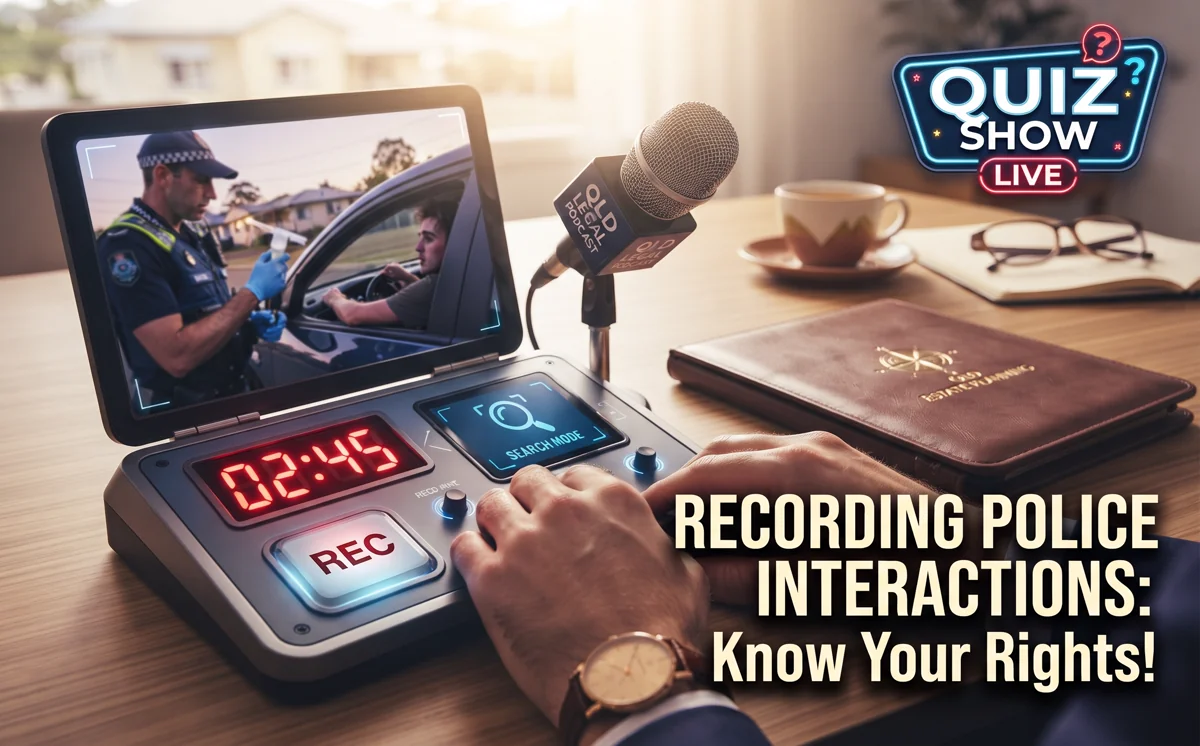
“Can we have a look at your phone?” Absolutely no. There is more on your phone than anyone has held in history. If they’ve got an order and can compel you, follow the order, but otherwise, “No thank you, I’d prefer not to.” And can you record the interaction? Yes, if you’re safely pulled over. I’d strongly encourage it. Police have body cams, but they don’t necessarily have them on, it may be muted, or you might catch a different angle. Start recording before anything goes bad rather than afterwards.
Colin: Andrew, great information as always. Thanks to Ron, George and Sue for their questions.
Andrew: Thank you. We’ll see you next week. You’re free to go, Colin!
📎 See also: Can Police Search Your Phone at a Traffic Stop? | What Are Your Rights If You’re Arrested in Queensland? | Do I Need a Lawyer for a Traffic Offence?
This transcript provides general legal information only; it is not personal legal advice. Everyone’s situation is different, so please seek independent legal advice for your own circumstances. Contact Bell & Senior Lawyers on (07) 5532 8777 or visit bellsenior.com.au.
Related Episodes
- Legal Matters Ep 33: Citizen’s Arrest, Self-Defence and Card Surcharges
- Legal Matters Ep 31: Queensland Police Roadside Stops, Your Rights and Obligations
- Legal Matters Ep 22: Wills, Probate and Family Provision Claims
- Legal Matters Ep 4: Blended Families
- Legal Matters Ep 9: Property, Form 2 and Strata