
Your Refund Rights Under Australian Consumer Law: The Complete QLD Guide

Need legal help with this topic?
Get a confidential assessment of your matter today.

Australian Consumer Law (ACL) gives every Australian automatic rights whenever they buy goods or services. Businesses cannot contract out of them, “no refund” signs are largely illegal, and yet most consumers accept “store policy” answers they should never hear. This guide explains what you are actually entitled to, how to demand it, and what to do when a business refuses.
1. The Consumer Guarantees: Rights You Have Automatically
Every purchase of goods or services (under $100,000, or any price for household use) comes with unwritten guarantees under the ACL:
For goods:
- Acceptable quality - safe, durable, free from defects, acceptable in appearance and finish
- Match the description, sample or demonstration model
- Fit for any purpose you made known to the supplier
- Repairs and spare parts reasonably available
- Clear title (undisputed ownership)
For services:
- Performed with due care and skill
- Reasonably fit for purpose
- Provided within a reasonable time (when no time is agreed)
These guarantees apply on top of any warranty. 1. A manufacturer’s 12-month warranty does not cut your ACL rights short, and an extended warranty you paid for supplements - never replaces - them.
2. “Major” vs “Minor” Failures: The Distinction That Decides Your Remedy
A major failure is one that:
- Would not have been bought if the buyer had known about the fault
- Is significantly different from the description or sample
- Is substantially unfit for its normal purpose and cannot easily be fixed
- Is unsafe
- Is not of acceptable quality
Your remedy for a major failure is your choice: reject the goods and get a refund or replacement, or keep them and claim compensation for the drop in value. You do not have to accept a repair for a major failure.
For minor failures, the supplier can choose to fix the problem (repair or replace) within a reasonable time. But if they fail or refuse, you escalate: get it fixed elsewhere and claim the cost, or treat it as major and reject the goods.
3. Signs Businesses Cannot Use Against You
The ACL specifically prohibits false or misleading signs. These are wrong:
- “No refunds on sale items” - sale goods carry full guarantees
- “No refunds on change of mind” (as a blanket sign) - misleading, because it implies no refunds ever
- “No refund without receipt” - other proof of purchase is fine
- “We exchange only” - unlawful where you are entitled to a refund for a major failure
- “Restocking fee” on faulty returns - you cannot be charged for rejecting faulty goods
- “Warranty void if… (removed sticker / used third-party repairer)” - largely unenforceable and its own ACL breach
4. How to Demand a Refund That Actually Works
- Act within a reasonable time of discovering the problem.
- Return to the supplier, not the manufacturer. 2 Your ACL contract is with whoever sold it to you. (Manufacturer warranties are extra.)
- Name the guarantee, not just your frustration: “These boots have split after three weeks - they are not of acceptable quality, and this is a major failure. I am rejecting them and requesting a refund under the Australian Consumer Law.”
- Bring alternative proof of purchase - bank statement, email confirmation, loyalty account history.
- Put it in writing if refused: a short, dated email to the store manager repeating the guarantee language and giving 7 days to respond. This creates the paper trail QCAT will want.
- Escalate deliberately: store → head office → the relevant external dispute scheme → QCAT (minor civil dispute up to $25,000). 3 → Office of Fair Trading complaint.
5. Services: Cancelling, Delays and Shoddy Work
- Careless work: you can require it be remedied at their expense, or have someone else fix it and claim the reasonable cost.
- Missed deadlines: if no time was agreed, “reasonable time” applies - chase in writing, then treat delay as a breach.
- Door-to-door and telemarketing contracts: a 10-business-day cooling-off period applies to unsolicited consumer agreements, with termination rights even after work begins.
- Deposits: a business must not pressure you into paying more than 10% (or $100, whichever is greater) for unsolicited agreements, and must refund unearned amounts on cancellation.
6. When to Get Legal Advice
Most consumer disputes resolve at step 4. Get advice when:
- The amount is significant (we regularly act in QCAT matters up to the $25,000 minor civil dispute limit and beyond)
- The supplier blames a manufacturer and both refuse
- The purchase involves a vehicle, renovation, or building work where “major failure” analysis is technical
- The business is insolvent, or you are chasing a director personally
- You have been threatened with legal costs for exercising your rights
Bell & Senior Lawyers advises Gold Coast consumers and small businesses on ACL disputes - from demand letters through QCAT hearings. General information, not legal advice: contact us on (07) 5532 8777 for advice on your situation.
Related Reading
- Auction purchases: as-is where-is
- Club membership fee disputes
- Travel company cancellations and refunds
- Australia Post stolen parcel claims
Chapter: The Two Questions That Decide Every Refund
Every refund dispute answers two questions in order:
1. Is there a problem with the goods or services? The consumer guarantees ask whether what you received is: of acceptable quality, matching its description, fit for the purpose you made known (or the ordinary purpose), and delivered with acceptable care and skill (services). If yes - a guarantee failed and remedies follow. If no - see question two.
2. Did you change your mind? Change-of-mind purchases carry no legal right to refund under Australian law. The store’s posted returns policy - 14 days, 30 days, whatever it says - is a voluntary goodwill policy, and it binds them to do what it promises but creates no statutory entitlement beyond it.
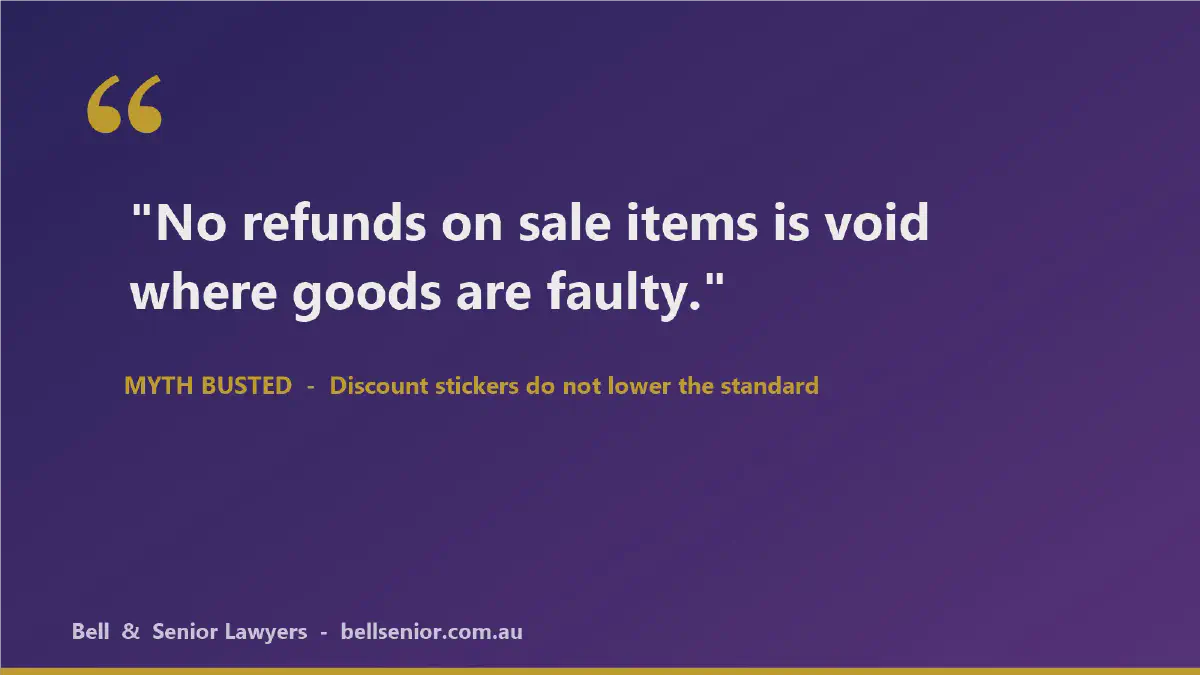
The misdirection to watch: stores that blur the line. The “no refunds on sale items” sign is legally meaningless where goods are faulty; the “you must have original packaging” rule cannot defeat a major-failure rejection. Faulty is faulty regardless of discount stickers.
Services: cancellation rights before performance differ from refund rights after poor performance. A service performed without due care and skill triggers the same remedy ladder - repeat performance or, failing that, refund of the price paid for the failed service.
Chapter: Minor vs Major Failure - The Remedy Ladder
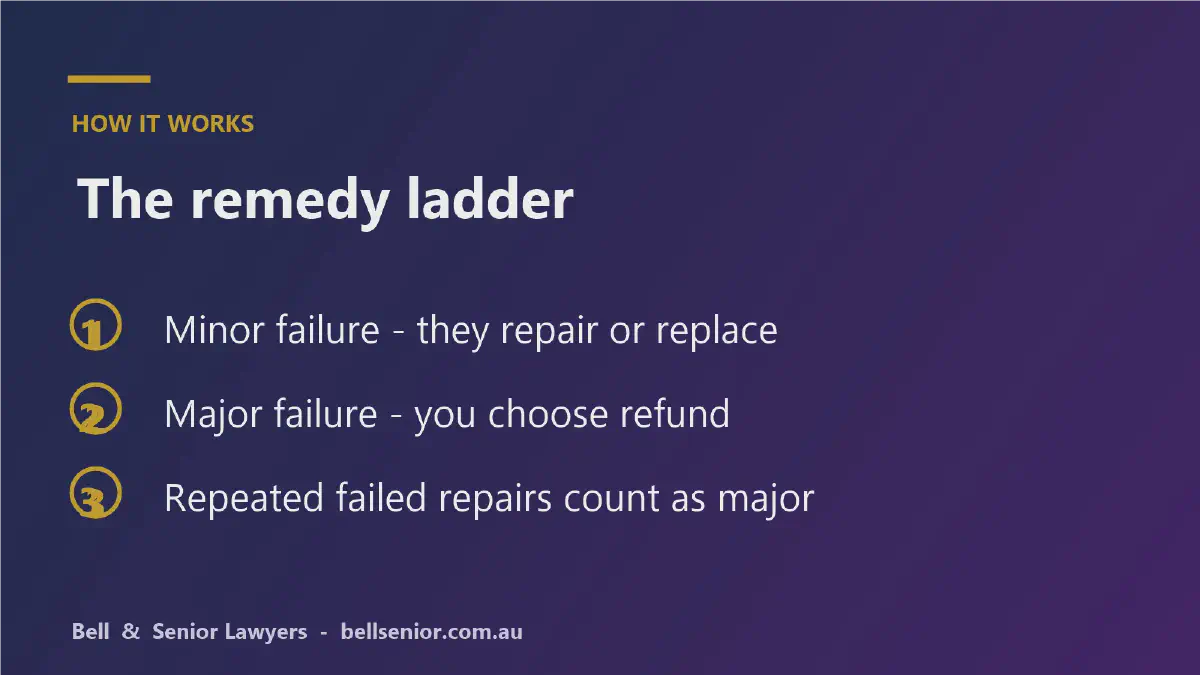
The guarantee framework sorts failures into two lanes:
Minor failure → repair, replace or refund at the supplier’s choice. You take the problem to the business first; they choose the fix within a reasonable time. A zipper replaced, a software bug patched, a chair leg re-fixed.
Major failure → your choice: reject for refund or replacement. The tests: a reasonable consumer would not have bought had they known; unsafe; substantially unfit for normal use; unable to be remedied in reasonable time. Examples: a phone that dies within weeks, a dress that falls apart first wear, a renovation leaking at completion, repeated unfixable faults.
The deemed-majority shortcut: the ACL treats certain patterns as major automatically - the same problem unsuccessfully repaired multiple times, or a failure making the goods substantially unusable. The repair-attempt ladder from our lemon guide applies here identically: document each attempt, each notice, each recurrence.
Chapter: Manufacturer Warranties vs Consumer Guarantees
The warranty card is not the guarantee - the distinction confuses almost everyone:
Consumer guarantees are automatic, statutory, and cannot be excluded. They apply whether or not you bought an extended warranty and regardless of what the box says.
Manufacturer’s warranties are voluntary promises (12 months parts and labour, say) with their own terms. Breaching a voluntary warranty is itself misleading conduct - but the warranty’s expiry does not end the guarantees: goods must last a reasonable time for their price and nature, which for a $2,000 appliance is plainly more than 12 months.
Extended warranties are paid add-ons duplicating rights you already have. The ACCC’s long-standing criticism stands: before buying one, compare its coverage against the free guarantees. The money is usually better banked against the replacement the guarantees would force anyway.
The practical script at the counter: “The goods failed within their reasonable life; I’m exercising my consumer guarantee rights” - not “the warranty says.” The framing matters: warranties expire; reasonable life endures.
Chapter: Time Limits and Reasonable Life
No fixed statutory deadline applies to guarantee claims - the test is failure within a reasonable time, assessed against:
- Price: durability expectations scale with cost
- Nature of goods: work boots outlast fashion sneakers; commercial equipment outlasts domestic
- Use: normal use for the stated purpose
- Disclosure: what the seller said about lifespan (“these last ten years” becomes a promise)
The claims that fail on time: the five-year-old $40 kettle, the wear item past obvious life. The claims that succeed late: the premium appliance failing at three years, the vehicle part failing well under expected mileage. When in doubt, claim early and in writing - the letter starts the clock on their response obligations.
Chapter: Who You Deal With - Supplier vs Manufacturer
Your refund contract is with the supplier (the store) - that is where rejection rights live. The manufacturer answers for repairs under its voluntary arrangements and parallel guarantee exposure. The store that says “that’s between you and the manufacturer” is deflecting: your statutory remedies run against whoever sold it to you. The manufacturer’s role matters for recalls, extended repair networks and the like - but the refund conversation belongs at the register.
Chapter: The Refund Demand - Doing It Properly
The demand that gets paid:
- Return to the seller with the problem documented - photographs, dates, what happened
- Name the guarantee - acceptable quality, matching description, fitness for purpose, due care and skill
- State the failure type - major (rejecting for refund) or minor (requesting their choice of repair/replace/refund)
- Set the deadline - 14 days is customary and reasonable
- Escalation warning - Fair Trading complaint, QCAT application if unresolved
Keep everything in writing from the first approach. The verbal request at the counter starts the negotiation; the written demand starts the legal record. Where the supplier stonewalls, the written trail becomes the QCAT evidence bundle almost unchanged.
Payment method notes: refunds should return by original payment method; credit-card chargebacks (through your bank) are a parallel route where the merchant refuses - though the ombudsman route prefers you tried the merchant first. Buy-now-pay-later arrangements add a layer: dispute processes exist within BNPL platforms, and pausing payments mid-dispute has its own risks - read before you stop paying.
Chapter: Online Purchases - The Extra Rules
Buying online adds protections on top of the guarantees:
- Distance-selling expectations: goods must match description all the more carefully because you could not inspect - the “not as pictured” claim maps onto the matching-description guarantee
- Delivery obligations: goods must arrive within a reasonable time (or the stated date); non-delivery is a straightforward refund claim
- Australian Consumer Protection: overseas sellers are harder to enforce against - but Australian-based online retailers carry full supplier obligations regardless of warehouse location
- Platform dispute mechanisms: eBay, Amazon and similar run buyer-protection schemes alongside statutory rights - use both in parallel when useful
The screenshot habit matters doubly online: capture the listing, price, delivery promise and any “in stock” representation at purchase - listings change and vanish.

Chapter: Services - The Same Rights, Different Shape
Service guarantees mirror the goods framework:
- Due care and skill: the work performed competently - the trade-standard test
- Fitness for purpose: the renovation is watertight; the tax return is correct
- Reasonable time: delivered within the promised or reasonable period
Remedies: minor failures → repeat performance at no cost, or (if that cannot fix it) refund of the portion paid for the failed service. Major failures → terminate and refund. The half-finished deck abandoned by the builder is a major failure of both time and quality: termination plus refund of overpayment.
The evidence shape differs: services disputes turn on specifications (what was agreed), progress records, and expert assessment of workmanship. The written scope from our contract checklist guide is what makes the service guarantee assessable at all.
Chapter: Gift Cards, Vouchers and Deposits
Gift cards carry their own national rules: minimum 3-year expiry, clear expiry disclosure, post-supply fees restricted. The short-expiry gift card sold before the reforms may still be honoured by goodwill - ask.
Deposits: refundable where no contract formed, or where the supplier breached. Non-refundable deposit terms in consumer contexts are UCT candidates. The business holding your deposit while failing to supply owes it back with interest arguments attached.
Lay-bys and preorders: statutory lay-by rules entitle termination with modest forfeits; preorder cancellations track change-of-mind limits unless the seller’s policy says better.
Chapter: Escalation - Fair Trading, Ombudsman, QCAT
When the supplier refuses a proper claim:
- Office of Fair Trading Queensland - free complaint and conciliation; the regulator’s involvement alone moves many merchants. Online portal, days to first response
- Industry ombudsman - AFCA for financial services; telecommunications ombudsman for telcos; energy ombudsman for utilities - free, binding-on-provider outcomes within limits
- QCAT minor debt/consumer claims - to $25,000: cheap filing, designed for self-representation, enforceable decisions
- Magistrates Court - larger claims where the supplier has assets worth pursuing
The escalation ladder works in order - each step’s paperwork feeds the next. The claimant who jumps straight to court without the demand letter and complaint trail hands the other side its defence narrative.
Chapter: Case Studies
The appliance that outlasted its warranty. A $2,400 refrigerator failed at 19 months - compressor dead, one month past the manufacturer’s warranty. The retailer refused: “out of warranty.” The demand letter reframed: acceptable-quality guarantee measured against reasonable life for the price - a premium fridge should substantially exceed two years. Repair quote attached ($1,100). Full refund settled within ten days of the letter. The word “warranty” never appeared.
The renovation refund. A Gold Coast bathroom renovation delivered with persistent leaks despite three return visits by the tiler. The homeowner’s written scope (from contract stage) specified waterproofing to standard; an independent waterproofer’s report located the failure. Major failure - substantially unfit, unremedied after repeated attempts. Termination notice plus QCAT claim recovered the overpayment beyond value received. The scope document and the independent report did all the persuading.
Chapter: For Businesses - Running Refund Compliance Properly
The guarantees bind sellers; compliance is cheaper than enforcement:
- Staff training on the fault/change-of-mind line - the counter staff who know the law stop the disputes at the door
- Signage that does not mislead - “no refunds” signs are offences in consumer contexts; state your goodwill policy without purporting to exclude statutory rights
- The returns process documented - who approves, what evidence required, what timelines
- Records kept of every guarantee claim and outcome - the pattern data reveals product problems before ACCC or litigation does
- Supplier recourse - pass failures back up the supply chain under your commercial terms
The business that handles guarantee claims generously and efficiently converts its returns desk into a marketing asset; the one that fights valid small claims collects QCAT judgments and reviews.
Chapter: The Evidence File for Consumers
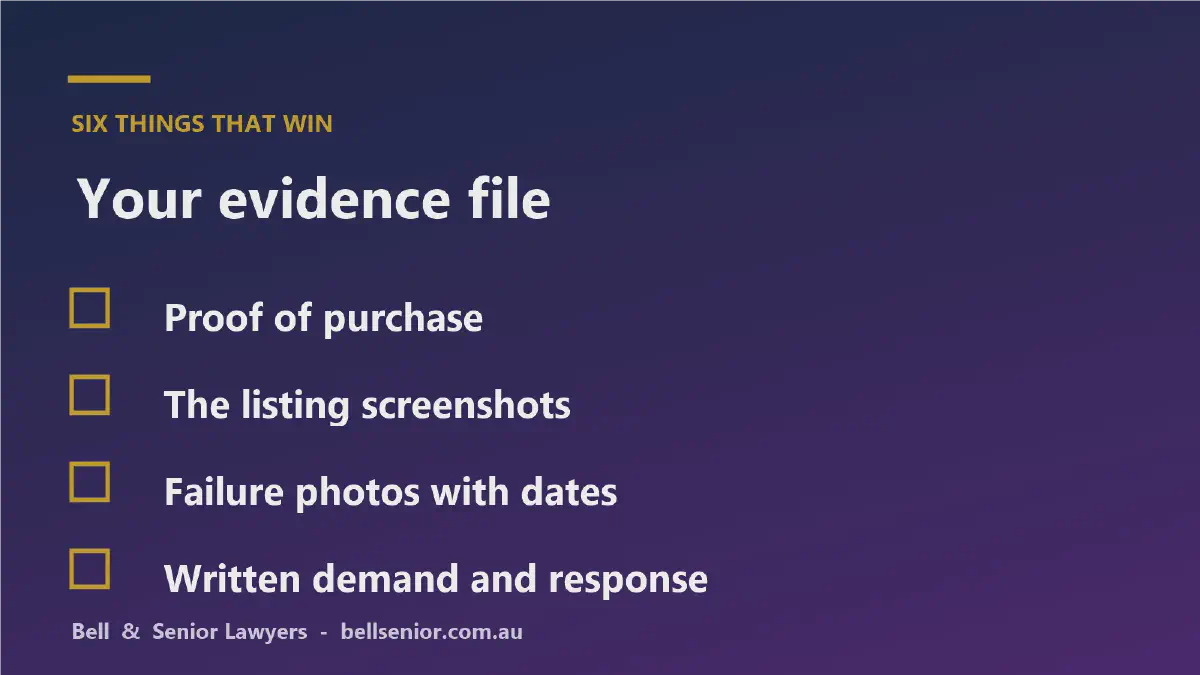
Six items win refund disputes:
- Proof of purchase - receipt, bank statement, online order record
- The listing/label - what was promised (screenshots for online)
- Failure documentation - photographs, dates, error messages
- The communication trail - every contact with the seller in writing
- Repair/assessment records - quotes and independent reports
- A one-page chronology
Build it from day one. The consumers who keep the file recover; the ones who reconstruct after refusal rarely do.
Chapter: Special Categories - Vehicles, Property and Big-Ticket Items
The guarantees apply to everything consumer-priced, but scale matters:
Vehicles carry their own overlay (statutory dealer warranties plus the guarantees) - the dedicated lemon guide covers the full mechanics. The headline: major failures mean rejection for refund regardless of the odometer.
Household goods bundles (kitchen packages, furniture sets): each item assessed on its own guarantee footing; one faulty component of a set can ground rejection of the set where useability is genuinely affected.
Pets and livestock: guaranteed fit for the purpose represented - breeders’ health disclosures matter; “sold as seen” defeats nothing statutory.
Digital products and software: substantial-unusability applies to apps and licences too; persistent bugs after reasonable repair attempts are the deemed-major-failure pathway.
Event tickets and travel: cancellations by the supplier refund automatically; your change-of-mind does not - but services not delivered with due care (the tour that never showed) trigger the service-guarantee remedies. Travel-specific schemes (ATAS accreditation for agents) add recovery routes.
Chapter: The Interaction With Warranties of Title and Misleading Conduct
Two parallel protections complete the consumer shield:
Misleading or deceptive conduct (ACL s 18): where the sale itself involved false representations - the “genuine leather” that is vinyl, the “never used” that was used - damages extend beyond refund to consequential losses the deception caused. The misrepresentation claim often outperforms the bare guarantee claim because it captures losses beyond price.
Unfair practices: unconscionable conduct, pressure sales against elderly or disadvantaged consumers, and bait advertising each open additional remedies - including setting aside contracts entirely. The vulnerable-consumer fact patterns (aged-care transitions, door-to-door solar) are where these provisions work hardest.
Chapter: Case Study Three - The Misrepresentation Multiplier
A first-home buyer purchased a “renovated, structurally sound” Queenslander. Post-settlement, an engineer’s inspection revealed subfloor stumping requiring $60,000 of work; the renovation permits on file covered only cosmetics. The buyer’s claim combined: misleading conduct (the agent’s structural representation), failure to disclose known defects (the seller’s engineer report from the previous sale existed), and guarantee failures where the sale contract’s consumer overlays applied.
The outcome: settlement at $45,000 against the repair cost - achieved before trial because the paper trail was unanswerable: the old report subpoenaed from council records, the listing screenshots, the engineer’s findings. The lesson generalises: misrepresentation claims recover consequential losses, not just refunds - and the discovery of the seller’s own prior documents is the moment most such cases settle.
Chapter: The Refund Negotiation Script
For readers who want the words:
At the counter: “This [item] failed within its reasonable life - it’s not of acceptable quality. I’m exercising my consumer guarantees and requesting a refund.”
On the major-failure pushback: “This is a major failure - a reasonable consumer wouldn’t have purchased knowing this. I’m rejecting the goods and choosing a refund under section 54.”
In writing: name the item, date and proof of purchase; describe the failure with dates; cite acceptable quality (s 54) or fitness for purpose (s 55); state major/minor classification; demand refund within 14 days; note Fair Trading/QCAT escalation.
If refused: Fair Trading complaint filed the same week; QCAT application ready to follow. The refusal letter becomes exhibit A.
The script is short because the law is short: goods must be what they promise, services competent, and failures remedied. Everything else is detail.
Chapter: FAQ Links and Further Reading
- Consumer law FAQs
- Travel company cancellations and refunds
- Buying at auction: as-is where-is
- Door-to-door sales cooling-off rights
- Consumer law practice area
- Consumer guarantees guide
- Used car buyers’ rights guide
- QCAT small claims guide
Chapter: The Annual Consumer Audit (For Businesses)
Businesses reading this guide should run their own version of the consumer’s evidence file:
- Review your returns policy against this guide - does it purport to exclude statutory rights anywhere?
- Audit signage and website copy - “no refunds” phrasing is the most common Fair Trading infringement notice trigger
- Train the front line annually - the counter staff who know the fault/change-of-mind line resolve 90% of approaches without escalation
- Track claim patterns - product failing repeatedly is a supplier problem to fix upstream before it becomes a reputation problem
- Check your own supply contracts - can you recover from your suppliers what you pay out under the guarantees?
The businesses that treat the guarantees as a cost of quality rather than a threat run leaner dispute desks and better reviews. The regime rewards compliance; punishing non-compliance is the regulator’s part.
Chapter: The Closing Word
Refund rights in Australia are strong by world standards - automatic guarantees, rejection rights for major failures, free escalation machinery, and tribunals built for exactly these disputes. What most consumers lack is not rights but method: the knowledge that “no refunds” signs are hollow, that warranties expire while reasonable life endures, that the written demand with the guarantee named moves mountains.
This guide’s entire method compresses to four habits: document the purchase, report failures promptly in writing, classify the failure correctly, escalate on deadline when refused. Consumers who follow them recover refunds; businesses who understand them build the processes that keep customers anyway.
Fighting a refund refusal? Bell & Senior acts for Gold Coast consumers in guarantee claims against retailers, builders and service providers - fixed fees where possible. Call (07) 5532 8777 or contact our Southport office . General information only - not legal advice.
Chapter: Common Myths - Corrected
The refund myths that cost consumers money:
“No refund on sale items.” False where goods are faulty. The discount changes the price benchmark; it does not lower the acceptable-quality standard below zero.
“You must have the original packaging.” Packaging requirements are goodwill-policy terms at best. A major failure is rejectable in whatever condition reasonable use left the goods.
“The warranty expired so there’s nothing we can do.” The voluntary warranty expired; the guarantees continue through the goods’ reasonable life. This myth dies with the script from earlier chapters.
“Store credit only.” For a major failure, the consumer chooses refund. Store credit requires your agreement - agreement implies you can decline.
“That’s between you and the manufacturer.” Your contract is with the seller. Full stop. Direct the claim to whoever took your money.
Each myth survives because enough consumers believe it. The reader of this guide is now the exception at every counter in Queensland.
Chapter: Quick Reference Table
| Situation | Your right |
|---|---|
| Faulty goods, minor failure | Supplier repairs or replaces (their choice) within reasonable time |
| Faulty goods, major failure | You choose: refund OR replacement |
| Same fault repaired multiple times | Treated as major - rejection rights activate |
| Goods don’t match the ad | Refund/replacement as for major failure where substantial |
| Service done badly | Repeat performance free, or partial/full refund |
| Change of mind | No statutory right - store’s posted policy only |
| “No refunds on sale items” sign | Legally void for faulty goods |
| Online order never arrived | Refund claim - straightforward |
| Premium appliance fails at 2 years | Likely still within reasonable life - claim |
Print it. Screenshot it. The table plus the demand-letter script is the whole consumer toolkit.
One final note on timing: the reasonable-life clock and the escalation deadlines both reward the consumer who acts promptly. The failure discovered today is documented today; the demand goes out this week; Fair Trading hears about it within a fortnight if the seller stalls. Promptness is free, and it is the difference between a clean claim and an arguable one.
Notes
Notes
Speak With a Lawyer
Contact our Gold Coast team for a confidential discussion about your matter.
Enquiry Sent
Thank you for reaching out. A member of our legal team will contact you shortly.
-
Competition and Consumer Act 2010 (Cth) sch 2 (‘Australian Consumer Law’) ss 54-59 (goods guarantees), ss 60-62 (services guarantees). ↩︎
-
Australian Consumer Law s 18 (misleading or deceptive conduct); s 21 (unconscionable conduct). ↩︎
-
Australian Consumer Law ss 259-262 (remedies for failure to comply with guarantees); s 262 (major failure rejection). ↩︎