
First Home Buyer's Queensland Conveyancing Road Map

Need legal help with this topic?
Get a confidential assessment of your matter today.

Buying your first home is equal parts excitement and paperwork. Queensland’s process is actually well-signposted - if you know the route. This road map walks every stage, flags the traps, and collects the concessions that can save a first home buyer serious money.
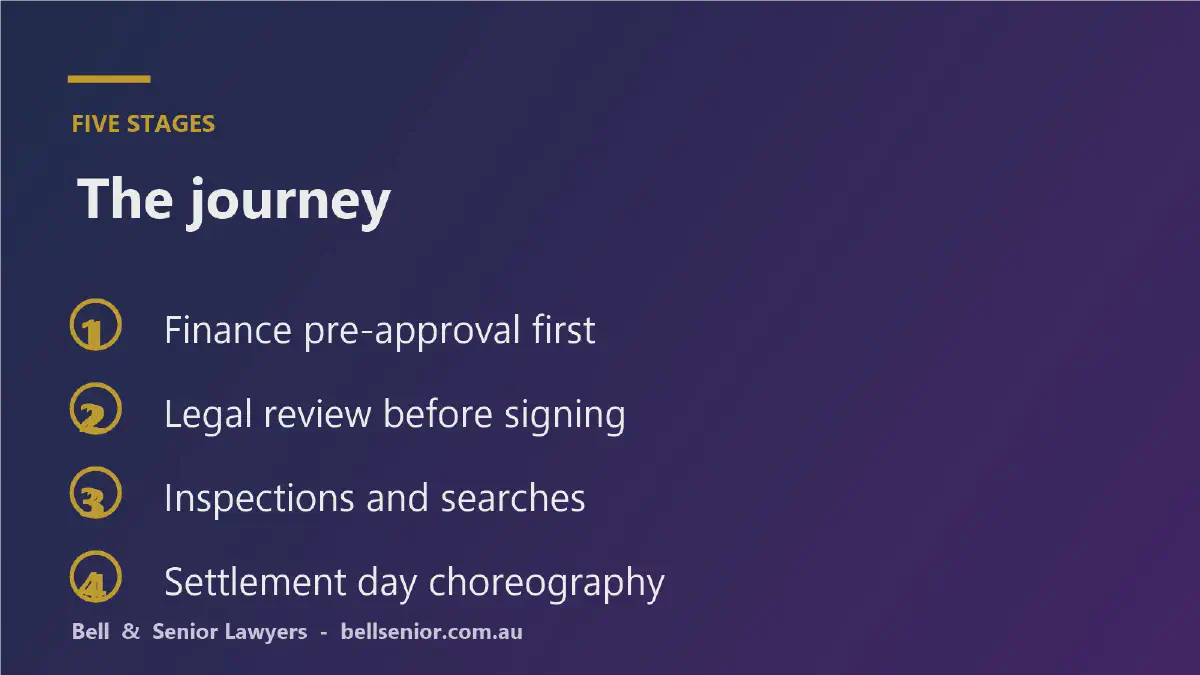
Stage 0: Before You Shop (finance and team)
- Pre-approval - know your borrowing power before inspecting; unconditional offers without finance clauses are how buyers lose deposits.
- Assemble your team early: a conveyancer/solicitor (we review the contract before you sign - the single cheapest insurance in the process), your broker, and a building inspector on speed dial.
- Budget beyond the deposit: stamp duty, transfer fees, searches, inspection costs, loan costs, insurance from contract date (yes - the property is your risk from 5pm the day you sign, even before settlement).
Stage 1: The Contract
Queensland uses standard REIQ (or ADL) contracts. The critical pieces:
- Form 2 seller disclosure - since August 2025 sellers must give a prescribed disclosure certificate with title searches and attachments before you sign. 1. You can terminate in limited circumstances if disclosure was defective - get advice fast if something looks wrong.
- Conditions to insist on: building and pest inspection, finance approval, and (for units/townhouses) a body corporate information contract. Each needs a realistic due date.
- Cooling-off: residential buyers get a 5 business day cooling-off period (0.25% penalty of the price if you terminate). It is a safety net, not a substitute for pre-signature review.
- Sunset and off-the-plan traps: off-the-plan contracts can run years before settlement - read the sunset clause and variation powers carefully. 2.
Stage 2: Due Diligence (the condition period)
Once signed, the clock runs. We order and interpret:
- Building & pest - negotiate repairs, price reductions or termination on the report
- Title and registered searches - easements, covenants, encroachments, caveats
- Council/authority searches - zoning, road proposals, outstanding orders, pool compliance
- Body corporate records (units) - levies in arrears, sinking fund health, litigation, by-law surprises
- Form 24 property transfer prepared for your signature
Stage 3: Stamp Duty - the First Home Buyer’s Best Friend
Queensland concessions for first home buyers are generous when they apply:
- First home (new build) concession: full stamp duty concession for new homes under $700,000 (vacant land under $400,000), phasing out above
- First home (existing home) concession: from 1 May 2025, no stamp duty on existing homes under $700,000, phasing out to $800,000
- First Home (new) $30,000 grant may stack separately (eligibility rules apply - new builds, contract dates, occupancy requirements)
We prepare and lodge the concession claims - missed eligibility is money permanently lost.
Stage 4: Pre-Settlement
- Finance confirmed and unconditional - now the deposit is released per contract terms
- Final inspection (usually a few days before settlement): check inclusions remain, no new damage
- We book settlement, prepare the settlement statement (rates, water and rent adjusted so each party pays their share to the day), and coordinate discharge of any mortgage
Stage 5: Settlement Day
Almost all Queensland settlements now run electronically on PEXA. On the day: funds exchange, duty is paid, the transfer is lodged, and the title moves to your name. You get the keys per the contract time - typically by early afternoon. Then: change the locks if you like, and update your address everywhere.
The Traps That Catch First Home Buyers
- Signing before the contract is reviewed (the cooling-off penalty is real money)
- Finance clauses with dates that don’t match the broker’s real timeline
- Skipping the body corporate contract on units - special levies can exceed your savings
- Forging ahead after a bad building report because “the market is hot” - that is what termination rights are for
- Assuming stamp duty is one flat number - concessions change the maths entirely
How We Help
Fixed-fee residential conveyancing, contract review before you sign, searches interpreted in plain English, concession claims lodged, and a human who answers the phone during the stressful weeks. Call Bell & Senior Lawyers on (07) 5532 8777 for a first-home quote. General information only - not legal advice for your specific purchase.
Related Reading
- Residential conveyancing: 5 critical steps
- First home grant Queensland
- Stamp duty in Queensland
- Settlement day: what actually happens
- Form 6 appointment: why it matters
Chapter: Before You Search - Finance Pre-Approval and the Real Budget
The legal conveyance is the last act of a purchase that starts with finance discipline:
Pre-approval vs approval. A pre-approval indicates lending capacity subject to conditions (valuation, final verification); it is not a guarantee. Offers made on pre-approvals carry condition risk that unconditional buyers do not - in competitive markets this difference decides auctions and multiple-offer situations.
What the bank will check: income stability, living expenses (the actual statements, not estimates), existing debts, deposit history (genuine savings rules vary by lender), and the property itself at valuation.
The hidden budget lines first-home buyers underestimate: transfer duty (with concessions - see next chapter), registration fees, lender’s mortgage insurance (LMI) where the deposit sits below 20%, building and pest inspections ($400-$700), legal fees, insurance from settlement day, and rates adjustments. The budget that survives contact with reality includes all of them.
The LMI decision: a 10% deposit on a $700,000 purchase can mean $15,000-$20,000 of LMI capitalised into the loan. First-home guarantee schemes (where eligible) avoid it entirely - eligibility checks belong before the search, not after the offer.
Chapter: Transfer Duty Concessions - The Money on the Table
Queensland’s transfer duty (stamp duty) for a $700,000 home runs to roughly $17,000 at general rates - but first-home concessions transform it:
First home concession (existing homes): full concession up to the threshold home value, phasing out above it - the concession value exceeds $17,000 at the right price point.
First home vacant land concession: for land purchases where you build within the required period.
Home concession (non-first-home): smaller but still material for anyone moving houses.
The mechanics matter: the concession is claimed through the duty lodgement (your lawyer or the OSR self-assessment route), eligibility requires occupying as your principal place of residence within the prescribed period (generally 1 year) and not disposing within the clawback window. Buying with a co-owner who has owned before affects eligibility fractions - structure the ownership before contracts sign, because post-settlement restructuring triggers duty again.
The concession planning conversation happens before contract signing; after settlement it becomes an application for something you may no longer qualify for.
Chapter: The Contract Review - What Your Lawyer Looks For
The REIQ standard house and land contract carries the process; the typed special conditions change everything. The review examines:
Standard-form items: the parties’ names (exact legal names - a nickname on title is a future problem), the price and deposit mechanics (deposit released only under the statutory framework after contract date), finance clause period (usually 14-21 days - is it enough for your lender?), building and pest dates (the inspection window that preserves exit rights), settlement date (realistic for both sides).
Special conditions - where deals live or die:
- Subject-to-sale clauses if you have an existing property (and their counterparty risk)
- Sunset clauses in off-the-plan purchases - the Land Sales Act 1984 ss 19C-19F regime now requires the buyer’s consent to extensions
- Inclusions/exclusions - the pool equipment, the blinds, the shed: unwritten assumptions are post-settlement disputes
- Building works disclosures - recent renovation permits and certifications
- Due diligence periods for unusual properties (flood zones, heritage, contaminated land history)
The flood search conversation belongs at review stage on the Gold Coast specifically: council flood overlays, historical inundation, insurance consequences. A cheap search before signing beats an uninsurable surprise after.
What the lawyer cannot do: value the property, guarantee the building’s condition (that is the inspector’s report), or approve your loan. The division of labour between lender, inspector and lawyer is worth understanding before each reports.
Chapter: Searches and Due Diligence - The Paper Trail Before Settlement
Between contract and settlement, the searches verify you are getting what the contract promises:
- Title search - ownership, encumbrances (mortgages to be discharged, easements, caveats). An undisclosed caveat is a red flag requiring immediate attention
- Registered plans - boundaries matching fences is not guaranteed
- Council rates and charges - arrears adjust at settlement
- Body corporate records (units/townhouses) - sinking fund health, insurance schedule, by-laws, pending levies. The $40,000 special levy voted two weeks before your settlement does not appear on the contract
- Land tax clearance, main roads proposals, contaminated land register
Each search answers one question; the set answers whether the purchase is what it appears. The conveyancer sequences them so problems surface while the contract can still be terminated.
Chapter: Building and Pest Inspections - Reading the Reports
The inspection reports are exit-ticket evidence - the contract’s building and pest clauses let you terminate for defects beyond stated thresholds, but only within the clause window and only on the reports’ terms.
What a good report contains: photographs, defect locations, cause analysis (not just symptoms), urgency grading (safety-critical / major / maintenance), and cost estimates. The inspector’s scope matters: timber pest inspections cover termites and borers; structural observations stop where access stops (subfloor hatches, roof space).
The negotiation menu after adverse reports: terminate (within the clause), renegotiate price, or require rectification before settlement. The choice depends on defect severity against price paid - a $15,000 termite treatment system on a $750,000 purchase is a price conversation; active structural movement is an exit.
First-home-specific advice: do not waive inspections in competitive markets. The waived-inspection purchase that reveals movement six months later has no contractual remedy at all - the buyer’s remedies end where the contract’s conditions did.
New-build buyers: the inspection happens at handover against the Queensland Building and Construction Commission Act standards, with the builder’s statutory warranty scheme behind defects found later. The handover inspection checklist differs from the established-home version - bring a lawyer into the build-contract review before signing it, not just at handover.

Chapter: Settlement Week - The Mechanics
Settlement day (now mostly electronic via PEXA) runs to a choreography the parties rarely see:
- The final figures - rates, water, strata levies adjusted to the day; the settlement statement reconciles every cent
- Documents verified - transfer duty lodged and paid (with your concession claimed), mortgage registered, transfer registered
- Funds flow - lender advances, deposit offsets, balance of purchase price exchanged simultaneously
- Title changes hands electronically, then keys release
Your settlement-week jobs: final walk-through 24-48 hours before (contract entitles you to inspect: is the property in the same condition? inclusions still there?), insurance effective from settlement day, utilities transferred, and the funds cleared well before the appointment.
When settlement slips: delay consequences run both ways - interest under the default provisions, notice requirements, and ultimately termination rights after prescribed periods. The party causing delay wears the machinery; communicate early through the lawyers rather than absorbing risk silently.
Chapter: Buying Off the Plan - Different Rules Entirely
Off-the-plan purchases reverse the risk structure: you contract now for a property that does not exist, at a price fixed today, settling years later. The protections:
- Sunset clause discipline (Land Sales Act 1984 ss 19C-19F): the developer cannot delay indefinitely or extend sunset dates without your consent (or court order); failure to complete by the sunset date lets you terminate with deposit returned plus interest
- Disclosure requirements: proposed plans, finishes schedule, by-laws drafts, and material changes requiring notice
- The valuation gap risk: market moves between signing and settlement can leave the bank’s valuation below your contract price - the finance clause is long gone; the risk is yours. The mitigation: extended finance clauses negotiated into the contract, or price-review provisions
- What you are buying from plans: the display suite is not the product; the schedule of finishes is. Read it as a lawyer reads a contract, because it is one
The off-the-plan review is specialist work - the standard-contract assumptions mostly do not apply, and the special conditions run to pages. Budget for that review before signing anything.
Chapter: Auctions - No Cooling-Off, Ever
The auction purchase is unconditional from the fall of the hammer:
- No cooling-off period applies to auction sales in Queensland
- Finance must be certain beforehand - the pre-approval needs to be effectively an approval
- Inspections complete before auction day, reports obtained, questions asked through the agent in writing
- The contract on display before auction is the contract you buy on - no negotiation follows; review it days ahead
- Bidding discipline: set the ceiling including all costs, register to bid, understand the reserve mechanics
First-home buyers at auctions need everything in this guide done before auction day rather than after - the compressed timeline is the point of the format, and it favours prepared buyers disproportionately.
Chapter: Co-Ownership Structures - Joint Tenants or Tenants in Common
Buying with a partner (or family member) forces a title-structure decision at contract time:
Joint tenants - the survivor takes all on death regardless of wills. The structure for couples whose intent is mutual succession. Severance is possible but is a legal act requiring paperwork.
Tenants in common - each holds a defined share (equal or specified percentages), passing through each owner’s estate. The structure for unequal contributions, blended families, investment partners, or anyone who wants their share to follow their will.
The contribution documentation: whatever the structure, document who contributed what at purchase (bank records, the transfer documents) - the future separation or dispute resolves on evidence, and contemporaneous records of contributions are the best evidence there is.
Cohabitation agreements for de facto couples buying together: ownership shares, exit mechanics, dispute processes. The conversation is awkward; the alternative is litigation without a map.
Chapter: After Settlement - The Compliance Calendar
Ownership begins where conveyancing ends:
- Title and mortgage registered - confirm both post-settlement
- Insurance continues - building cover permanent, contents from day one
- Council rates and water - direct debit setup prevents the arrears surprise
- Body corporate levies (units) - due dates diarised
- First-home concession compliance - move in within the required period; no disposal during clawback
- The maintenance log starts now - the eventual sale’s vendor disclosure draws on it
Chapter: Case Studies
The concession that nearly lapsed. A buyer claimed the first-home duty concession, then relocated for work after eight months of occupancy, leasing the property out. The concession required occupation as principal place of residence within one year and continuation through the clawback period. Advice before the lease was signed restructured the timing: she returned for the balance of the requirement year, then let freely - preserving roughly $16,000 of concession against an OSR reassessment that would have reclaimed it with penalty.
The special levy surprise. An apartment buyer settled in March. In April, the body corporate voted a $38,000 sinking-fund levy for concrete remediation - approved at a meeting held before settlement, notices distributed after. The buyer’s conveyancer had ordered strata records in February; the minutes recording the committee’s intention existed but nobody read them past page one. The lesson: strata searches are only as good as the reading of them. Your lawyer reads them - that is part of what you are paying for.
Chapter: The Timeline at a Glance
| Week | What happens | Your job |
|---|---|---|
| Pre-search | Finance pre-approval; eligibility checks (concessions, schemes) | Budget honestly |
| Offer accepted | Contract signed; lawyer review within cooling-off | Review before expiry |
| Week 1-2 | Building & pest inspections | Attend the inspections |
| Week 2-3 | Finance condition satisfied or extended | Chase lender, not vice versa |
| Weeks 3-6 | Searches; strata records if applicable | Respond to queries fast |
| Settlement week | Final figures; walk-through; funds verified | Walk-through; insurance live |
| Settlement day | Electronic settlement; keys release | Collect keys; start the log |
The timeline compresses or stretches with finance speed - the lender’s turnaround is the variable most outside your lawyer’s control. Choose the lender partly on settlement-service reputation, not rate alone.

Chapter: Ten Mistakes First-Home Buyers Make
- Signing before legal review - the standard contract is negotiable only until signed
- Skipping the building inspection to compete - the waived right is the future liability
- Budgeting to the borrowing maximum - the buffer absorbs life, not just rates
- Forgetting LMI in the cost stack below 20% deposits
- Not checking flood overlays - on the Gold Coast, specifically
- Ignoring strata records - levies and by-laws run units forever after
- Assuming the display home equals the plan purchase - read the finishes schedule
- Bidding past the ceiling because auctions feel like theatre
- Letting the concession eligibility lapse through early leasing
- Treating the lawyer as a formality - the review is where problems are cheap
Each mistake is avoidable with the process this guide describes. The buyers who avoid them are not lucky; they are sequenced.
Chapter: Where the Money Goes - A Worked Example
A $650,000 established home, Gold Coast, first-home buyer with 12% deposit:
- Deposit: $78,000
- Transfer duty after full first-home concession: $0 (within threshold)
- Registration and lodgement fees: ~$1,000
- Building & pest: ~$550
- Legal/professional fees: ~$1,800-$2,500
- LMI: avoided via guarantee scheme eligibility (otherwise ~$12,000+)
- Adjustments (rates/water prepaid by seller): credit of a few hundred
Total transaction costs beyond deposit: roughly $4,000-$5,000 with the concession and scheme working - versus $30,000+ without them. The concessions are not decoration; they are the difference between buying now and buying next year.
Chapter: Choosing Your Team
Three professionals decide the quality of your purchase experience:
The mortgage broker or lender. Rate matters; so does settlement reliability and how the lender handles valuation disputes and condition extensions. Ask other buyers about settlement-week performance, not just headline rates.
The building inspector. Licensing (QBCC), insurance, sample reports before booking. The two-page report with three photos is not an inspection; the forty-page report with cause analysis is.
The conveyancer or property lawyer. The distinction: complex contracts (off-the-plan, unusual titles, disputes) need a lawyer; straightforward purchases run fine with either - until they do not. The questions to ask at engagement: who handles my file day-to-day, what is included in the fixed fee, and when do you call me versus handle it?
The team works best assembled in order: finance first (you cannot offer credibly without it), lawyer second (before signing anything), inspectors third (during conditions).
Chapter: FAQ Links and Further Reading
- Property FAQs
- First home grant in Queensland
- Stamp duty in Queensland explained
- Building and pest inspections
- Property law practice area
- Renting rights guide
- Contract review checklist
Chapter: The Finance Clause - Your Exit and How to Use It
The finance condition is the most misunderstood clause in the standard contract:
What it requires: genuine application within the clause period, and honest engagement with the lender’s requirements. What it does not allow: shopping indefinitely, or terminating because you found a better rate.
Extensions: negotiated by variation before expiry - never assume. The seller who agrees to extend once may refuse twice; the refusal creates a hard deadline that catches unprepared buyers.
Terminating properly: written notice citing the finance condition within the clause period, with evidence of the declined application. The buyer who terminates on day 15 of a 14-day clause has repudiated - the deposit is at risk. Diarise every clause date when the contract signs; the calendar is the cheapest lawyer in the transaction.
Valuation shortfalls: the loan approved at contract can shrink if the valuation comes in low. Options: top up the deposit from savings, renegotiate price on the valuation, extend and retry with a different lender (if the clause allows), or exit under the finance condition while it still runs. Each option has a deadline attached.
Chapter: Case Study Three - The Clause Date That Saved $650,000
A Robina couple signed a house contract on a Friday; their solicitor diarised the building-pest expiry for day 12 and finance for day 16. Day 9: the inspection report found active termites plus subfloor moisture damage - remediation quotes near $22,000. Rather than negotiate blind, the buyers issued a proper termination notice under the building condition on day 11, evidence attached. Deposit returned in full within a week. The property sold again a month later at a price reflecting the defects. Without the diarised dates and the correctly addressed notice, the outcome is a dispute about whether the termination was valid - and possibly the loss of the deposit over an invalid one.
Chapter: The Master Checklist
Before searching:
- Finance pre-approval in writing with conditions understood
- First-home concession and guarantee-scheme eligibility confirmed
- Full cost stack budgeted (duty, LMI, inspections, legal, adjustments)
- Team assembled: lender, lawyer, inspector contacts ready
- Ceiling price set including all costs
When offering:
- Lawyer reviews contract before signing (including special conditions)
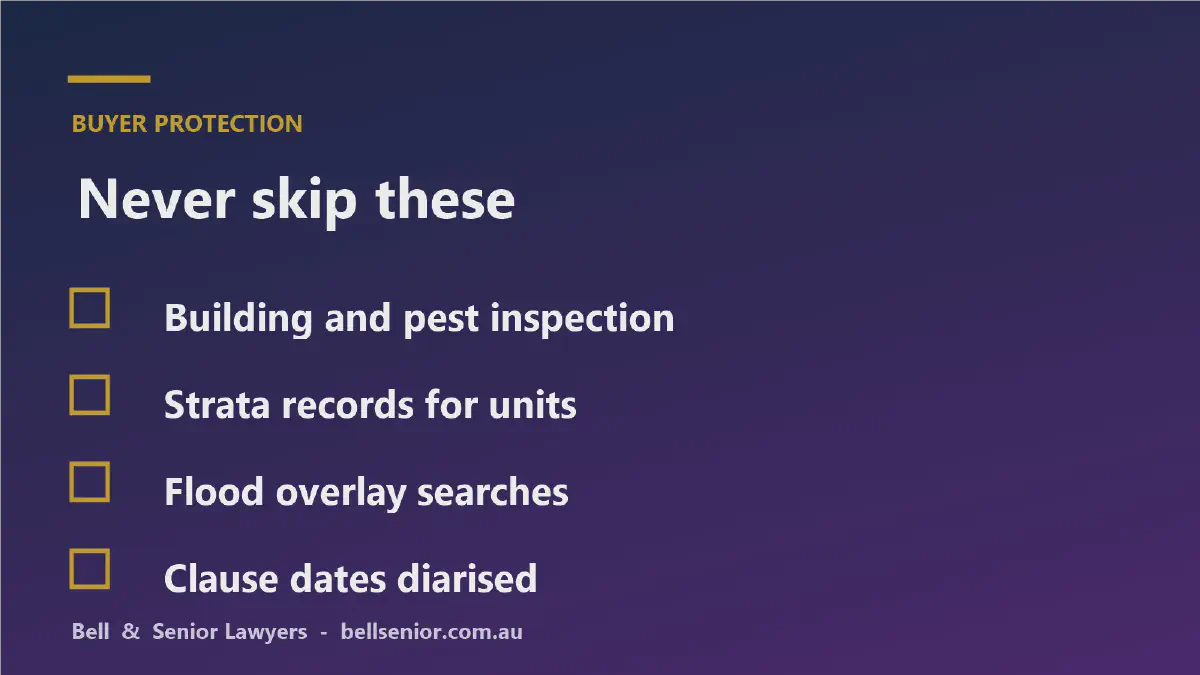
- Clause dates diarised the day the contract signs
- Auction purchases: everything above completed pre-auction
Under contract:
- Building & pest inspection attended; reports read past page one
- Strata records ordered and reviewed (units/townhouses)
- Flood/council searches discussed with your lawyer
- Finance condition satisfied properly or varied before expiry
- Any termination done by written notice citing the clause, within it
Settlement:
- Final walk-through within 24-48 hours of settlement
- Insurance effective from settlement day
- Concession compliance calendar set (move-in deadline)
After:
- Title/mortgage registration confirmed
- Rates, utilities, levies transferred
- Maintenance log started
Print it. Work it. The checklist is this guide compressed to one page.
Chapter: The Final Word
The first purchase is the steepest learning curve in property - and the one where the mistakes cost the most relative to experience. But the process is genuinely learnable: the contract review before signing, the clause dates diarised, the inspections attended, the searches read, and the settlement choreography trusted to professionals once you understand what they are doing.
Every chapter of this guide reduces to the same principle: the buyers who understand the machinery make better decisions than the buyers who hope. The concession eligibility checked before searching, the flood overlay discovered before offering, the special levy found in the strata minutes before settlement - each is a decision made early instead of a problem absorbed late.
Welcome to property ownership. Start with the checklist, engage the team early, and ask the questions before signing anything. The second purchase is easier; the first one only needs to be done carefully. And careful, for property, has a precise meaning: everything in writing, every date diarised, every report read, and every question asked before the ink dries rather than after. Buyers who work that way rarely need the remedies chapters of property law; buyers who skip it end up reading them anyway. The difference in cost between the two paths is measured in deposits - and occasionally in the purchase itself. Review first, sign second, always.
Buying your first home on the Gold Coast? Bell & Senior reviews contracts, runs conveyances and claims concessions - fixed fees, fast turnarounds. Call (07) 5532 8777 or contact our Southport office . General information only - not legal advice.
Notes
Notes
Speak With a Lawyer
Contact our Gold Coast team for a confidential discussion about your matter.
Enquiry Sent
Thank you for reaching out. A member of our legal team will contact you shortly.